
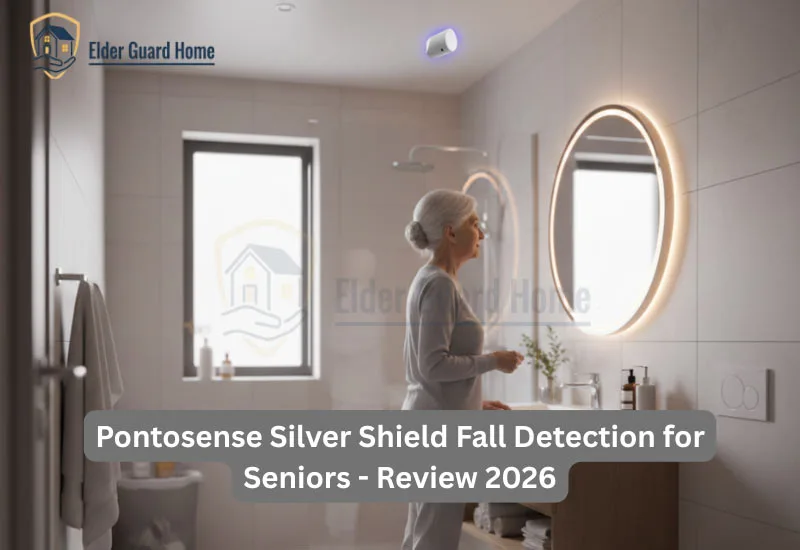
As families look for safer ways to protect aging parents, one problem keeps resurfacing: many seniors simply refuse to wear medical alert pendants. They forget to charge them, take them off, or decline them altogether. Consequently, traditional emergency buttons often fail when they’re needed most.
At the same time, camera-based systems raise serious privacy concerns—especially in bedrooms and bathrooms. According to the National Institute on Aging, falls remain one of the leading causes of injury among older adults, making reliable monitoring critical. Yet seniors deserve dignity along with protection.
This is where Pontosense Silver Shield fall detection enters the conversation. Instead of wearables or cameras, it uses radar-based sensing to monitor movement patterns discreetly. In this guide, we’ll examine:
How it works
How it compares to other systems
Real-world performance insights
Who it’s best suited for
Its limitations
If you’re exploring alternatives, you may also want to review our complete guide on AI fall detection without wearable buttons for broader context on the technology landscape.
Key Facts: Pontosense Silver Shield
- Uses mmWave radar for contactless fall detection.
- Does not use cameras or wearables.
- Works in bathrooms and bedrooms.
- Edge AI processes data on-device for privacy.
- Best for moderate fall risk individuals.
What Is Pontosense Silver Shield fall detection and how does it work?
A Contactless Fall Detection System
At its core, Pontosense Silver Shield fall detection is a contactless fall detection system built on radar sensing technology.
Here’s what that means:
No pendants
No wristbands
No smartwatches
No cameras
No audio recording
Instead, the system emits low-power radio waves that bounce off objects and human bodies. By analyzing those reflections, it detects movement, posture changes, and sudden impact events.
Because it avoids video capture entirely, it aligns with privacy-first home safety monitoring principles. There is no visual surveillance, no stored images, and no recorded footage—making it particularly suitable for sensitive spaces like bathrooms.
How does radar detect falls in seniors?
Unlike simple motion sensors, radar-based senior monitoring goes deeper. It doesn’t just detect that movement occurred; it evaluates how it occurred.
The system analyzes:
Motion velocity
Direction changes
Sudden vertical displacement
Micro-movement after impact
For example, a controlled sit-down motion differs significantly from a sudden collapse. AI-driven algorithms classify these motion signatures in real time. As a result, the system reduces false alarms compared to basic motion-trigger devices.
Importantly, radar can detect subtle post-fall micro-movements—such as shallow breathing or small limb shifts—providing added confidence in event classification.
How does edge AI detect and alert falls?
Another major advantage is edge AI processing.
Instead of streaming raw data to the cloud, the device processes signals locally. Therefore:
Sensitive data stays inside the home
Bandwidth usage is minimal
Alerts are faster
Privacy risks are reduced
When a fall is detected, caregivers receive alerts through the configured notification system. Depending on deployment, this may include:
App notifications
SMS alerts
Integration with care platforms
This on-device processing approach differentiates it from cloud-heavy monitoring systems.
How does Pontosense Silver Shield differ from traditional systems?
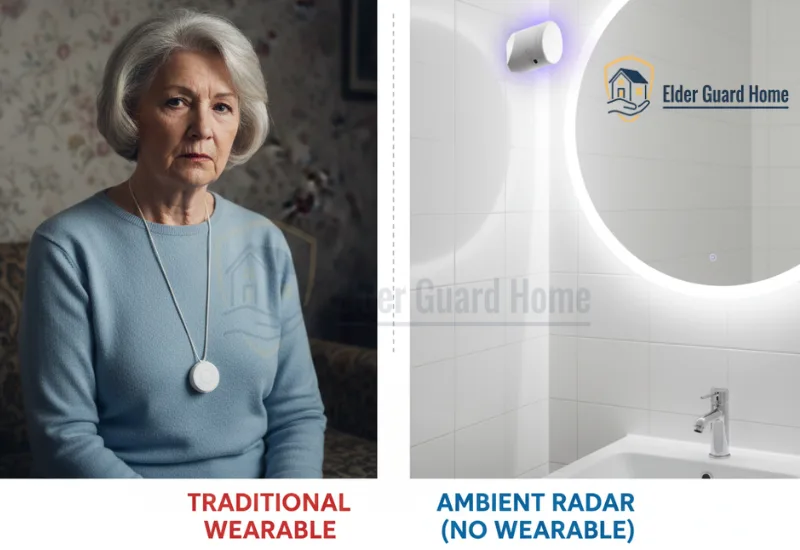
Non-Wearable Fall Detection for Elderly vs Medical Alert Buttons
Traditional medical alert systems rely on manual activation. However, in many real-world cases, seniors cannot press the button after a fall.
Non-wearable fall detection for elderly systems like Pontosense remove that dependency entirely.
| Feature | Medical Alert Button | Pontosense Silver Shield |
|---|---|---|
| Requires wearing device | Yes | No |
| Requires charging | Yes | No |
| Manual activation needed | Yes | No |
| Passive monitoring | No | Yes |
Because it runs passively in the background, compliance improves significantly. Seniors who resist wearing devices are far more likely to accept radar-based monitoring.
If you’re deciding between pendants and automation, our AI fall detection vs medical alert buttons comparison breaks down real-world response differences.
Camera Systems vs Privacy-First Home Safety Monitoring
Camera systems offer visual verification. However, they introduce privacy trade-offs:
- Continuous visual recording
- Cloud storage concerns
- Family discomfort
- Bathroom limitations
In contrast, privacy-first home safety monitoring through radar avoids image capture entirely. Therefore, it works in bedrooms and bathrooms without creating ethical tension.
If privacy resistance has been a barrier, this distinction becomes critical.
For deeper analysis on camera trade-offs, see our related guide on Radar vs Camera Fall Detection Systems.
Pontosense Silver Shield vs Other Non-Wearable Fall Detection Systems
This section provides a practical comparison for buyers evaluating multiple technologies.
Radar-Based Systems vs Camera-Based Systems
Accuracy:
Camera systems may visually confirm events but depend on lighting and line of sight. Radar works in darkness and through steam.
Installation Complexity:
Cameras require placement optimization and sometimes multiple units. Radar systems typically mount on ceilings or walls.
Privacy Considerations:
Radar offers a clear advantage—no video, no recording.
Pontosense vs Ceiling-Mounted Radar Devices
Not all radar systems are equal.
Key comparison factors include:
- Detection coverage area
- Steam resistance (bathroom suitability)
- Integration with emergency workflows
- Edge AI sophistication
Pontosense’s positioning emphasizes high-resolution motion classification rather than simple presence detection.
Pontosense vs WiFi-Based Motion Monitoring Systems
WiFi-based monitoring uses signal disruption patterns. However:
- It may generate false alerts from pets or visitors
- It depends heavily on network infrastructure
- It typically detects presence—not confirmed falls
By contrast, Pontosense focuses on actual fall pattern recognition, reducing ambiguity.
Pontosense vs Traditional Medical Alert Systems
| Factor | Traditional Medical Alert | Pontosense Silver Shield |
|---|---|---|
| Emergency dispatch | Often included | Depends on setup |
| Real-time automatic detection | No | Yes |
| Subscription model | Common | Varies |
| User activation required | Yes | No |
Therefore, families seeking proactive monitoring may prefer radar systems, while those prioritizing 24/7 dispatch centers might combine both.
Key Features of Pontosense Silver Shield Fall Detection
For quick reference:
Contactless detection technology
AI-powered motion analytics
Real-time caregiver alerts
Continuous presence monitoring
Designed for in-home installation
Expandable multi-device deployment
No cameras, no wearables
Because these features align with modern aging-in-place needs, the system fits well in homes prioritizing discretion.
Pros and Cons of Pontosense Silver Shield Fall Detection
Pros
No wearable required
High privacy (no cameras)
Continuous passive monitoring
Works in bathrooms and bedrooms
Suitable for seniors who resist devices
Edge processing reduces cloud exposure
Cons
Not a medical-grade emergency dispatch system
May require professional installation
Multi-room coverage may require multiple units
Pricing transparency varies by provider
When Pontosense Silver Shield May NOT Be Enough (Limitations)
Pontosense Silver Shield fall detection improves awareness inside the home. However, it is not designed for every medical situation.
First, high fall-risk seniors who require 24/7 emergency dispatch may need more than monitoring. If a person has severe mobility issues, frequent fainting episodes, or cardiac instability, immediate professional response matters. In those cases, a certified emergency response system may be more appropriate.
Second, advanced dementia patients who wander outside monitored zones may not be fully protected. The system works within installed coverage areas. Therefore, outdoor exits, driveways, or gardens may remain unmonitored unless additional layers are added.
Third, multi-floor homes present practical challenges. One device does not typically cover multiple levels. As a result, expanded coverage increases complexity and cost.
Finally, situations requiring certified medical-grade monitoring demand regulated solutions. Radar-based senior monitoring offers intelligent detection. Still, it does not replace hospital-grade or government-certified emergency infrastructure.
While Pontosense Silver Shield improves in-home awareness, it does not replace dedicated emergency response systems for high-risk medical scenarios.
Is Pontosense Silver Shield a Replacement for Medical Alert Systems?
This is one of the most common questions.
Can it replace Life Alert–type systems? In most cases, no. Traditional systems connect directly to 24/7 dispatch centers. Pontosense Silver Shield focuses on automatic detection and caregiver notification. The functions are different.
However, it can work as a complementary layer.
Monitoring and emergency response are not the same. Monitoring detects events. Emergency response deploys help. When combined, they create stronger protection.
For example:
Radar detects a fall automatically.
Caregivers receive instant alerts.
A medical alert system provides professional dispatch if needed.
This hybrid monitoring strategy often works best for moderate-to-high risk seniors. It balances automation with professional support.
Real-World Usage Analysis: Daily Performance Evaluation
Performance in Small Apartments
In small apartments, coverage is typically efficient. A single device can often monitor a bedroom or living area effectively.
Motion accuracy tends to be strong in contained spaces. Because movement patterns are easier to isolate, false alert potential is lower.
However, pets or multiple occupants may slightly affect signal interpretation. Proper placement reduces that risk.
Accuracy matters, which is why we analyzed fall detection false alarm rates and how AI systems reduce unnecessary caregiver alerts.
Use in Multi-Room Homes
In larger homes, single-device limitations become clear. Walls and structural barriers reduce effective coverage.
Therefore, multi-unit configuration may be required. Each monitored zone needs appropriate placement. Planning becomes essential.
While expansion is possible, it increases installation complexity.
Bathroom and High-Humidity Environments
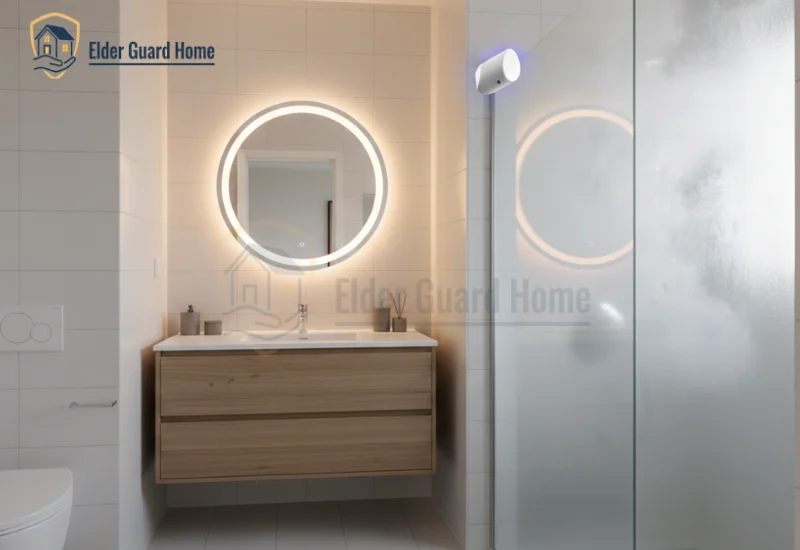
Bathrooms are high-risk fall zones. Steam and humidity can interfere with some technologies.
Radar-based systems generally perform better than camera-based alternatives in low visibility. Steam does not block radio waves the way it blocks lenses.
However, extremely dense humidity may slightly affect signal clarity. Compared to dedicated bathroom-only systems, Pontosense offers broader flexibility but may not be purpose-built solely for that environment.
Bathrooms present unique risks, which we examine in our best bathroom fall detection systems guide focused on steam-resistant monitoring.
Senior Compliance and Behavioral Factors
One of the strongest advantages is passive monitoring acceptance.
Many seniors resist pendants or wristbands. They forget to wear them. Or they remove them intentionally.
Non-wearable fall detection for elderly users reduces that resistance. Because nothing needs to be worn, daily life remains unchanged. As a result, compliance improves naturally.
How accurate is Pontosense Silver Shield fall detection?
Pontosense Silver Shield uses mmWave radar and AI motion pattern analysis to detect both standing and seated falls. While accuracy depends on installation height and room layout, it is designed to minimize false alarms compared to camera-based or motion-only systems.
Can the system detect falls in steam or low light?
Yes. Because it uses radar instead of cameras, it works in darkness, bathroom steam, and high-humidity environments without visual interference.
What is the coverage range of the device?
When mounted high on a wall corner, the device can typically monitor a single room up to approximately 5–6 meters, depending on layout and obstructions.
Best For: Who Should Consider Pontosense Silver Shield?
Pontosense Silver Shield fall detection is best suited for:
Seniors living alone who refuse wearables
Families seeking privacy-first home safety monitoring
Moderate fall-risk individuals
Care agencies exploring radar-based senior monitoring
Homes where bathroom privacy is a major concern
It works particularly well when dignity and discretion are priorities.
However, extremely high-risk patients may require layered solutions.
Is Pontosense Silver Shield Consumer-Focused or B2B?
The positioning appears hybrid.
On one hand, professional care partnerships suggest B2B deployment potential. Assisted living facilities and home care agencies may benefit from scalable radar-based senior monitoring.
On the other hand, home deployment is feasible. Families can install the system in private residences, depending on configuration.
Scalability is a key factor. Multi-unit setups allow expansion across larger care environments. Yet planning and coordination increase with scale.
Therefore, it sits between consumer-focused safety tech and professional care infrastructure.
Installation, Coverage, and Practical Considerations
Installation requires thoughtful room placement.
The device must cover primary movement zones, such as:
Bed-to-bathroom pathways
Living room seating areas
Hallways
Coverage radius depends on room size and structural layout. Walls and heavy furniture may affect signal performance.
For multi-room planning, additional units may be necessary. Each zone should be assessed individually.
Internet dependency varies by configuration. While edge AI processing reduces cloud reliance, alert delivery often requires connectivity.
Maintenance is minimal. However, firmware updates and system checks should be scheduled periodically.
Practical setup matters more than marketing claims.
FAQ
Does Pontosense Silver Shield use cameras?
No. It uses radar sensing and does not record video or images. It is a contactless fall detection system.
Is Pontosense Silver Shield a medical-grade fall detection system?
No. It is a monitoring system, not a certified medical emergency device.
Can Pontosense Silver Shield work in bathrooms?
Yes. Radar technology allows operation in bathrooms, including low-visibility conditions.
Does it require a wearable device?
No. It is a contactless fall detection system and requires nothing to be worn.
Can Pontosense Silver Shield replace medical alert systems?
Not completely. While it automatically detects falls, it does not function as a certified 24/7 emergency dispatch service. However, it can work alongside traditional medical alert systems as a complementary layer.
Is Pontosense Silver Shield suitable for high-risk seniors?
It is best suited for moderate fall-risk individuals. Seniors who require continuous medical supervision or guaranteed emergency dispatch may need additional systems.
Does Pontosense Silver Shield detect routine activity changes?
Yes. In addition to falls, it can track changes in movement patterns and daily routines.
Final Verdict
Pontosense Silver Shield fall detection for older adults offers a strong privacy-first alternative to wearables and cameras.
It provides intelligent monitoring through radar analysis. Moreover, it improves awareness without requiring active participation from seniors.
However, it is not a replacement for medical dispatch services. It does not function as a certified emergency response system.
Overall, it is best suited for moderate-risk seniors who value privacy and resist wearable devices. When combined with other safety layers, it becomes even more effective.