
Printable Home Safety Checklist for Seniors: Free PDF
- By Nisha Sharma
- Last Updates: September 14, 2026
Article Summary:
This printable home safety checklist for seniors helps families review common hazards room by room. Use it to check lighting, walking paths, bathrooms, bedrooms, kitchens, stairs, entrances, and outdoor areas. The checklist helps you identify concerns and decide which changes deserve attention first.
What Does This Checklist Cover?
A printable home safety checklist for seniors helps families review common hazards throughout the home.
It covers bathrooms, bedrooms, kitchens, living areas, hallways, stairs, entrances, and outdoor spaces.
Use the checklist to identify problems, record needed changes, and prioritize improvements.
It is a practical screening tool, not a substitute for individualized professional assessment.
If you are planning broader home changes, see our Aging in Place Safely guide for a step-by-step approach to assessing the home and prioritizing improvements.
Download the Free Home Safety Checklist
Ready to check your home?
Download the Home Safety Checklist for Seniors PDF and print it before starting your walkthrough.
[Download the Free Printable Home Safety Checklist for Seniors PDF]
The checklist is designed for:
- Older adults living independently.
- Adult children helping aging parents.
- Family caregivers.
- Families preparing for aging in place safely.
- People reviewing a new home.
- Families noticing changes in mobility or daily routines.
You do not need to inspect the entire home in one session.
Start with the areas that affect daily movement most.
Then work through the remaining rooms at a comfortable pace.
What Makes the ElderGuardHome Checklist Different?
Many home safety checklists simply provide a long list of possible hazards.
Our approach adds a decision-making step.
The goal is to help you identify a concern and decide what deserves attention first.
The checklist focuses on practical observations such as:
- Clear walking paths.
- Lighting around common routes.
- Bathroom access and movement.
- Bedroom pathways.
- Kitchen organization.
- Stairs and handrails.
- Entryway conditions.
- Outdoor walking surfaces.
- Everyday reach and movement.
- Technology that may solve a specific problem.
You do not need to fix everything at once.
The most useful starting point is usually the problem that affects safe everyday movement.
How to Use the Home Safety Checklist
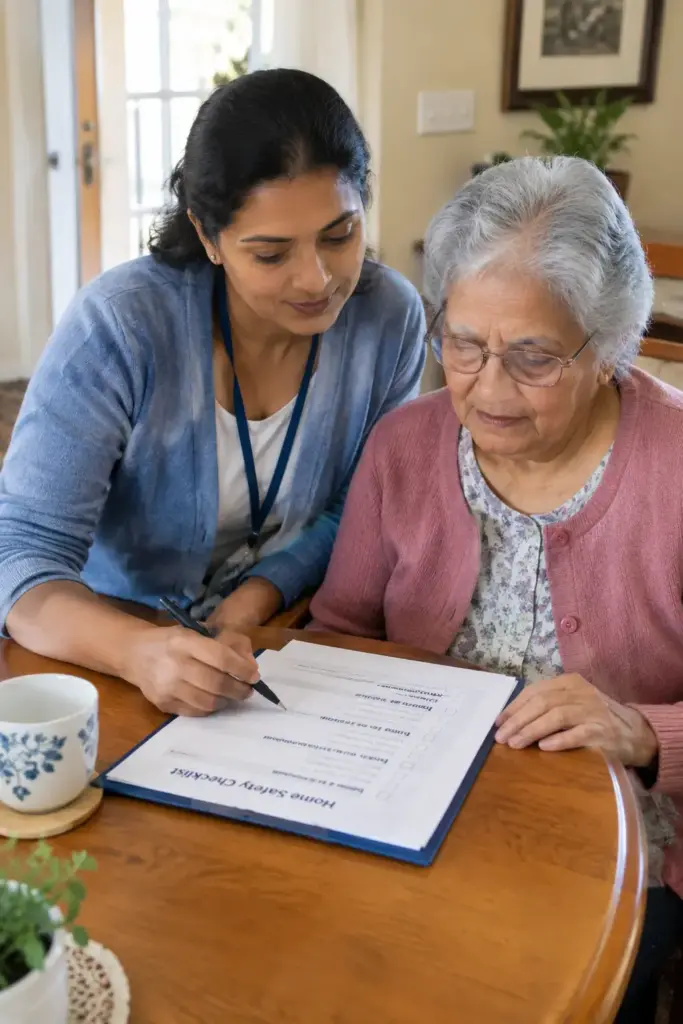
Use the checklist during a normal walk through the home.
Do not inspect only from a standing position.
Think about how the older adult actually moves through each space.
1. Choose a comfortable time
Avoid rushing through the inspection.
Give the older adult enough time to explain what feels difficult.
2. Walk through the home normally
Follow common routes between the bedroom, bathroom, kitchen, living room, and entrance.
Notice where movement feels awkward or restricted.
3. Mark each concern
Use a simple system:
- Safe: No immediate concern.
- Needs attention: Consider a change.
- High priority: Address soon.
4. Discuss the findings
Ask the older adult what feels uncomfortable or difficult.
Safety changes should support independence and personal preferences.
5. Create a short action list
Choose the first three to five changes.
Complete those before starting a long list of lower-priority improvements.
A room-by-room approach is also recommended by the National Institute on Aging.
Who Should Use This Checklist?
A home safety checklist for older adults can be useful in many situations.
Older adults living independently
Use the checklist to identify changes that could make everyday movement easier.
Adult children helping parents
Walk through the home together instead of making decisions from a distance.
Family caregivers
Use the checklist to organize observations and create a practical action list.
Families planning for aging in place
Review the home before mobility or daily activities become more difficult.
Families after a fall or near-fall
A walkthrough can help identify environmental factors that deserve attention.
A checklist cannot determine the cause of a fall.
It can, however, help identify environmental concerns that may need further attention.
Room-by-Room Home Safety Checklist
Bathroom Safety Checks for Older Adults
Bathrooms can combine wet surfaces, limited space, and difficult transfers.
Pay attention to how the person enters, exits, sits, stands, and reaches.
Check these areas:
- ☐ Walking paths are clear.
- ☐ Shower or tub entry is manageable.
- ☐ Wet surfaces have appropriate traction.
- ☐ Grab bars are installed where appropriate.
- ☐ Lighting is adequate.
- ☐ Frequently used items are easy to reach.
- ☐ Towels and toiletries do not require unsafe reaching.
- ☐ The toilet area allows comfortable movement.
- ☐ Bathing equipment does not block the walking path.
- ☐ Emergency access to the bathroom remains practical.
For more detailed bathroom safety guidance, explore our Bathroom Hardware & Renovation guides, including information about grab bars, shower support, and other bathroom modifications.
The National Institute on Aging recommends good lighting, appropriate grab bars, and measures that reduce slipping hazards.
Important installation note
Do not assume every grab bar installation is structurally adequate.
Installation requirements depend on the wall, mounting method, product, and location.
Follow the product’s installation instructions or seek appropriate professional guidance when needed.
If you are considering a grab bar, see our detailed guide to ADA-compliant grab bars before choosing a product or installation method.
Bedroom Safety Checks
The bedroom should support safe movement during ordinary routines.
Pay particular attention to the route between the bed and bathroom.
Check these areas:
- ☐ The path beside the bed is clear.
- ☐ The floor is free from loose rugs.
- ☐ Lighting is easy to reach.
- ☐ A night light provides useful visibility.
- ☐ Shoes and clothing are not left in walking paths.
- ☐ Frequently used items are within comfortable reach.
- ☐ Furniture does not restrict movement.
- ☐ The bed height feels manageable.
- ☐ Mobility equipment can be positioned safely.
- ☐ The route to the bathroom remains clear at night.
Night lighting and clear pathways are also included in established home fall-prevention guidance.
If nighttime movement is a concern, our guide to night lights for elderly adults explains placement and features to consider.
Kitchen Safety Checks
Kitchen safety involves more than preventing burns.
Look at reach, visibility, movement, storage, and appliance use.
Check these areas:
- ☐ Frequently used items are easy to reach.
- ☐ Heavy items are not stored where unsafe lifting is required.
- ☐ Counters are free from unnecessary clutter.
- ☐ Appliance controls are easy to see.
- ☐ Cords do not cross walking paths.
- ☐ Floor surfaces are stable and reasonably slip resistant.
- ☐ Frequently used cookware is accessible.
- ☐ Step stools are not being used for routine tasks.
- ☐ Smoke alarms are maintained.
- ☐ Fire extinguishing equipment is accessible.
The goal is not to remove independence from the kitchen.
The goal is to make common tasks easier to complete safely.
For more kitchen-specific safety ideas, explore our Kitchen Utility & Appliance Safety guides, covering safer appliances, cooking equipment, and practical kitchen modifications.
Living Room Safety Checks
Living rooms often contain furniture, rugs, cords, and other items that affect movement.
Walk through the room using the same route the older adult normally takes.
Check these areas:
- ☐ Walking paths are clear.
- ☐ Furniture does not create narrow passages.
- ☐ Throw rugs are removed or secured appropriately.
- ☐ Electrical cords do not cross walking areas.
- ☐ Lighting covers commonly used paths.
- ☐ Chairs are positioned for comfortable access.
- ☐ Frequently used controls are easy to reach.
- ☐ Floor transitions are easy to notice.
- ☐ Mobility equipment can move through the room.
The CDC recommends removing objects that could cause trips and improving lighting around the home.
For a deeper review of rugs, floor surfaces, and transitions, see our Floor & Surface Safety guides.
Hallway Safety Checks
Hallways connect the rooms used throughout the day.
A small obstruction can become a bigger problem when someone is carrying something or using mobility equipment.
Check these areas:
- ☐ Walking paths remain clear.
- ☐ Electrical cords are secured away from pathways.
- ☐ Rugs do not move underfoot.
- ☐ Hallways have adequate lighting.
- ☐ Nighttime routes are visible.
- ☐ Doors can open without blocking the walking path.
- ☐ Furniture does not narrow the route unnecessarily.
Pay special attention to the route between the bedroom and bathroom.
That route may be used during low-light hours.
If lighting is a concern along bedroom and bathroom routes, see our Lighting & Electrical Optimization guides for more detailed guidance.
Stair and Step Safety Checks
Stairs deserve careful attention because they combine elevation changes with balance and movement.
Check these areas:
- ☐ Handrails are stable.
- ☐ Steps are clearly visible.
- ☐ Stairways have adequate lighting.
- ☐ Objects are not stored on steps.
- ☐ Flooring is secure.
- ☐ Indoor and outdoor steps are maintained.
- ☐ The older adult can use the stairs comfortably.
- ☐ Mobility equipment can be used safely around the area.
The CDC recommends railings on both sides of stairs as part of home fall-prevention guidance.
If stairs are becoming difficult, do not rely only on a checklist.
For broader fall-prevention guidance around stairs, floors, and walking surfaces, see our Floor & Surface Safety guides.
The person’s mobility needs may require individualized assessment.
Entryway Safety Checks
The entrance is part of the home’s safety system.
Check both the inside and outside approach.
Check these areas:
- ☐ The walkway is reasonably clear.
- ☐ Outdoor surfaces are maintained.
- ☐ Steps have stable handrails where needed.
- ☐ Entrance lighting is adequate.
- ☐ House numbers are easy to see.
- ☐ Doorways provide enough practical clearance.
- ☐ Mats do not move unexpectedly.
- ☐ Packages do not create walking obstacles.
- ☐ Keys and frequently used items are easy to manage.
The National Institute on Aging recommends safer entrances, good lighting, and appropriate handrails or ramps where needed.
Outdoor Area Safety Checks
Outdoor hazards can be easy to overlook.
Walk the normal route from the entrance to the driveway, sidewalk, mailbox, or other frequently used areas.
Check these areas:
- ☐ Walkways are reasonably even.
- ☐ Loose objects are removed.
- ☐ Outdoor lighting is adequate.
- ☐ Steps are clearly visible.
- ☐ Handrails are stable.
- ☐ Leaves and other debris are cleared.
- ☐ Garden hoses do not cross walking paths.
- ☐ Outdoor furniture does not restrict movement.
- ☐ Weather-related hazards are considered.
Outdoor conditions can change with seasons and weather.
Review areas again when those conditions change.
How to Prioritize the Problems You Find
Finding several problems can feel overwhelming.
You do not need to correct every issue immediately.
Use three priority levels.
Priority 1: Immediate hazards
Start with problems that could interfere with safe movement.
Examples include:
- Loose rugs.
- Blocked walking paths.
- Unstable handrails.
- Poor lighting on stairs.
- Exposed cords across pathways.
- Difficult or unsafe bathroom access.
Address these concerns first.
Priority 2: Daily movement problems
Next, consider problems that make ordinary activities harder.
Examples include:
- Frequently used items placed too high.
- Difficult bedroom access.
- Poor bathroom organization.
- Furniture that restricts movement.
- Difficult transitions between rooms.
These changes may improve comfort and independence.
Priority 3: Convenience improvements
Finally, consider optional improvements.
Examples include:
- Smart lighting.
- Voice controls.
- Video doorbells.
- Water sensors.
- Additional storage solutions.
These features may help when they solve a specific problem.
Technology should support basic safety improvements rather than replace them.
If you are unsure which home changes should come first, use our Aging in Place Safely guide to work through the home’s safety priorities step by step.
Common Home Safety Problems to Look For
Some hazards are easy to overlook because they become part of everyday life.
During your walkthrough, look for:
Trip hazards
Check rugs, cords, clutter, thresholds, and furniture placement.
Lighting problems
Look for dark areas around stairs, bedrooms, bathrooms, and hallways.
Reach problems
Notice items that require climbing, stretching, or repeated bending.
Transfer problems
Consider how the person gets into and out of beds, chairs, toilets, and showers.
Visibility problems
Check whether important controls, steps, and obstacles are easy to see.
Access problems
Make sure common routes remain practical for the person’s current mobility.
The National Institute on Aging recommends reassessing home safety as needs and behaviors change.
When Smart Home Technology May Help
Technology can be useful when it addresses a specific safety or accessibility problem.
It should not be added simply because a device is popular.
Motion-activated lighting
Useful when someone regularly walks through dark areas at night.
Voice-controlled devices
They may help when reaching a phone or switch is difficult.
Video doorbells
They can let someone see visitors without immediately walking to the door.
Automatic stove shut-off devices
These may be worth considering when leaving cooking appliances unattended is a concern.
Water sensors
They can provide an alert when unwanted water is detected.
Smart locks
These may be useful for some households that need controlled access.
Technology has limitations.
Connectivity, setup, maintenance, privacy, cost, and user comfort should all be considered.
Choose technology because it solves a real problem.
For more senior-focused technology guidance, explore our Smart Tech & Monitoring guides before choosing a device for the home.
What This Checklist Cannot Tell You
A home safety checklist is useful, but it has limits.
It cannot determine whether a specific person needs a medical evaluation.
It cannot confirm whether a particular mobility aid is appropriate.
It cannot verify the structural suitability of every home modification.
It cannot determine whether a particular grab bar installation is adequate.
It also cannot replace professional advice for complex mobility or accessibility needs.
Consider appropriate professional guidance when there are repeated falls, major mobility changes, significant balance problems, or major renovation needs.
The checklist should help you identify questions that deserve further attention.
How Often Should You Review Your Home?
Home safety does not need to follow a rigid schedule.
Review the home when something meaningful changes.
Examples include:
- A change in mobility.
- A new walking aid.
- A recent fall or near-fall.
- Changes in vision or hearing.
- A new medication that affects daily function.
- Furniture changes.
- A home renovation.
- Seasonal outdoor changes.
- A change in caregiving arrangements.
The National Institute on Aging also recommends reevaluating home safety as needs change.
You can also perform a periodic review when no obvious change has occurred.
The important point is to avoid treating the checklist as a permanent one-time inspection.
Home Safety Checklist Summary
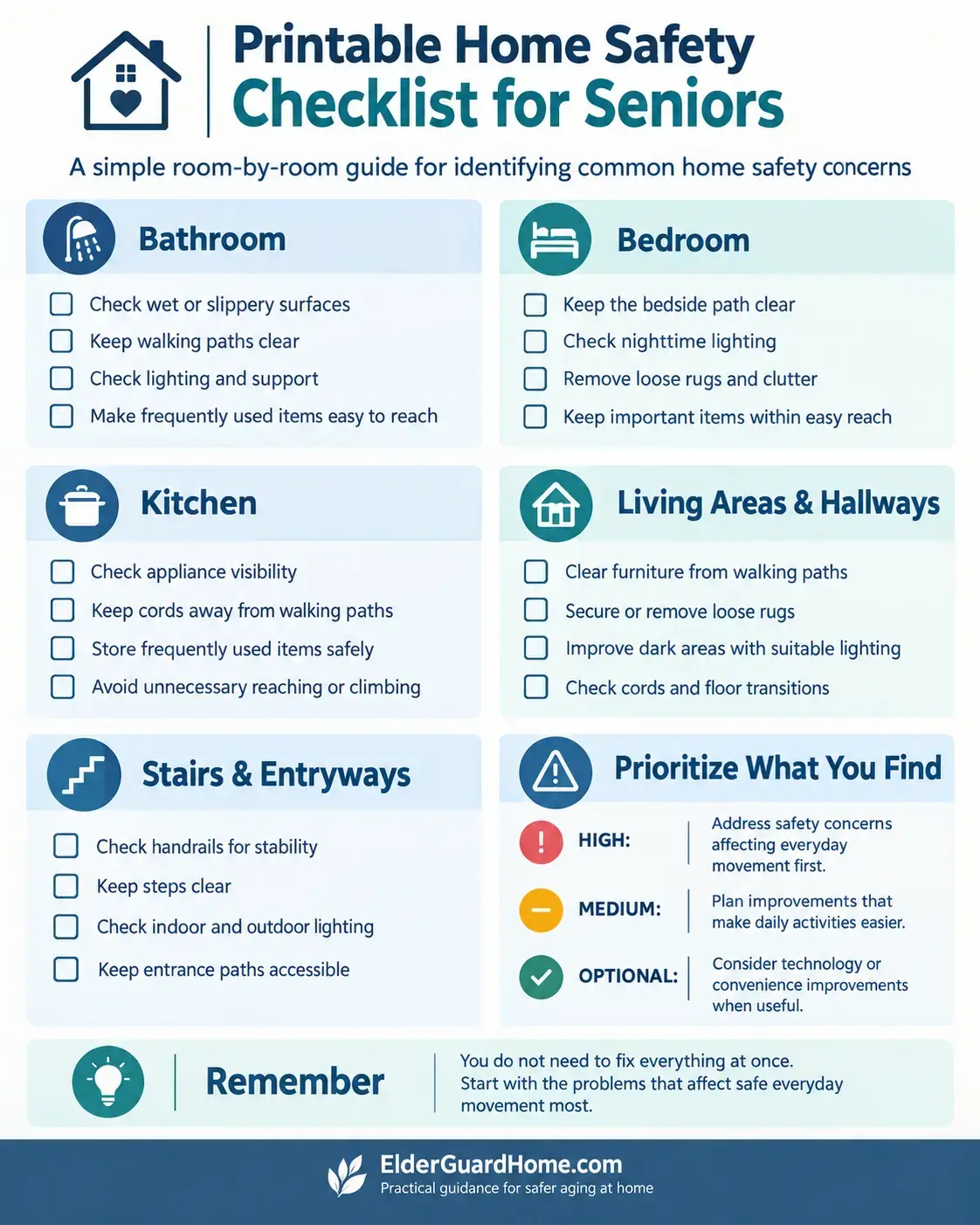
The right priority depends on the individual home and the older adult’s needs.
| Area | What to Check | Priority |
|---|---|---|
| Bathroom | Wet surfaces, access, lighting, and support | High |
| Bedroom | Bedside path, lighting, and clutter | High |
| Kitchen | Reach, cords, appliances, and visibility | Medium |
| Living Room | Rugs, furniture placement, and walking paths | High |
| Hallways | Lighting, cords, and clear walking paths | High |
| Stairs | Handrails, steps, and lighting | High |
| Entryway | Steps, lighting, mats, and access | High |
| Outdoor Areas | Walkways, debris, steps, and lighting | Medium |
| Smart Technology | Devices that solve a specific safety or accessibility problem | Optional |
| Pet Areas | Toys, bowls, and items that affect walking paths | Medium |
Remember: You do not need to address every concern at once.
Start with problems that could interfere with safe everyday movement.
Download the Home Safety Checklist for Seniors PDF
You have now seen how to use the checklist.
The printable version makes it easier to record findings while walking through the home.
[Download the Free Home Safety Checklist for Seniors PDF]
Print one copy for the initial review.
Keep your completed copy so you can track changes later.
If your home changes, you can print another copy and repeat the process.
Frequently Asked Questions About Home Safety
Where can I find a printable home safety checklist for seniors?
You can download our free, printable checklist directly from this page. You can find download link on top and bottom of this article.
Why is a room-by-room senior safety assessment better?
It prevents missed hazards and focuses on real movement patterns. Every room has unique hazards. A room-by-room senior safety assessment ensures you don’t overlook specific issues like kitchen grease on the floor or bedroom lighting.
What are the most important age in place home safety standards?
The most important standards include having a “no-trip” floor policy, installing proper grab bars in bathrooms, and ensuring every transition area is brightly lit.
Is the home safety checklist for seniors PDF free?
Yes! No signup. No email required.
Can I use this checklist in an apartment?
Absolutely. It works for houses, apartments, and assisted living units. While you may not be able to make structural changes in a rental, the room-by-room senior safety assessment will highlight “non-permanent” fixes like better lighting and furniture placement.
What if an older adult does not want to make a suggested change?
Start with a conversation.
Explain the concern and ask what solution feels acceptable.
A safety improvement is more useful when it fits the person’s routines and preferences.
How often should I complete a home safety checklist?
There is no single schedule that fits every household.
Review the home when mobility, routines, equipment, or living conditions change.
A periodic review can also help identify new concerns.
Does the checklist replace a professional home safety assessment?
No.
It is a practical screening tool for identifying common environmental concerns.
A professional assessment may be appropriate when the person’s needs are complex.
What is included in the home safety checklist for older adults?
The checklist covers common areas such as bathrooms, bedrooms, kitchens, living rooms, hallways, stairs, entrances, and outdoor spaces.
It also includes practical checks for lighting, walking paths, reach, and everyday movement.
Can a caregiver complete the checklist?
Yes.
Caregivers can walk through the home with the older adult and discuss each concern.
The older adult’s preferences and daily routines should remain part of the conversation.
What should I do after finding a safety problem?
Start with the highest-priority concerns.
Choose a small number of practical changes rather than trying to change everything at once.
Seek appropriate professional guidance when the problem involves complex mobility or major home modifications.
Who Creates ElderGuardHome's Guides?
Nisha Sharma
Bachelor of Science in Social Work
Certified Senior Home Safety Specialist
Nisha Sharma focuses on practical home safety, fall prevention, aging-in-place modifications, and caregiver education.
ElderGuardHome’s guides combine research, product documentation, safety information, and practical guidance for families supporting older adults.
Our Editorial Process
ElderGuardHome aims to make safety information useful, transparent, and practical.
Our content process includes research, source checking, product documentation, analysis, editorial review, and updates.
We distinguish verified product information from our own analysis.
We also avoid claiming hands-on testing when hands-on testing has not occurred.
Final Thoughts
A safer home does not require changing everything at once.
Start by observing how the older adult actually uses the home.
Then identify the problems that affect everyday movement most.
Use the checklist to record those concerns and create a practical action plan.
Small, appropriate changes can make a home easier to navigate.
Download the free printable home safety checklist for seniors and start your room-by-room review today.
Sources and Further Reading
- National Institute on Aging: Home Safety Tips for Older Adults.
- National Institute on Aging: Falls and Falls Prevention.
- National Institute on Aging: Home Safety Checklist.
- Centers for Disease Control and Prevention: Preventing Falls and Hip Fractures.
- Centers for Disease Control and Prevention: Check for Safety, Home Fall Prevention Checklist.
These sources provide additional information about home safety and fall prevention for older adults.