
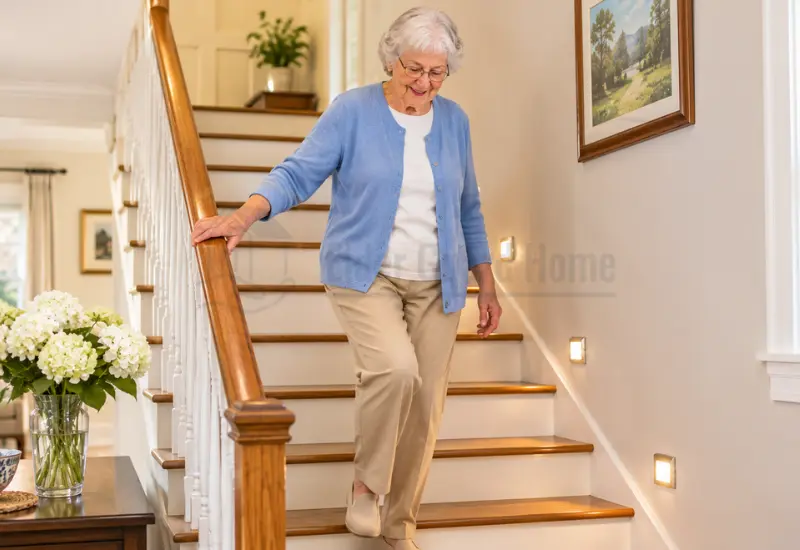
A staircase can become difficult to navigate when the lighting is poor. The problem is not always a completely dark stairway. Sometimes the overhead light illuminates the landing but leaves the lower steps in shadow. A person may also struggle to find the wall switch before taking the first step.
For older adults, these small visibility problems deserve attention. A step that blends into the one below it can be difficult to judge, especially when someone has reduced vision or is moving slowly.
The best stair lights for seniors should make the full staircase easier to see. They should illuminate the top and bottom landings, help distinguish individual steps, and activate reliably when needed.
There are several ways to improve stair lighting. Battery-operated step lights work without permanent wiring. Rechargeable motion-sensor lights offer another wireless option. Plug-in lights can provide automatic illumination where a suitable outlet is available. Professionally installed LED fixtures may be better for staircases that need permanent, consistent lighting.
This guide compares these options and explains what to check before buying. You will also learn how to position the lights, test motion sensors, and avoid installation choices that could create new hazards.
Why Is Proper Stair Lighting Important for Seniors?
Stairs require careful lighting because people need to judge changes in height while moving. A person must see where each step begins, where it ends, and how the next step differs from the previous one.
Poor lighting can make this harder. Dark carpeting, similar-colored treads and risers, reflections, and shadows may hide step edges. Even a staircase that looks bright from the hallway may have poorly lit sections.
The National Institute on Aging recommends good lighting, with switches at both the top and bottom of stairs. It also suggests considering plug-in motion-activated lights to illuminate stairwells and pathways. Read the NIA’s home fall-prevention guidance.
Why the Top and Bottom of Stairs Need Good Lighting
The first and last steps deserve particular attention. People often move from a brighter room into a darker stairway or from a dim staircase into a brighter hallway.
This change in light can make it harder to judge the first step. The bottom landing can create a similar problem when the staircase ends in a dark hallway.
Provide enough light to see both transition areas clearly. If the staircase has a switch at each end, make sure both switches work and are easy to reach.
Why Every Step Should Be Easy to See
Lighting only the landing does not necessarily illuminate the steps between them. A ceiling fixture may cast shadows from the stair treads, handrails, or nearby walls.
The goal is to make the staircase visually clear from top to bottom. Each tread should be distinguishable, and there should not be large dark gaps between illuminated areas.
Why Motion-Activated Lighting Can Be Helpful
Motion-sensor lights can turn on without someone searching for a switch. This is useful when a person approaches the stairs with both hands occupied or has difficulty reaching a wall switch.
However, a motion sensor is not guaranteed to activate every time. Its performance depends on its position, detection angle, range, lighting conditions, and the person’s approach.
Treat automatic lighting as a convenience and an additional layer of visibility. Maintain dependable general lighting as well.
What Are the Best Types of Stair Lights for Seniors?
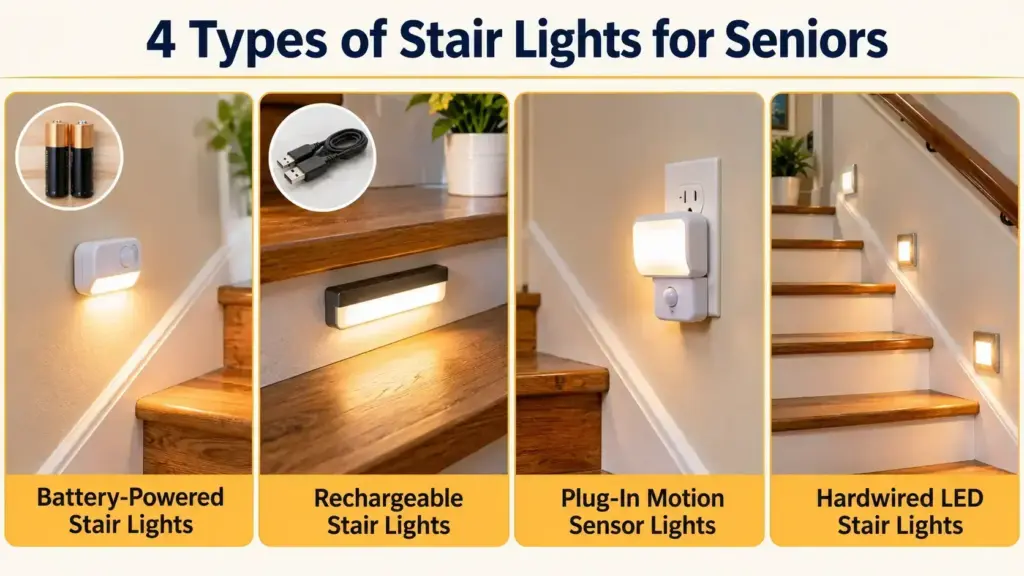
There is no single stair-lighting product that suits every home. The best choice depends on the staircase layout, nearby outlets, existing wiring, and how much light the steps need.
Here are the main options to compare.
Battery-Operated LED Stair Lights
Battery-operated step lights are useful when there is no convenient electrical outlet near the staircase. They can usually be mounted on a wall or another suitable surface without installing new wiring.
Some models use replaceable AA or AAA batteries. Others contain rechargeable batteries, so check the power source before ordering.
Advantages:
No permanent electrical wiring is needed.
Many models are simple to mount.
Replaceable-battery versions can be ready again quickly after a battery change.
They can be useful in rental homes where permanent modifications are restricted.
Limitations:
Batteries need regular replacement.
Light output may weaken as batteries become depleted.
Adhesive mounting can fail on unsuitable or dusty surfaces.
Small lights may not illuminate an entire staircase.
Battery-operated lights are best treated as supplemental lighting unless their actual output and coverage are suitable for the entire stairway.
Rechargeable Motion-Sensor Stair Lights
Rechargeable stair lights use built-in batteries that can be charged through a USB cable. Many models have a magnetic mounting plate, allowing the light to be removed for charging.
Some offer motion-only operation. Others include a dim mode that stays illuminated after motion is detected.
Advantages:
No disposable batteries are required.
Many models offer automatic motion activation.
Removable magnetic designs can make charging easier.
Some provide adjustable brightness or color settings.
Limitations:
Each unit must be recharged.
Battery runtime varies with brightness and activation frequency.
A light may be unavailable while charging if there is no spare.
Adhesive mounting plates must remain secure.
Check the manufacturer’s stated runtime and how it was measured. A claim such as “months of battery life” may assume only a limited number of activations each day.
For a staircase used frequently, choose a model with a manageable charging routine. Keep a spare light or another dependable source available if the units must be removed for charging.
Plug-In Motion-Sensor Stair Lights
Plug-in motion-sensor lights connect directly to a wall outlet. They can be convenient when an outlet is positioned near the staircase and the light can illuminate the intended area.
Some models activate only in darkness. Others turn on when they detect movement and switch off after a preset period.
Advantages:
No battery replacement or charging is needed.
Automatic activation can reduce the need to find a switch.
The light is ready whenever the outlet has power.
Some models combine motion detection with a darkness sensor.
Limitations:
An outlet may not be available in the right position.
A plug-in light may illuminate only a small section.
Furniture, walls, or railings can obstruct its sensor.
It will not operate normally during a power failure unless it has backup power.
Never use an extension cord stretched across a landing or staircase to position a light. Keep electrical cords away from walking routes.
Professionally Installed Hardwired LED Stair Lighting
Hardwired lighting is worth considering when the staircase is used throughout the day and night or when portable lights cannot provide consistent coverage.
A qualified electrician can assess options such as low-level wall fixtures, recessed step lights, or suitable LED lighting controlled by wall switches or occupancy sensors.
Advantages:
Permanent fixtures do not need routine battery charging.
Lighting can be planned for the full staircase.
Controls can be positioned at useful locations.
A properly designed system can provide more consistent coverage.
Limitations:
Installation may require electrical work and wall modifications.
The project may cost more than wireless lights.
Fixture placement and wiring need professional assessment.
A power failure can affect the system unless backup lighting is included.
For a frequently used staircase, permanent lighting may be the better long-term solution. Ask the electrician to assess the landings, direction changes, shadows, and visibility from both ends.
Which Stair Light Type Is Best for Different Homes?
Use this comparison to narrow down the options before buying.
| Staircase situation | Option to consider | Important check |
|---|---|---|
| No convenient outlet | Battery-operated or rechargeable lights | Battery access and maintenance |
| Suitable outlet near the stairs | Plug-in motion-sensor light | Sensor direction and coverage |
| Rental property | Removable wireless lights, where permitted | Secure mounting and landlord rules |
| Long or frequently used staircase | Professionally designed hardwired lighting | Continuous coverage |
| Staircase with a turn or landing | Multiple appropriately positioned fixtures | Dark spots around the turn |
| Occasional backup lighting | Rechargeable or battery-powered light | Runtime and backup availability |
A small wireless light can improve visibility in a dark area, but it should not be expected to replace a well-designed lighting system.
If the general staircase lighting is inadequate, fix that problem first. Add motion-activated lights to make the system more convenient.
How to Choose the Best Stair Lights for Seniors
A product can look attractive and still be unsuitable for a particular staircase. Before buying, check how it illuminates the steps and how reliably it operates.
Brightness and Light Distribution
Do not choose a stair light based only on its advertised lumen number. Lumens describe the total visible light output, but they do not tell you exactly how much light reaches the steps.
A small light with a narrow beam may create a bright spot while leaving nearby treads dark. A diffused fixture may spread light more evenly, even if its output is lower.
Look for:
Light directed toward the treads rather than into someone’s eyes.
Enough coverage to distinguish individual steps.
Minimal dark gaps between fixtures.
A comfortable brightness level when entering a dim staircase.
There is no single lumen rating that works for every staircase. The required output depends on fixture spacing, mounting position, wall color, existing lighting, and the person’s vision.
Motion Sensor Range and Detection Angle
A motion sensor must detect someone before they begin using the stairs. A light that activates only after a person has already climbed several steps is not positioned effectively.
Check the manufacturer’s stated detection range and angle. Then consider the actual approach.
For example, a sensor facing directly toward the hallway may work well for someone approaching from the front. It may respond poorly to someone approaching from the side.
Also check whether the sensor:
Works only in darkness or throughout the day.
Detects movement from both directions.
Has an unobstructed view of the approach.
Can be triggered by pets or movement nearby.
Activates consistently at the person’s normal walking pace.
Manufacturer range figures are not a guarantee of real-world performance. Test the light after installation.
Automatic Shutoff and Continuous-On Modes
Many motion lights turn off after a preset period without detecting movement. This saves battery power, but the timer must suit the person using the stairs.
A short timer may be inconvenient for someone who moves slowly or pauses on a landing. The light could switch off before the person reaches the next step.
Look for adjustable timers or a continuous-on mode if available. Test the chosen setting while someone uses the stairs at a normal, comfortable pace.
Do not assume that a longer timer is always better. The best setting provides enough time without creating unnecessary light throughout the night.
Glare, Shadows, and Light Color
A light can be bright without being comfortable. Exposed LEDs, glossy surfaces, and poorly directed beams can create glare.
Choose fixtures that direct light toward the steps rather than toward the person’s face. Diffused covers or shielded designs may help reduce direct brightness.
Also inspect the shadows. A fixture mounted behind a handrail or at an awkward angle may create dark bands across the treads.
Warm or neutral white light can be comfortable, but color temperature alone does not determine visibility. The more important questions are whether the steps are clearly visible and whether the light creates uncomfortable reflections.
Mounting Security and Physical Obstructions
A stair light should not protrude into the walking area. Avoid mounting anything where a shoe, walker, clothing, or hand could catch it.
Check the mounting instructions and surface compatibility. Adhesive pads may not hold reliably on dusty, textured, damp, or uneven surfaces.
For a staircase used every day, a secure screw-mounted fixture may be more appropriate than an adhesive-only fitting, provided the installation is suitable for the wall and does not damage hidden wiring or plumbing.
Battery Life, Charging, and Maintenance
Battery maintenance is easy to overlook when comparing products.
Before ordering, check whether the light uses replaceable batteries or a built-in rechargeable battery. Look for a low-battery indicator, charging status light, or clear instructions for replacing batteries.
Also ask:
Can the light be removed easily for charging?
How long does a full charge take?
Does the light work while charging?
Are replacement batteries easy to find?
Does the manufacturer explain expected runtime?
Can someone safely reach the light for maintenance?
If charging requires standing on the stairs or stretching over the handrail, the mounting position needs reconsideration.
Where Should Stair Lights Be Installed?
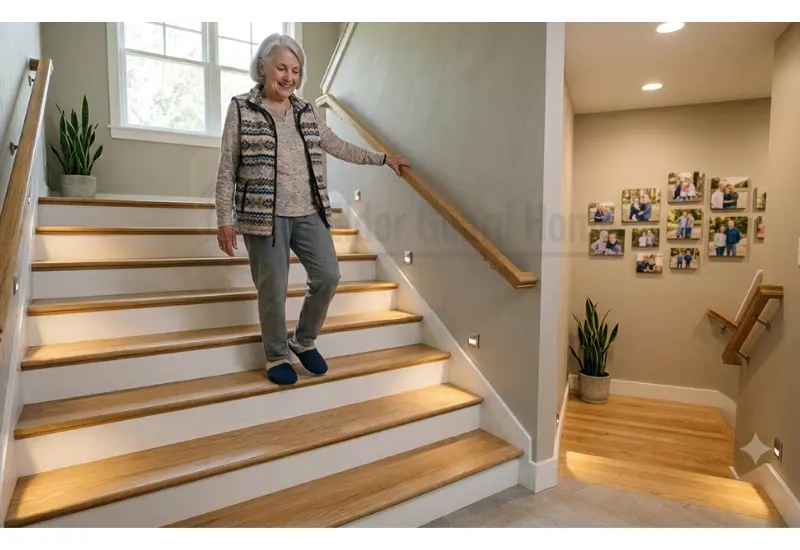
Correct placement matters as much as the product itself. A well-made light cannot help if it points away from the steps or leaves a dark area between fixtures.
Light the Top and Bottom Landings
Make sure the top and bottom landings are easy to see before anyone takes the first or last step.
A light near the top should illuminate the approach and the first tread. At the bottom, the person should be able to see where the final step ends and the landing begins.
Do not rely on a single fixture at one end to illuminate the entire staircase.
Illuminate the Steps Along the Full Staircase
Walkways and steps should not alternate between bright and very dark areas.
Check the staircase from both directions. Look at the tread surfaces and step edges rather than judging the light only from the hallway.
If there are dark gaps, consider repositioning the existing lights or adding fixtures. The spacing should depend on the beam spread and actual coverage of each product, not an assumed universal distance.
Wall-Mounted Step Lights and Riser Lighting
Low-level wall lights can direct illumination across the steps without placing equipment on the tread itself.
Some professionally installed systems use recessed fixtures near the risers. Others use wall-mounted fittings that cast light down onto the treads.
The correct arrangement depends on the staircase construction and fixture design. Avoid a position that shines directly into someone’s eyes while they are climbing or descending.
Staircases With Turns or Intermediate Landings
A staircase with a turn needs extra attention. The direction change can create shadows, and a sensor facing the wrong way may not detect someone approaching the next flight.
Check the landing separately. Make sure the person can see the floor, the next flight, and the direction of travel.
For U-shaped or L-shaped staircases, more than one sensor may be needed. Test each approach rather than assuming one sensor can cover the entire layout.
Avoid These Stair-Light Placement Mistakes
Common mistakes include:
Installing lights only at the top or bottom.
Pointing a bright fixture directly toward eye level.
Leaving dark gaps between illuminated steps.
Placing a sensor behind a railing or other obstruction.
Mounting a fixture where it can catch a shoe or walker.
Installing adhesive lights on unsuitable surfaces.
Positioning a light where it cannot be reached for maintenance.
If a fixture keeps falling or shifting, do not simply stick it back in place. Check the mounting surface and use an installation method approved by the manufacturer.
How Many Stair Lights Do You Need?
There is no fixed number that works for every staircase. The number depends on the length of the flight, the shape of the staircase, the light output, beam spread, mounting position, and existing room lighting.
A short staircase may need fewer fixtures than a long staircase with a turn. However, even a small staircase can have a dark corner or poorly lit landing.
Small Staircases
Start by checking the top landing, bottom landing, and every tread between them. Do not assume that one light will cover all the steps simply because the staircase is short.
If one fixture leaves the middle steps dark, add suitable coverage or improve the main lighting.
Long or Steep Staircases
Longer staircases need a more careful lighting assessment. Check for dark sections between fixtures and make sure the light reaches the full width of the treads.
If the existing ceiling light creates strong shadows, additional wall-mounted or professionally installed fixtures may help.
Staircases With Turns and Landings
Treat each flight and landing as a separate area when assessing coverage.
A light that illuminates the first flight may not reach around a corner. Check the change in direction from both approaches and add lighting where needed.
A practical check: Stand at the top and look down the staircase. Then inspect it from the bottom. If any step blends into the next one or disappears into shadow, the lighting arrangement needs improvement.
Best Stair Lights for Seniors — What to Compare Before Buying
The following products illustrate different ways to add automatic or supplemental lighting. They are not all dedicated stair fixtures, and their suitability depends on the staircase.
Product specifications below are based on available product documentation and manufacturer information. They are not independent performance tests. Check the exact model, package size, current listing, and instructions before ordering.
Best Battery-Operated Option — Mr. Beams MB720 or MB720A
The Mr. Beams MB720 series is a battery-powered motion-sensing light that can be mounted without permanent wiring.
The MB720 documentation describes a 20-lumen output, motion activation, a darkness sensor, and automatic shutoff after 30 seconds without motion. The MB720 uses four AA batteries, which are sold separately. The MB720A amber version is another model in the range.
Why consider it: It can be useful where a small wireless light is needed and no outlet is available.
What to check: Its stated light output is modest. Do not assume one unit can illuminate a full flight of stairs. Check the exact model and mounting instructions before buying.
Best Rechargeable Stair-Light Candidate — NIORSUN LH-TD26
The NIORSUN LH-TD26 rechargeable stair lights are designed for indoor use and have a rechargeable battery with USB-C charging.
The available product manual describes:
1,200mAh rechargeable battery.
Up to 35 lumens of light output.
Three color-temperature settings: 3000K, 4500K, and 6000K.
Motion sensing with a stated range of up to 10 feet and a 120-degree angle.
Magnetic mounting with adhesive metal plates.
A motion-only mode and a mode that dims after the initial illumination.
Why consider it: The removable magnetic design may make charging easier, and the dimming mode may suit a landing where a low-level glow is useful.
What to check: The stated sensor range is a manufacturer specification, not a guarantee for every staircase. Check the package quantity and exact model number. The light is intended for indoor use and is not water resistant.
Another Rechargeable Option — Electight HML6-3Y3W
The Electight rechargeable motion-sensor light is another wireless option to compare.
Its available manual describes a 400mAh rechargeable battery, magnetic mounting, ON/AUTO/OFF modes, and motion activation in low-light conditions. The stated detection range is up to approximately 10 feet, with a 120-degree detection angle.
Why consider it: The removable magnetic mounting design can make charging more convenient than a permanently fixed unit.
What to check: Its battery capacity is smaller than the NIORSUN model described above. Compare runtime information, charging frequency, and actual brightness before choosing it. Do not rely on advertised runtime without checking the usage assumptions.
Best Plug-In Motion-Sensor Candidate — GE Motion-Activated LED Night Light
The GE plug-in motion-activated night light is an option where an outlet is suitably located.
The GE model 26140 listing describes a 40-lumen LED, motion activation, a light sensor, and automatic shutoff after 90 seconds without activity. The manufacturer listing should be checked for the exact variant and current availability.
Why consider it: It avoids battery replacement and can provide automatic light near a suitable outlet.
What to check: A plug-in night light may illuminate only a small area. Confirm that its position provides useful light without obstructing the outlet or creating a protrusion in the walking route.
Best Permanent Option — Professionally Installed LED Step Lighting
For a staircase that needs consistent lighting across several steps, a professionally installed system may be more appropriate than multiple small portable lights.
Ask a qualified electrician to assess:
Low-level wall-mounted LED fixtures.
Recessed step lights, where the wall construction permits them.
Switches at both ends of the staircase.
Suitable occupancy or motion-sensor controls.
Backup lighting during power failures.
This is a lighting-system recommendation rather than a single consumer product. The electrician should select fixtures and controls based on the staircase layout and applicable electrical requirements.
Product Comparison at a Glance
The table below summarizes the main differences. The listed lumen figures are manufacturer or product-documentation claims, not a guarantee of useful staircase coverage.
| Product or option | Power source | Published light output | Useful feature | Main consideration |
|---|---|---|---|---|
| Mr. Beams MB720 / MB720A | 4 AA batteries | 20 lumens | Wireless motion activation | Modest output; may need multiple lights |
| NIORSUN LH-TD26 | Rechargeable USB-C battery | Up to 35 lumens | Magnetic mounting and dim mode | Requires periodic charging |
| Electight HML6-3Y3W | Rechargeable battery | Not confirmed in the available manual | ON/AUTO/OFF modes | Check exact brightness and runtime |
| GE model 26140 | Plug-in electrical power | 40 lumens | Motion and light sensing | Outlet position and limited coverage |
| Professionally installed LED step lights | Hardwired | Depends on fixture design | Permanent staircase coverage | Requires electrical assessment and installation |
Before ordering: Product names, model numbers, pack sizes, prices, and availability can change. The Amazon links above are model-specific search links, not confirmation of a particular seller’s current listing. Match the model number and specifications before purchasing.
How to Install Stair Lights Without Creating New Hazards
The installation method depends on the light and the staircase. A product advertised as easy to install is not automatically suitable for every wall or step.
Before Installing Battery or Rechargeable Lights
Read the manufacturer’s instructions before choosing a location. Check that the mounting surface is clean, dry, and compatible with the supplied adhesive or screws.
Position the light so it illuminates the tread without protruding into the walking area. If the light has a removable magnetic body, make sure the mounting plate remains securely attached when the unit is removed for charging.
Do not place a light on the tread itself unless the manufacturer specifically designs it for that purpose and the installation cannot create a raised or slippery surface.
Installing Plug-In Lights Safely
Use an outlet that is already positioned safely near the staircase. Make sure the light does not block a switch, another necessary outlet, or the walking route.
Do not run an extension cord across a step or landing to reach a more convenient location. The Consumer Product Safety Commission explains that damaged or unsuitable extension cords can create shock and fire hazards. Its home-safety checklist also warns against cords placed where people may step on them.
If the outlet is not in a useful position, consider a different lighting option rather than routing a cord across the stairs.
When to Hire an Electrician
Hire a qualified electrician for new wiring, recessed fixtures, hardwired step lights, switch changes, or work that involves opening walls.
A professional can check for hidden wiring and other obstacles before drilling. They can also assess whether the proposed lighting provides suitable coverage for the full staircase.
Do not attempt electrical work beyond your training or local legal permissions.
How to Test Stair Lights Before Relying on Them
A light that turns on in a product demonstration may behave differently in a real staircase. Test the complete setup before relying on it.
Test the Motion Sensor From Both Directions
Approach the staircase from the top and bottom. Check whether the light activates before the person reaches the first step.
Repeat the test from the side if the staircase has a turn. If the sensor responds only from one direction, adjust its position or consider an additional sensor.
Check the Entire Staircase for Dark Spots
Look at every tread and landing. Check whether the step edges are visible and whether railings or fixtures cast shadows.
Do not judge the lighting from one standing position alone. Inspect the staircase from both ends and from the normal approach paths.
Check the Timer at a Comfortable Walking Pace
Test the light while someone moves at the pace they normally use on the stairs.
If it turns off before they reach the landing, the timer is too short or the sensor is not detecting movement consistently. Select a longer setting if available or choose a different lighting arrangement.
Test After Dark and in Normal Room Lighting
Some lights activate only when the surrounding area is dark. Others respond to movement regardless of daylight.
Test the selected mode under the conditions in which the light will be used. Make sure nearby lamps or hallway lighting do not prevent a darkness sensor from activating when needed.
How to Maintain Stair Lights and Keep Them Working
A staircase lighting system needs occasional checks. A light that has stopped working may not be noticed until someone approaches the stairs in the dark.
Use this simple maintenance routine:
Replace disposable batteries when the light becomes dim or the manufacturer recommends replacement.
Recharge rechargeable units before they become completely depleted.
Check low-battery indicators and charging lights.
Clean the sensor area and light cover according to the manufacturer’s instructions.
Inspect adhesive plates, screws, and mounting brackets.
Test motion activation from both directions.
Confirm that timer and darkness settings have not changed.
Keep a flashlight or suitable backup light available for power failures.
Do not climb the staircase while balancing on a step to clean or recharge a fixture. Arrange maintenance from a safe position or ask someone to help.
If a light repeatedly detaches, flickers, or fails to activate, stop relying on it until the problem is corrected.
Common Stair Lighting Mistakes to Avoid
A few purchasing and installation mistakes can reduce the usefulness of an otherwise good light.
1. Lighting only one end of the staircase
The top and bottom landings both need attention. One light may leave the rest of the steps in shadow.
2. Choosing the brightest-looking product
A bright point of light can create glare without illuminating the full tread. Look at light distribution, not just the advertised lumen number.
3. Ignoring shadows
Railings, wall corners, and poorly positioned fixtures can create dark bands across the steps.
4. Relying entirely on a motion sensor
Sensors can fail to activate because of placement, obstruction, lighting conditions, or detection limitations. Maintain dependable general lighting.
5. Installing fixtures where they can be bumped
A protruding light can catch a shoe, walker, clothing, or hand. Keep fixtures outside the walking area.
6. Running cords across the stairs
An extension cord across a landing or tread creates an additional hazard. Use a suitably located outlet or another power option.
7. Forgetting battery maintenance
A wireless light is useful only when its battery is charged or replaced. Add battery checks to the household maintenance routine.
8. Treating decorative strip lights as complete stair lighting
Decorative lighting may make a staircase look attractive without illuminating each tread properly. Check actual visibility before relying on it.
9. Treating lighting as a replacement for handrails
Lights help people see the steps. They do not provide physical support. Secure handrails remain important.
Are Stair Lights Enough to Make Stairs Safer for Seniors?
Good lighting is an important part of stair safety, but it is not the only factor.
The National Institute on Aging recommends secure handrails on both sides of stairs, good lighting, and keeping stairways clear. The American Academy of Orthopaedic Surgeons also advises providing enough light to see each stair and both landings.
Check the following areas as part of a wider safety review:
Handrails: Make sure they are secure and easy to grip.
Step surfaces: Repair loose boards and carpeting.
Step edges: Make the edges easier to distinguish where needed.
Clutter: Keep shoes, packages, and other objects off the stairs.
Footwear: Use properly fitting footwear with suitable grip.
Lighting controls: Make switches accessible at both ends of the staircase.
If an older adult has difficulty judging steps despite improved lighting, consider a professional home-safety assessment. Vision changes, balance problems, and mobility limitations may require additional support.
For more ways to improve visibility throughout the home, read our guide to safe home lighting design for seniors.
You can also review our guide to choosing LED light bulbs for seniors when updating the main fixtures that illuminate the staircase.
Stair lighting is also different from general nighttime navigation. Our guide to night lights for elderly adults covers lighting for bedrooms, hallways, and other nighttime routes.
For other areas of the home, see our bathroom fall-prevention guide for seniors and our guide to the best flooring for seniors aging in place.
FAQ
What are the best stair lights for seniors?
The best option depends on the staircase and its power supply. Battery-powered and rechargeable lights can add illumination without wiring. Plug-in motion lights are useful when an outlet is safely positioned. Professionally installed LED step lighting may be better for permanent coverage across a frequently used staircase.
Are motion-sensor stair lights better than regular stair lights?
Motion-sensor lights can be more convenient because they turn on automatically when movement is detected. However, they depend on sensor position, detection range, and lighting conditions. A reliable general lighting system with accessible switches should remain available.
Are battery-operated stair lights reliable?
They can be useful when installed securely and maintained properly. Their reliability depends on battery condition, light output, mounting quality, and sensor performance. Check batteries regularly and do not rely on a dim or untested light.
How long do rechargeable stair lights stay on?
It varies by model, brightness setting, battery capacity, and how often the sensor activates. Check the manufacturer’s runtime information and its usage assumptions. Frequent activation or continuous-on operation will usually require more frequent charging.
Where should motion-sensor stair lights be placed?
Position lights so they illuminate the top landing, bottom landing, and steps between them. Sensors should detect someone before they begin climbing or descending. Avoid positions where walls, railings, or furniture block detection.
How many lights do I need for a staircase?
There is no universal number. It depends on the staircase length, turns, fixture output, beam spread, and existing lighting. Check every tread and landing from both directions. Add lighting wherever dark gaps remain.
Can I install stair lights without wiring?
Yes. Battery-operated and rechargeable lights can often be mounted without permanent wiring. Follow the manufacturer’s instructions and make sure the mounting method is secure. Wireless lights may provide supplemental illumination rather than full staircase coverage.
Are plug-in stair lights safe to use?
They can be suitable when plugged into a properly located outlet and installed according to the manufacturer’s instructions. The light should not obstruct the walking route or require a cord across the stairs. Check that the fixture does not interfere with other outlet use.
What color light is best for indoor stairs?
A comfortable warm or neutral white light may work well, but color temperature alone does not determine stair visibility. The important factors are even illumination, visible step edges, low glare, and limited shadows. Choose a light that makes the treads easy to distinguish.
Do stair lights help prevent falls in older adults?
Good lighting can improve visibility and help people judge steps more clearly. However, it cannot eliminate fall risk. Secure handrails, clear steps, suitable footwear, and attention to vision and mobility are also important.
Conclusion
The best stair lights for seniors are the ones that provide dependable visibility for the actual staircase. Battery-operated lights can help where wiring is unavailable. Rechargeable models offer a wireless alternative, while plug-in motion lights are convenient when an outlet is safely positioned. For a long or frequently used staircase, professionally installed lighting may provide more consistent coverage.
Before choosing a product, look beyond its appearance and advertised brightness. Check the sensor range, timer, light distribution, mounting method, and maintenance requirements.
Most importantly, inspect the staircase from both directions. Make sure the top landing, bottom landing, and every step are visible without uncomfortable glare or deep shadows.
Lighting is one part of a safer home. Combine it with secure handrails, clear steps, and regular maintenance to make everyday stair use easier and more comfortable.