
A bathroom fall detection system for elderly adults is no longer a luxury. It is a safety essential.
Bathrooms are the highest fall-risk zone inside any home. Wet floors. Hard tiles. Sharp edges.
Because seniors often remove wearable devices before showering, traditional alert systems fail when they are needed most. Therefore, a properly installed bathroom fall detection system for elderly users can mean the difference between fast response and delayed emergency care.
If you’re new to AI-based monitoring, start with our complete guide to AI fall detection systems.
Why Are Bathrooms the Most Dangerous Places for Senior Falls?
Bathrooms are high-risk for senior falls because of wet floors, hard tile surfaces, and confined space. As a result, even minor slips can lead to serious injuries.
In fact, studies show that bathroom falls are more than twice as likely to lead to serious injury than falls in other rooms. This makes targeted fall detection essential.
Moreover, seniors often move quickly in bathrooms. They rush. They twist. They lose balance.
According to clinical research, bathroom falls are more than twice as likely to result in injury compared with other household falls, especially among older adults.
Slip and Fall Statistics in Bathrooms
Research consistently shows that bathroom falls account for a significant percentage of home injuries among seniors.
Most falls happen near:
- Shower entrances
- Bathtubs
- Toilets
- Wet tile flooring
Consequently, prevention inside this room has a higher safety impact than in most other areas of the home.
Before investing in a detection system, the simplest first step is securing the floor itself. Our guide on non-slip bath mats for elderly adults covers the 7 safest options for both inside the tub and the step-out area — rated for suction strength and drain coverage.
Why Traditional Medical Alert Buttons Fail in Bathrooms
Traditional buttons depend on manual activation.
However, seniors may:
- Be unconscious
- Be disoriented
- Forget to wear the pendant
Additionally, water exposure often discourages wearing devices during bathing. For a full breakdown, read our comparison of AI Fall Detection vs Medical Alert Buttons.
The Problem with Wearables During Showering
Wearables are removed.
It is misplaced.
Wearables are forgotten.
Therefore, relying only on manual alert systems creates a dangerous gap in protection.
This is where non-wearable bathroom fall detection becomes critical.
Understanding Bathroom Fall Detection Systems for Seniors
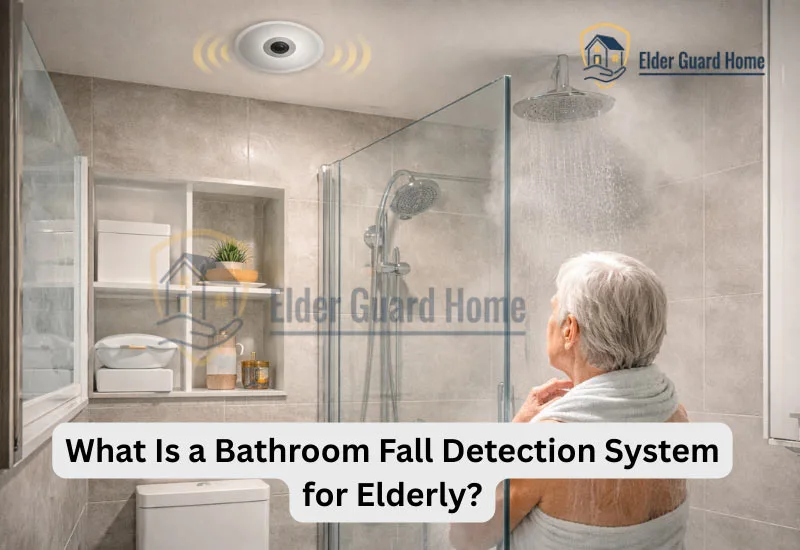
A bathroom fall detection system for elderly is a purpose-built sensor system that detects falls automatically without requiring wearables or pendants. It uses non-visual sensors that respect privacy while providing rapid alerts on serious falls.
Importantly, peer-reviewed engineering research has demonstrated that non-contact fall detection systems can achieve high detection accuracy in controlled bathroom scenarios.
As a result, privacy-preserving sensor technology is now considered a viable alternative to wearable devices in high-risk areas like bathrooms.
Unlike general home systems, bathroom-specific systems must:
- Operate reliably in steam
- Maintain privacy
- Function in compact layouts
- Resist humidity damage
Importantly, the best systems are designed for AI fall detection in humid environments where steam and condensation interfere with traditional sensors.
Most high-quality models use:
- Radar-based motion sensing
- Edge AI processing
- Automatic emergency alerts
As a result, they function continuously — even during shower use.
How Non-Wearable Bathroom Fall Detection Sensors Work
These systems work by continuously monitoring motion patterns and detecting sudden posture changes that indicate a fall. When a fall is confirmed, alerts are sent to caregivers or monitoring services instantly.
Unlike medical alert pendants, Non wearable bathroom fall detection systems do not rely on buttons or wristbands. Instead, they use intelligent sensors to monitor movement patterns inside the bathroom. As a result, they can detect falls automatically — even if the person cannot call for help.
Let’s break down how this technology works.
Step 1: Continuous Motion Monitoring
First, the sensor monitors movement inside the bathroom 24/7.
Typically, it uses radar, mmWave sensing, or depth-based motion detection. Importantly, it does not record video. Instead, it tracks motion signatures and body positioning in real time.
Therefore, privacy remains protected.
Step 2: Pattern Recognition and Behavior Learning
Next, the system learns normal bathroom activity patterns.
For example, it understands the difference between:
Standing
Sitting
Bending
Normal shower movement
Over time, it builds a behavioral baseline. As a result, it can distinguish routine movement from abnormal events.
This is where AI makes the difference.
Step 3: Sudden Impact or Vertical-to-Horizontal Shift Detection
Then, if a rapid downward movement occurs, the system analyzes it instantly.
Specifically, it looks for:
Sudden acceleration
Loss of vertical posture
Extended inactivity after impact
If those conditions match fall criteria, the system flags it as a potential fall.
This is the core mechanism behind Fall detection for bathroom environments.
Step 4: Post-Fall Inactivity Confirmation
However, smart systems do not trigger alerts immediately.
Instead, they check for inactivity after the suspected fall. If the person remains motionless beyond a preset time threshold, the system confirms the emergency.
Consequently, this reduces false alarms significantly.
For a deeper analysis, you can reference your False Alarm Rates cluster article here.
Step 5: Alert Trigger and Notification
Finally, once the fall is confirmed, the system sends alerts.
Depending on the setup, it may:
Notify caregivers via app
Send SMS alerts
Trigger a monitoring center
Activate a smart speaker emergency call
Because the system works automatically, the senior does not need to press anything.
That is the key advantage of Non wearable bathroom fall detection over wearable devices.
In homes where internet connections are unreliable, families may prefer systems that work independently of wireless networks. In these situations, a home security system without WiFi can still deliver emergency alerts through cellular or landline connections.
Why This Matters in Bathrooms
Bathrooms are high-risk areas due to:
Wet floors
Hard tile surfaces
Confined space
Limited mobility
Therefore, automatic detection becomes essential. In many cases, seniors cannot reach a wearable device after a fall. However, sensor-based Fall detection for bathroom continues working passively in the background.
That difference can save minutes.
And in emergencies, minutes matter.
Radar vs Camera – Which Type of Bathroom Fall Detection Is Safer?
Radar systems are generally safer than cameras in bathrooms because they maintain accuracy in steam and protect privacy. Cameras may record visuals and are often blocked by moisture or fog.
For a full breakdown, read our comparison of Radar vs Camera Fall Detection.
However, bathrooms require special consideration.
| Feature | Radar-Based | Camera-Based |
|---|---|---|
| Works in Steam | ✅ Yes | ⚠️ Limited |
| Privacy Safe | ✅ High | ❌ Low |
| Night Vision | ✅ Yes | ⚠️ Depends |
| Installation | Moderate | Easy |
| False Alarms | Low | Medium |
Why Cameras Raise Privacy Concerns in Bathrooms
Bathrooms demand dignity.
A Bathroom require privacy.
Bathrooms deserve discretion.
Even if footage is encrypted, the psychological discomfort remains. Therefore, when choosing the best fall detection system for bathroom privacy, radar-based systems are generally preferred.
Why Radar Is More Reliable in Steam & Condensation
Radar uses radio waves instead of visual data.
Steam does not block radio frequency signals.
Condensation does not blur radar readings.
Because of this, radar systems maintain accuracy even in dense humidity, making them ideal for a bathroom fall detection system for elderly users.
While bathroom safety is critical, it’s often most effective when combined with a layered monitoring approach. Learn how hybrid fall detection systems extend protection beyond a single room.
What Are the Privacy Risks in Bathroom Monitoring?
Privacy concerns in bathrooms arise when cameras or cloud storage are used. Non-visual sensors like radar avoid these risks by analyzing motion data without recording identifiable footage.
Privacy is often the biggest concern.
Fortunately, modern systems solve this problem through:
Edge AI processing
No video storage
Local data processing
No cloud recording
Unlike camera-based monitoring, radar systems do not capture identifiable images. Instead, they analyze movement patterns.
Therefore, a properly configured bathroom fall detection system for elderly users protects both safety and dignity.
How Do Steam and Humidity Affect Fall Detection Sensors?
Steam and humidity reduce visibility for camera-based sensors but have minimal impact on radar and other motion-based systems, which use non-visual signals to detect movement even in moist environments.
Steam distorts light.
Humidity damages electronics.
Condensation interferes with optics.
This is why AI fall detection in humid environments requires specialized hardware.
Why Optical Systems Struggle
Camera lenses fog up.
Infrared sensors lose clarity.
Low light worsens detection accuracy.
Consequently, cheaper optical systems trigger more false alarms in bathrooms.
Why mmWave Radar Performs Better
mmWave radar penetrates steam.
A mmWave radar tracks motion patterns.
mmWave radar maintains signal consistency.
Therefore, radar systems are more stable inside bathrooms.
IP Ratings You Should Look For
Look for:
IP65 or higher moisture resistance
Sealed casing
Anti-corrosion components
Buyer Checklist:
Steam-resistant design
Edge AI processing
No camera recording
Emergency alert integration
Best Non-Wearable Bathroom Fall Detection Systems (2026 Comparison)
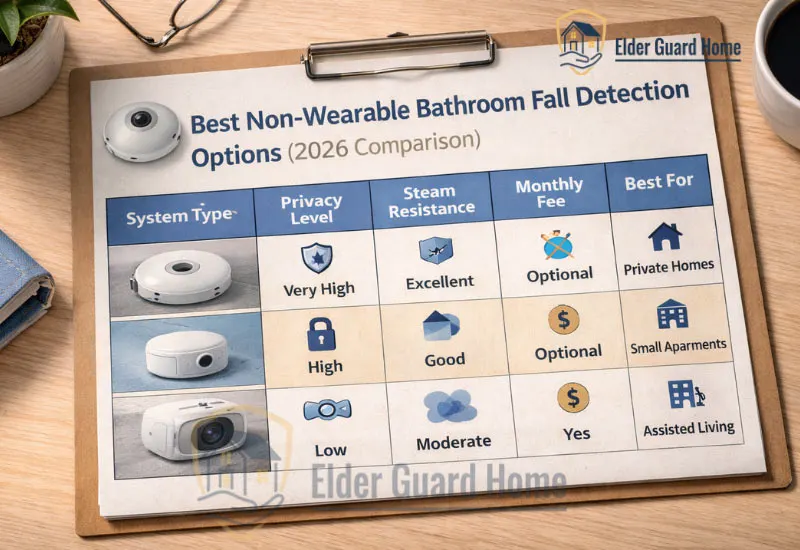
Choosing the right bathroom fall detection system for elderly homeowners depends on privacy and environment.
| System Type | Privacy Level | Steam Resistance | Monthly Fee | Best For |
|---|---|---|---|---|
| Radar (Edge AI) | Very High | Excellent | Optional | Private Homes |
| WiFi-Based | High | Good | No | Small Apartments |
| Camera AI | Low | Moderate | Yes | Assisted Living |
1. Aqara Presence Sensor FP2 (Top Rated for Accuracy)
The Aqara FP2 is currently the best-rated consumer radar sensor on Amazon. It uses millimeter-wave (mmWave) technology to track human presence with surgical precision. It does not use a camera, so it is perfect for 100% bathroom privacy.
- Best Fit For: Families who want a “set it and forget it” system with no monthly fees.
- How it Works: It uses radar to map the bathroom. You can designate the floor as a “Fall Zone.” If the AI detects a human body at floor level for too long, it sends an instant alert.
Pros and Cons:
| Pros | Cons |
| No monthly subscription fees | Requires an Aqara Hub for some features |
| Tracks up to 5 people simultaneously | Complex initial setup (Zone mapping) |
| Works in steam and total darkness | Must be plugged into a power source |
| IPX5 water resistance for bathrooms | App interface can be overwhelming at first |
2. Xandar Kardian XK300 (Hospital Grade Home Version)
If you want the most reliable tech, the XK300 is the first FDA-cleared class II medical device that uses radar for home safety. It is much more advanced than Vayyar Care. It doesn’t just detect falls; it monitors heart and breathing rates through walls and blankets.
Best Fit For: Seniors with serious medical conditions who need clinical-grade monitoring.
How it Works: It senses “micro-vibrations” from the human body. It can tell if a person is breathing normally or in distress without any contact.
Rating: Highly praised by medical professionals for its zero-false-alarm rate.
Pros and Cons:
| Pros | Cons |
| FDA Cleared for medical accuracy | High upfront cost (Professional grade) |
| Monitors vitals (Heart & Breathing) | Not as “sleek” as consumer smart home gear |
| Zero privacy issues (No camera/mic) | May require a professional caregiver dashboard |
| Detects “slow collapses” others miss | Harder to find in stock due to high demand |
3. Nobi Smart Lamp (Best Design & Lighting)
The Nobi Smart Lamp is a “hidden in plain sight” device. It looks like a high-end ceiling light but contains sophisticated AI sensors. It is widely used in luxury senior living facilities in Europe and is now available for home use. This is mainly for living and bedrooms for you can also use it in bathroom.
Best Fit For: Seniors who want a stylish home without “medical-looking” gadgets.
How it Works: It monitors the room 24/7. If a fall occurs, it asks “Are you okay?” via built-in speakers. If no answer is given, it calls family and even unlocks the smart lock for help.
Rating: Exceptional for its dual-purpose as a fall preventer (it turns on soft lights when a senior sits up at night).
Pros and Cons:
| Pros | Cons |
| Prevents falls by lighting the path | Requires professional ceiling installation |
| 2-way audio for instant talking | High-ticket luxury item |
| Beautiful design (not a “gadget”) | Requires a stable Wi-Fi connection |
| Privacy-first (Uses stick-figure AI) | Larger physical footprint than sensors |
Comparison Table – Best bathroom monitoring system seniors
| Product Name | Pros | Cons | Best Fit For |
|---|---|---|---|
| Aqara Presence Sensor FP2 |
|
| Budget-conscious smart homes |
| Xandar Kardian XK300 |
|
| Seniors with high medical risk |
| Nobi Smart Lamp |
|
| Luxury homes & fall prevention |
Pros and Cons of Installing Fall Detection in Bathrooms
✅ Pros
- Immediate emergency response
- Works even if unconscious
- No wearable required
- Reduces caregiver anxiety
❌ Cons
- Installation complexity
- Upfront cost
- Some false positives
For deeper accuracy data, see our detailed guide on False Alarm Rates in AI Fall Detection.
Who Should Install a Bathroom Fall Detection System?
A bathroom fall detection system for elderly individuals is especially recommended for:
Best For:
Seniors living alone
Post-surgery recovery
Parkinson’s patients
High fall-risk individuals
Not Ideal For:
Fully assisted environments
Shared public bathrooms
Installation Considerations (Ceiling vs Wall Mount)
Choosing the right placement for a bathroom fall detection system for elderly users is just as important as choosing the technology itself.
Proper installation improves accuracy. Good installation reduces false alarms. Proper installation ensures full-room coverage.
Optimal Positioning
For most bathrooms, ceiling placement offers the widest detection range.
Ceiling mounting:
- Covers the entire room
- Minimizes blind spots
- Avoids obstruction from fixtures
However, wall mounting may work in compact bathrooms where ceiling access is limited.
Ideally, install the sensor:
- In the center of the ceiling
- At least 7–9 feet above floor level
- Away from direct water exposure
Because bathrooms are tight spaces, correct angle calibration significantly improves detection precision.
Avoid Shower Spray Path
Never install directly above active shower heads.
Continuous water spray can:
- Reduce hardware lifespan
- Trigger unnecessary motion alerts
- Cause condensation buildup
Even though modern systems are built for AI fall detection in humid environments, direct spray exposure should still be avoided.
Avoid Reflective Tile Interference
Glossy tiles reflect signals.
Metal fixtures bounce radar waves.
Mirrors create signal distortion.
Therefore, position sensors away from large mirrors and chrome fixtures when possible.
Suggested Placement Diagram (For Image Later)
You can later include a realistic diagram showing:
- Ceiling-mounted radar sensor (center position)
- Shower zone marked
- Toilet area covered
- “Avoid” areas near mirrors and spray zone
This visual will improve dwell time and clarity.
Cost Breakdown – Is It Worth It?
Many families hesitate before investing in a bathroom fall detection system for elderly parents.
However, the real question is not cost.
The real question is consequence.
The real question is delay.
Additionally, according to the CDC, falls are the leading cause of injury among older adults in the United States. Consequently, preventing even one serious fall can save thousands in emergency and hospital costs.
Here’s a simple ROI comparison:
| Scenario | Without System | With System |
|---|---|---|
| ER Visit Cost | $3,000 – $5,000+ | Often Prevented |
| Hospital Stay (Fall-Related) | $20,000 – $40,000+ | Reduced Risk & Shorter Stay |
| Monthly Subscription | $0 | $10 – $30 |
| ⭐ Best Financial Decision | High Emergency & Rehab Costs | Lower Long-Term Cost & Faster Response |
One untreated fall can lead to:
- Surgery
- Long-term rehabilitation
- Loss of independence
In contrast, early detection reduces response time dramatically.
Therefore, when framed as risk prevention rather than gadget expense, the value becomes clear.
A properly installed non-wearable bathroom fall detection system can pay for itself after a single prevented emergency escalation.
Common Mistakes to Avoid in Fall detection for bathroom
Even the best bathroom fall detection system for elderly users can underperform if installed incorrectly.
Avoid these common mistakes:
Installing Camera in Shower Area
This creates privacy concerns.
Camera increases condensation distortion.
This raises compliance questions.
If privacy matters, review our in-depth comparison of radar vs camera systems earlier in this guide.
Ignoring Humidity Specifications
Not all systems are designed for AI fall detection in humid environments.
Always check:
- IP rating (IP65 or higher preferred)
- Sealed housing
- Corrosion-resistant materials
Choosing Cloud-Only Systems
Cloud-only camera systems:
- Store data remotely
- Raise privacy concerns
- Depend entirely on internet connectivity
Instead, prioritize edge AI processing with local analysis.
Not Testing Alert Notifications
Installation is not enough.
Testing is critical.
Testing confirms reliability.
After setup:
- Trigger a fall simulation
- Verify caregiver notifications
- Confirm alert delay timing
Accuracy matters. If you want deeper insight, read our detailed breakdown of False Alarm Rates in AI Fall Detection.
Frequently Asked Questions
Do bathroom fall detection systems work in steam?
Yes. Radar-based systems are specifically designed for AI fall detection in humid environments. They use radio waves instead of visual data, so steam does not block detection.
Are camera systems legal in bathrooms?
Legality depends on jurisdiction and consent. However, from a privacy standpoint, radar systems are generally considered the safer choice inside private bathrooms.
Is radar fall detection accurate in small bathrooms?
Yes. In fact, smaller bathrooms can improve signal precision because the detection zone is compact and easier to monitor.
Do these systems require WiFi?
Some require WiFi for alert notifications. However, edge AI models can process data locally and only use internet connectivity for sending alerts.
Can Medicare cover bathroom fall detection systems?
Coverage varies. In most cases, Medicare does not directly cover home-installed AI monitoring devices. However, certain medical alert systems may qualify under specific plans.
What is the most accurate type of fall detection for bathrooms?
Radar-based systems with non-visual sensing are generally the most accurate for bathroom falls due to steam resistance and privacy protection.
Final Verdict: What Is the Safest Bathroom Fall Detection System for Elderly?
Radar-based non-wearable bathroom fall detection is the safest choice due to privacy protection, humidity resistance, and automatic alerting. This balances detection accuracy with dignity and comfort.
If privacy is a priority, camera systems create discomfort.
If steam is constant, optical systems struggle.
Radar sensors provide superior results when accuracy is your main goal.
Therefore, the safest choice for most homes is a radar-based bathroom fall detection system for elderly users powered by edge AI.
It protects privacy.
Radar resists humidity.
It reduces response time.
It works without wearables.
For families serious about safety and dignity, this combination offers the strongest balance of protection and reliability.
Before deciding, explore our full comparison guide on Non-wearable elderly safety monitoring and evaluate which system fits your bathroom layout best.