
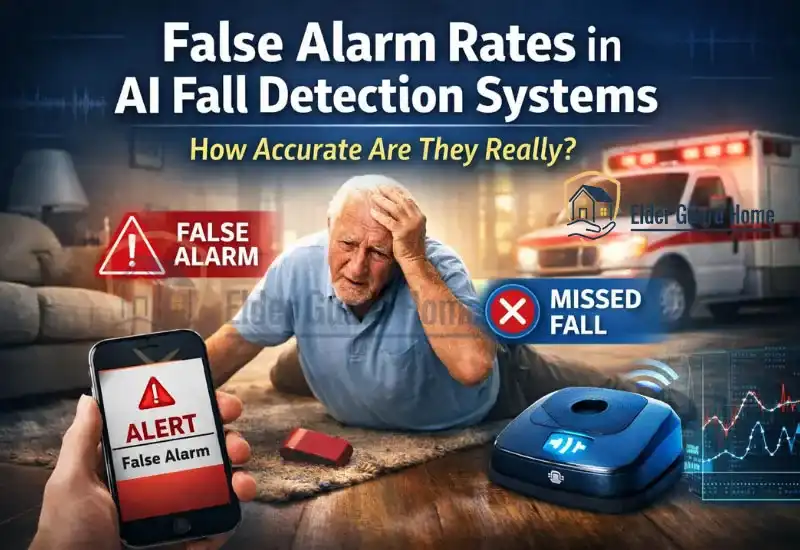
When families research smart safety solutions, one question comes up quickly: How reliable is it, really?
Understanding false alarm rates in AI fall detection systems is critical before trusting one with a loved one’s safety. A system that alerts too often causes panic and fatigue. A system that misses falls can be dangerous.
In this guide, we break down AI fall detection false positives, missed fall cases, real-world accuracy data, and what families should realistically expect.
If you’re new to non-wearable systems, you may want to first read our pillar guide on AI fall detection without wearable buttons.
Now, let’s focus specifically on reliability and error rates.
What Are False Alarm Rates in AI Fall Detection Systems?
Before evaluating performance, we need clarity on definitions.
False Positive (AI Fall Detection False Positive)
A false positive occurs when the system detects a fall — but no fall actually happened.
Example:
A senior drops into a chair quickly, and the system interprets it as a fall.
These are the most common type of error in automated systems.
False Negative
A false negative occurs when a real fall happens — but the system fails to detect it.
This is more serious because it delays emergency response.
Why False Alarms Matter for Caregivers
False alarms create:
Alert fatigue
Reduced urgency over time
Emotional stress
Distrust in the technology
Research from the National Institute on Aging emphasizes that response reliability significantly impacts caregiver behavior and long-term adoption of safety technology:
When caregivers stop trusting alerts, safety systems lose effectiveness.
What Is the Error Rate?
The error rate refers to the percentage of total events that are incorrectly classified.
In fall detection systems, this includes:
False positives
False negatives
Lower error rates indicate higher AI fall detection reliability.
AI Fall Detection False Positives vs False Negatives (Understanding the Difference)
Both errors matter — but in different ways.
What Causes AI Fall Detection False Positives?
Several real-world scenarios increase false positives in fall detection:
1. Dropping to sit quickly
Sudden vertical motion can resemble impact.
2. Pets triggering motion
Medium-to-large dogs can activate motion-based sensors.
3. Sudden lying down
Fast movements onto a bed or couch may trigger alerts.
4. Bedding or blanket movement
Camera-based AI sometimes misinterprets movement patterns.
5. Sensor misinterpretation
Radar systems may detect rapid changes in body posture.
Most modern systems use machine learning to reduce these triggers over time.
What Are False Negatives in Fall Detection Systems?
False negatives in fall detection are more complex and harder to detect.
Common scenarios include:
1. Slow collapses
Gradual sliding down a wall may not register as impact.
2. Partial falls
If someone catches themselves mid-fall, it may not trigger detection.
3. Slumping against furniture
Low-impact falls are harder to classify.
4. Falls outside detection zone
If monitoring coverage is incomplete, missed fall detection cases increase.
Unlike false positives, false negatives are often underreported because they are not always immediately visible.
Fall Detection Accuracy Rate: What Do Real-World Studies Show?
The fall detection accuracy rate varies widely depending on technology and testing conditions.
Academic research published in JMIR mHealth and uHealth shows lab-based fall detection systems achieving 85%–98% detection rates under controlled conditions.
However, real-world performance is often lower.
Why?
Because homes are unpredictable environments.
Lab Testing vs Real-World Performance
In laboratories:
Controlled lighting
Single user
Simulated falls
No pets
No furniture interference
In real homes:
Multi-person households
Pets
Cluttered spaces
Variable lighting
Bathroom humidity
This explains why marketing claims sometimes appear higher than realistic expectations.
How Accurate Is AI Fall Detection?
In real-world environments, many AI-based systems operate within:
80%–95% detection accuracy
5%–15% false alarm rate
These ranges vary based on configuration and placement.
How Accuracy Differs by Technology Type
Accuracy also varies depending on whether the system uses radar, computer vision, or hybrid sensing.
For a detailed comparison, see our breakdown of: Radar vs Camera Fall Detection for Seniors. That article focuses on technology differences — while this guide focuses strictly on error rates.
What Increases False Alarm Rates in AI Fall Detection Systems?
Several practical factors increase false alarm rates in AI fall detection systems.
Understanding these is essential for reducing false alarms in fall detection systems.
- Poor Installation Placement: Incorrect sensor height or angle can distort movement interpretation.
- Bathroom Humidity Interference: Steam can interfere with certain camera-based systems.
- Lighting Issues (Camera Systems): Low light or shadows may affect computer vision models.
- Multi-Person Households: More movement equals more classification complexity.
- Pets: Large dogs significantly increase false positives in some systems.
- Large Furniture Blocking Sensors: Obstructed line-of-sight reduces accuracy.
Most false alarms are installation-related — not necessarily AI failure.
Sensitivity vs Specificity in AI Fall Detection Reliability
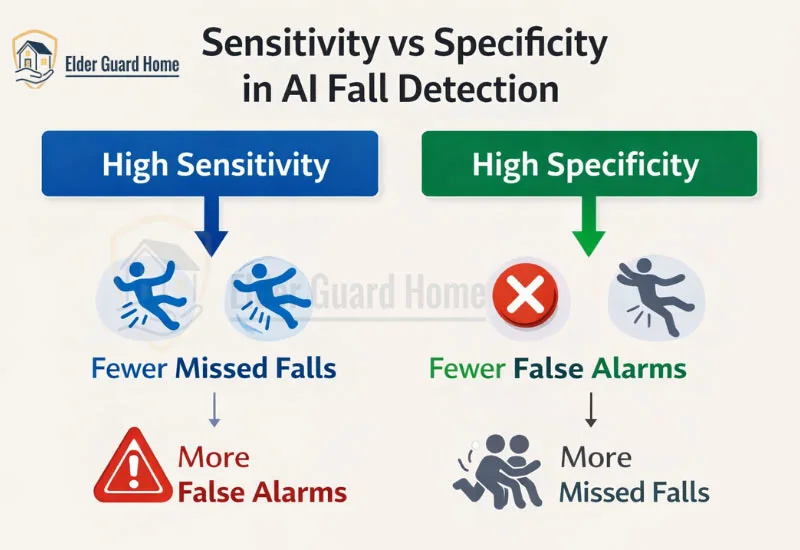
This concept is rarely explained clearly — but it’s critical.
Sensitivity measures how well a system detects actual falls.
Specificity measures how well it avoids false alarms.
High Sensitivity
Pros:
- Fewer missed falls
Cons: - More false positives
High Specificity
Pros:
- Fewer false alerts
Cons: - Possible missed falls
Balancing fall detection sensitivity vs specificity determines overall AI fall detection reliability.
Manufacturers often tune systems toward higher sensitivity — because missing a fall is more dangerous than sending a false alert.
The ideal system maintains a balanced threshold.
How AI Fall Detection Compares to Medical Alert Buttons in Error Rate
When comparing error rates:
Medical alert buttons have almost zero false positives.
But they rely entirely on the user pressing the button.
The larger issue with traditional systems is non-activation.
Studies show that many seniors fail to activate emergency buttons during real falls due to shock, confusion, or unconsciousness.
For a deeper comparison, see our article on: AI fall detection vs medical alert buttons.
Automated AI systems may produce occasional false alarms — but they remove human dependency.
How Modern AI Systems Reduce False Alarms
Early-generation fall detection systems were rigid. They relied on simple motion thresholds. If movement exceeded a certain pattern, an alert was triggered.
Modern systems are far more advanced.
Today, reducing false alarms in fall detection systems is one of the main engineering priorities for manufacturers.
Here’s how newer systems improve reliability.
Machine Learning Behavior Tracking
Instead of reacting to single movements, advanced AI systems learn normal daily patterns.
For example:
How quickly a person usually sits
How often they lie down during the day
Typical walking speed
Regular movement routes inside the home
Over time, the system adapts to the individual’s habits. This reduces unnecessary alerts caused by routine behaviors.
The longer the system runs, the more refined its detection logic becomes.
Adaptive Motion Analysis
Older systems treated every sudden motion as suspicious.
Modern AI analyzes:
Angle of descent
Speed of movement
Impact force
Post-fall immobility duration
For instance, if someone sits quickly but continues moving normally afterward, the system may suppress the alert.
True falls usually involve:
Rapid descent
Followed by unusual inactivity
This layered analysis significantly lowers false positives.
Multi-Sensor Verification
Some advanced setups combine:
Radar sensing
Computer vision
Motion detectors
Floor vibration sensors
Instead of relying on a single data source, the system verifies events across multiple inputs before triggering an alert.
If only one sensor detects a fall but others do not confirm it, the alert may be delayed or canceled.
This cross-verification model greatly improves AI fall detection reliability.
Delayed Alert Confirmation Systems
Many systems now use a short verification window.
Example:
Fall detected
10–30 second observation window
System checks if the person stands up
If no recovery movement is detected → alert is sent
This approach filters out many harmless incidents.
Two-Step Caregiver Verification
Some platforms send alerts in stages:
Stage 1: Push notification to caregiver app
Stage 2: Confirmation prompt
Stage 3: Escalation to emergency contact if no response
This layered escalation prevents unnecessary emergency dispatch while maintaining safety.
The result is smarter alert logic — not just faster alerts.
What Is an Acceptable False Alarm Rate for Families?
This is where decisions become practical.
Families often ask:
“How many false alarms are too many?”
In real-world residential environments, a 5–15% false alarm rate is generally considered typical across various AI fall detection systems.
But numbers alone don’t tell the full story.
Realistic Expectations (5–15% Range Explained)
A 5% false alarm rate means:
Out of 100 detected “fall-like events,” about five may be incorrect.
In homes with pets, multiple occupants, or high activity, that number can move toward the higher end of the range.
Context matters.
The Trade-Off Between Safety and Convenience
Higher sensitivity:
Detects more true falls
May generate more false alerts
Lower sensitivity:
Fewer false alerts
Increased risk of missed fall detection cases
Families must decide which trade-off feels safer.
Most caregivers prefer slightly higher sensitivity. Missing a real fall has greater consequences than responding to a false alert.
When False Alarms Become a Problem
False alarms become concerning when:
They happen multiple times per week
Caregivers start ignoring alerts
Emergency services are triggered unnecessarily
The senior feels anxious about constant notifications
At that point, system recalibration or repositioning is necessary.
Monitoring Fatigue
Repeated alerts can create “monitoring fatigue.”
When caregivers become desensitized, response speed drops. This defeats the purpose of having the system in place.
A well-calibrated system should strike a balance — alerting only when behavior truly deviates from normal patterns.
Limitations of AI Fall Detection Accuracy
No safety technology is perfect.
Understanding limitations prevents unrealistic expectations.
No System Is 100% Accurate
Even under controlled testing, no fall detection system achieves flawless performance.
Home environments introduce too many variables.
Complex Movements
Not all falls look dramatic.
Slow slides from a couch or gradual knee buckling can be difficult to classify.
These subtle movements sometimes lead to false negatives in fall detection.
Multiple Occupants
When more than one person is present, motion complexity increases.
Some systems struggle to differentiate between individuals without advanced tracking.
Furniture Layout Impact
Large sofas, partitions, or clutter can obstruct detection zones.
This affects both camera-based and radar-based setups.
Power or Wi-Fi Interruption
Most AI systems depend on:
Stable internet
Continuous power supply
Outages temporarily reduce monitoring reliability unless backup systems are installed.
Understanding these limitations allows families to plan accordingly.
Pros and Cons of AI Fall Detection Reliability
Here is a balanced view.
Pros
- Automatic Detection: No button pressing required. The system acts independently.
- 24/7 Monitoring: Continuous observation reduces reliance on human awareness.
- Improves Emergency Response Time: Faster detection can reduce time spent on the floor, which is critical for recovery outcomes.
Cons
- Occasional False Alerts: Even advanced systems produce some false positives in fall detection.
- Setup Sensitivity: Proper placement significantly impacts accuracy.
- Learning Curve: Caregivers may need time to adjust alert settings and understand system behavior.
Best For (Based on Reliability Needs)
Not every household has the same risk profile.
AI fall detection systems are most suitable for:
- Seniors Living Alone: No one nearby to respond quickly.
- High Fall-Risk Patients: Those with mobility issues, osteoporosis, or neurological conditions.
- Families Living Far Away: Remote monitoring provides peace of mind when daily check-ins aren’t possible.
- Not Ideal for Multi-Pet Households: Large or active pets may increase false alarm rates unless the system includes pet filtering technology.
Frequently Asked Questions
How often do AI fall detection systems give false alarms?
Most residential systems operate within a 5–15% false alarm range, depending on environment, placement, and sensitivity settings.
Can pets trigger fall detection alerts?
Yes. Medium-to-large pets can increase false positives in fall detection, particularly in motion-based systems. Advanced AI systems use filtering algorithms to reduce this issue.
What is worse: false positive or false negative?
From a safety perspective, false negatives are more serious because they involve missed fall detection cases. However, excessive false positives can cause monitoring fatigue.
Are radar systems more accurate than cameras?
Accuracy depends on installation and environment. Radar systems often perform better in low-light conditions, while camera-based systems may provide more detailed posture analysis. See our comparison of Radar vs Camera Fall Detection for deeper analysis.
Can you adjust sensitivity settings?
Many modern systems allow caregivers to adjust sensitivity levels. This helps balance fall detection sensitivity vs specificity based on the household’s needs.
Conclusion: Understanding False Alarm Rates Before You Decide
When evaluating safety technology for a loved one, reliability matters more than marketing promises.
False alarm rates in AI fall detection systems are not just technical statistics — they directly affect caregiver trust, response speed, and long-term system adoption.
A few key takeaways:
No system is 100% accurate.
Most real-world setups operate within a 5–15% false alert range.
Higher sensitivity reduces missed falls but may increase false positives.
Proper installation and calibration significantly improve performance.
The goal isn’t eliminating every false alert.
The goal is finding the right balance between safety and practicality.
For many families, an occasional false notification is a small trade-off compared to the risk of a missed fall — especially for seniors living alone or those at high fall risk.
If you’re still exploring how non-wearable systems work and whether they fit your situation, our complete guide on Non-wearable fall detection system breaks down technology types, privacy concerns, and setup considerations in detail.
Choosing a system is not about perfection.
It’s about improving response time, increasing peace of mind, and making independent living safer — without compromising dignity.