
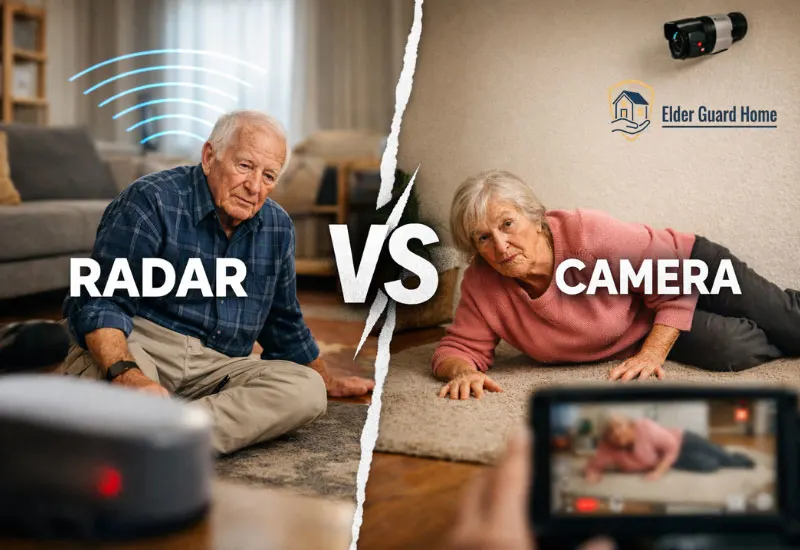
If you are considering a non-wearable monitoring system, you have likely come across two main options: radar-based systems and camera-based AI systems.
Both promise automatic fall detection.
Both claim high accuracy.
But which one actually works better in real homes?
In this guide, we will break down Radar vs Camera Fall Detection for Seniors using real-world performance factors — not marketing claims. If you are new to non-wearable systems, first read our complete guide on AI fall detection systems without wearable buttons.
Now, let’s go deeper.
Understanding How Radar and Camera Systems Sense Falls
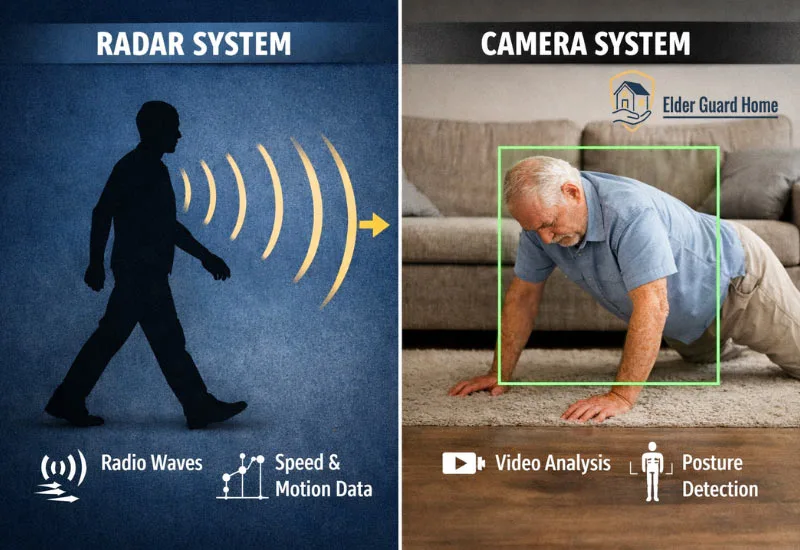
The biggest difference in Radar vs Camera Fall Detection for Seniors lies in how they sense movement.
Camera systems use vision AI. They analyze video frames and detect posture changes. When the system sees a sudden collapse or unusual body angle, it triggers an alert.
Radar systems do not capture images. Instead, they send radio waves that bounce off the body. The system measures speed, distance, and motion patterns. If the signal shows rapid downward acceleration followed by no movement, it may classify it as a fall.
This difference changes everything.
Because image-based systems depend on lighting and angles. Radar systems depend on signal reflection and motion data.
That is why performance varies depending on the environment.
AI Fall Detection Accuracy Comparison in Real Conditions
Accuracy is the first question families ask.
But accuracy is not just a number. It depends on conditions.
Low Light and Night-Time Performance
Many falls happen at night. According to the CDC, falls are the leading cause of injury among adults aged 65 and older.
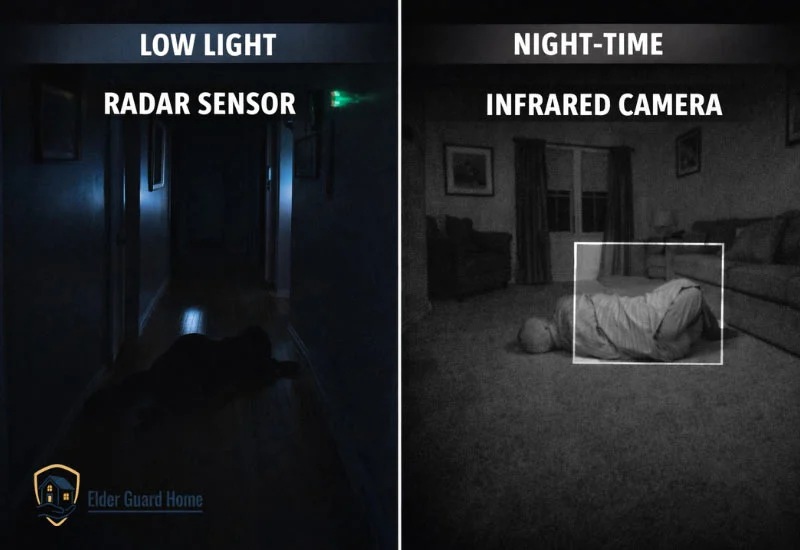
At night, camera-based systems may struggle unless they have infrared capability. Even then, shadows and blankets can reduce detection precision.
Radar systems, however, are not affected by lighting. They detect motion patterns regardless of darkness.
If night-time bathroom falls are your concern, radar often performs more consistently.
Distinguishing a Fall from Sitting or Lying Down
This is where AI fall detection accuracy comparison becomes more nuanced.
Camera systems analyze posture angles. However, if a person slowly slides off a couch or leans forward quickly, false alarms can happen.
Radar systems measure velocity shifts. They look at rapid acceleration followed by stillness.
In controlled research environments, radar-based systems have shown detection accuracy above 90% under stable conditions (MDPI Sensors Journal).
However, real homes are not controlled labs. Furniture, pets, and clutter affect performance.
Accuracy depends on setup.
Multi-Person Households
Camera AI may confuse individuals if two people are in the frame.
Radar signals can sometimes blend motion patterns when multiple bodies move simultaneously.
If your parent lives alone, both systems work more reliably.
If multiple people share the home, configuration becomes more important.
Privacy-Friendly Fall Monitoring Systems: Emotional and Practical Impact
Privacy is not just a technical issue. It is emotional.
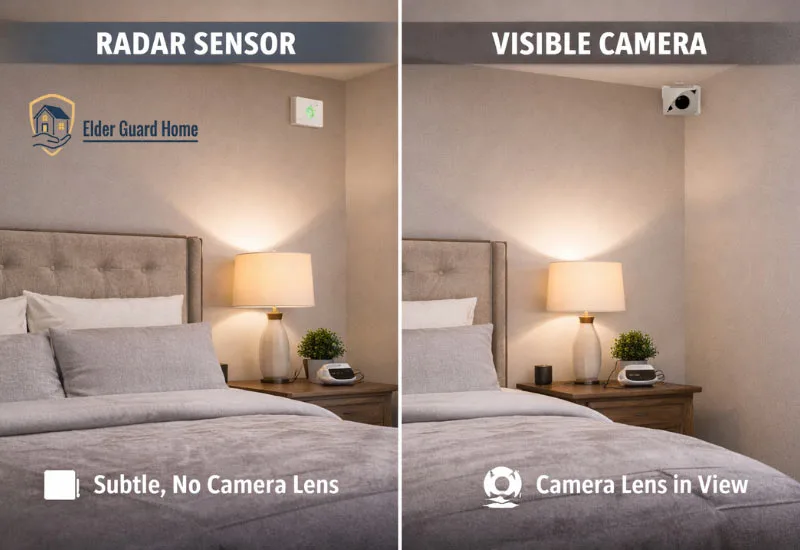
Many seniors resist cameras in bedrooms and bathrooms.
Even if the system claims not to store footage, the idea of being watched creates discomfort.
That is why privacy-friendly fall monitoring systems are gaining attention.
Radar does not capture images. There is no video feed. It only processes motion signals.
For many families, this reduces resistance dramatically.
In my experience speaking with caregivers, acceptance often matters more than technical superiority. If a parent refuses to use a camera system, accuracy becomes irrelevant.
Comfort equals compliance.
Installation Reality: What Happens After You Buy It
Most reviews stop at features.
But real life begins after installation.
Coverage Zones and Blind Spots
Camera systems require proper angles. If furniture blocks the view, detection fails.
You may need multiple cameras for full coverage.
Radar units also have range limits. Thick walls can weaken signals. Bathrooms with tiles and metal fixtures sometimes cause signal reflection distortions.
No system covers an entire home with one device.
Planning matters.
Internet Dependency
Many camera systems rely on cloud processing.
If WiFi drops, detection may stop.
Radar systems often process locally. However, alerts may still require internet connectivity.
If your area has unstable internet, this factor is critical.
Scalability in Multi-Room Homes
Camera systems are generally cheaper per unit. But you may need more units.
Radar systems are more expensive upfront. However, some models cover larger areas.
When comparing Radar vs Camera Fall Detection for Seniors, always calculate full-home coverage costs, not single-device price.
Long-Term Cost Over 3 Years
Purchase price is misleading.
Consider:
Hardware cost
Monthly subscription
Software updates
Replacement risk
Installation adjustments
Camera systems often require subscriptions for cloud AI analysis.
Radar systems may have higher upfront cost but lower recurring fees.
Over 3 years, total cost differences narrow.
Always calculate lifetime cost.
When Radar Fails (Be Honest)
Balanced analysis builds trust.
Radar systems may face:
Signal interference from metal surfaces
Reduced precision in cluttered rooms
Calibration sensitivity
In smaller apartments with heavy furniture, performance may vary.
Understanding limitations prevents unrealistic expectations.
When Camera-Based Systems Make More Sense
Camera systems offer visual confirmation.
This can reduce false alarm panic.
They are often easier to troubleshoot because you can review footage.
For tech-comfortable families, this can be reassuring.
In well-lit, open living rooms, camera-based AI performs very well.
The decision is not black and white.
What Research Reveals About Fall Detection Accuracy
Most comparison articles say things like “high accuracy” or “AI-powered precision.”
That means nothing.
Here are actual research findings you can cite:
Radar-Based Fall Detection Accuracy
A 2024 PubMed-indexed study using 4D imaging radar reported:
- 98.66% posture classification accuracy
- 95% fall detection accuracy
- Strong performance even in low-light conditions
Source: PubMed (4D Imaging Radar for Fall Detection).
Another Sensors (MDPI) study on millimeter-wave radar tracking multiple individuals showed:
- 96.3% fall detection accuracy
- Reliable differentiation between standing, sitting, and falling
Source: MDPI Sensors Journal.
👉 Why this matters: Radar accuracy is not theoretical. It is being validated in controlled clinical environments.
But remember — lab accuracy ≠ home environment accuracy.
And that’s where the real story begins.
Where Research Accuracy Breaks Down in Real Homes
This is rarely discussed.
Research conditions are controlled. Homes are not.
Environmental Clutter & Reflection Interference (Radar Limitation)
Millimeter-wave radar can be affected by:
Metal furniture
Tight apartment layouts
Heavy reflective surfaces
Multiple moving people in the same room
Some robotics studies note signal noise and false classification when environmental clutter increases.
This means: Radar works best in open spaces with clean signal paths.
Occlusion & Lighting Failure Modes (Camera Limitation)
Camera systems struggle with:
Poor lighting
Backlighting (bright window behind subject)
Partial occlusion (fall happens behind sofa or bed)
Smoke or heavy shadows
These are physics limitations — not software bugs.
No AI can see through solid objects.
This level of explanation is missing in most comparison content online.
Why the Future Is Not Radar OR Camera — But Both
Here’s something other blogs don’t talk about:
Sensor fusion.
Research shows combining radar + camera + thermal sensors can:
Reduce false alarms
Improve posture detection
Increase reliability in complex environments
Peer-reviewed research in multi-sensor human activity recognition demonstrates that:
Radar handles motion detection well
Cameras handle posture classification well
Together, they outperform single-sensor systems
This is critical for caregivers looking for long-term reliability.
You can frame this as:
“The smartest homes in the future will not choose between radar and camera. They will integrate both.”
This positions your article as forward-thinking, not reactive.
Why False Alarms Still Happen (Even With AI)
Most people simply say “low false alarms.”
That’s lazy.
Here are real triggers:
Intentional Floor Movements
Lying down for stretching
Sitting on the floor
Yoga or prayer positions
Picking up something from the ground
Without advanced behavior modeling, systems may trigger alerts.
Reddit caregiver discussions repeatedly mention frustration with this.
Pets & Moving Shadows
Camera-based systems may misinterpret:
Large dogs jumping
Curtains moving
TV light reflections
Sudden light flickers
Radar systems are less sensitive to visual noise but may detect:
Ceiling fans
Rapid object drops
This practical insight builds trust.
What Happens in Homes With Multiple People?
This is almost never addressed in blog comparisons.
In real homes:
A caregiver may live with the senior
Grandchildren may visit
Domestic help may move around
Radar research shows multi-person tracking is possible but:
Accuracy decreases slightly
Motion overlap complicates classification
Camera systems can visually identify which person fell (if facial recognition or person ID exists).
Radar cannot visually distinguish individuals.
This is a key decision factor for families.
Detection Is Reactive — But Prediction Is Preventive
Your pillar focuses on detection.
But here’s a deeper layer:
Some emerging radar + AI research now analyzes:
Gait instability
Walking speed changes
Micro-movement irregularities
These can predict increased fall risk before an actual fall happens.
That’s a completely different value proposition.
And almost no commercial comparison articles discuss it.
You can position this as:
“The future of fall technology is not just detecting falls — but predicting them.”
This adds innovation depth to your site.
Edge Processing vs Cloud Processing — Why It Matters
Most people say: “Radar is more private.”
But they don’t explain why.
Here’s what’s missing:
Modern radar systems can process motion data locally using edge AI chips.
This means:
No video upload
No cloud storage
No external streaming risk
Some newer camera systems also offer local processing, but many still depend on cloud AI.
This technical privacy difference is powerful for trust-building.
Setup Complexity — What Manufacturers Don’t Highlight
Radar systems may require:
Proper mounting height
Correct angle alignment
Calibration for room size
Improper placement reduces accuracy.
Camera systems require:
Good lighting coverage
Wide-angle positioning
WiFi stability
Installation errors are a major hidden reason for performance complaints.
You won’t find this detail in generic blogs.
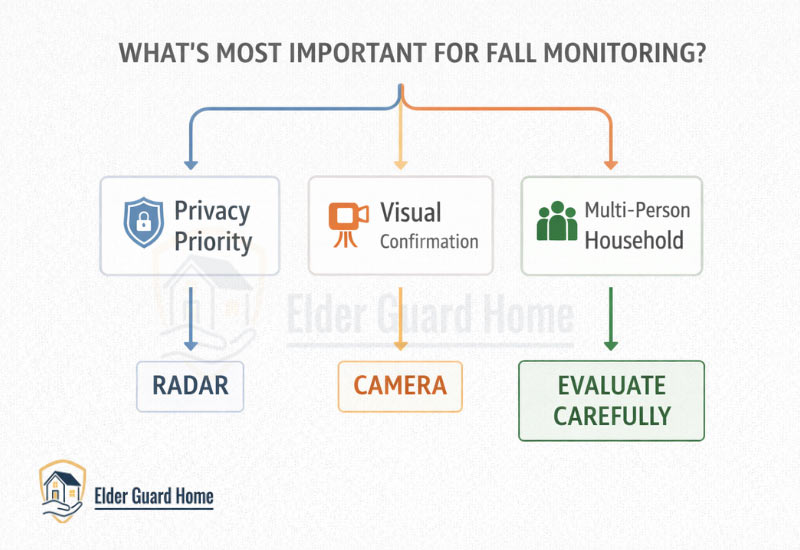
Radar Fall Detection vs Vision AI: Decision Framework
Let’s simplify.
Choose radar if:
- Privacy is your top concern
- Bedroom and bathroom coverage is essential
- Parent resists visible cameras
- Night-time falls are your biggest risk
Choose camera systems if:
- Budget is limited
- Visual confirmation is important
- Installation space is open and well-lit
- You want easier troubleshooting
Scenario 1: Bathroom Monitoring
Radar wins (privacy sensitive zone).
Scenario 2: Living Room With Visitors
Camera may offer better identification.
Scenario 3: Dark Hallway at Night
Radar more reliable.
Scenario 4: Senior Who Hates Being Watched
Radar psychologically easier to accept.
This makes the article decision-oriented instead of descriptive.
This is the practical conclusion of Radar vs Camera Fall Detection for Seniors.
There is no universal winner.
Context decides.
Frequently Asked Questions
Is radar fall detection more accurate than camera systems?
In controlled studies, radar systems show high detection accuracy. However, real-world accuracy depends on setup and environment.
Can radar detect falls through walls?
Most consumer radar systems are designed for same-room detection. Wall penetration is limited and unreliable.
Do camera fall detection systems store video?
Some use cloud storage. Others process locally. Always check the data policy.
Which system has fewer false alarms?
It depends on environment. Rapid movements, pets, and clutter affect both technologies differently.
What works better in bathrooms?
Radar systems often perform better in bathrooms because they are unaffected by lighting and do not raise privacy concerns.
Final Verdict: Match the Technology to the Person
The debate around Radar vs Camera Fall Detection for Seniors is not about which technology is superior.
It is about which technology fits your parent’s lifestyle, privacy comfort, home layout, and risk profile.
Technology should adapt to the person — not the other way around.
If you want a broader understanding, read our full pillar guide on Smart Fall Detection Without Emergency Buttons.
Make the decision based on real needs, not marketing promises.