An older adult may have enough light to move around the living room but still struggle to read a newspaper, follow a recipe, thread a needle, or check the small print on a medication label. This is one reason choosing the best task lamps for seniors requires more thought than simply buying a brighter bulb.
Ordinary ceiling lights illuminate a large area. They do not always provide enough focused light on the book, table, or small object someone is trying to see. A dedicated task lamp brings illumination closer to the activity and allows the user to direct it where it is most useful.
This can make a meaningful difference for people experiencing age-related vision changes or living with conditions that affect their sight. However, more light does not automatically mean better visibility. A poorly positioned lamp can create reflections, harsh shadows, or uncomfortable glare.
The best choice depends on what the person wants to do. Someone who reads every evening may prefer an adjustable-arm lamp. A person who enjoys sewing may benefit from a magnifying model. Someone working at a small craft table might find a clamp-on design more practical.
This guide explains how these lamps differ, what features to check before buying, and how to set up task lighting comfortably. The goal is to help older adults continue enjoying familiar activities without making their workspace difficult to use.
What Is a Task Lamp, and Why Can It Help Seniors with Low Vision?
A task lamp is a light designed to illuminate a particular working area rather than an entire room. It directs light toward an activity such as reading, writing, sewing, cooking, or examining small objects.
For an older adult with low vision, this focused illumination can be more useful than relying on a ceiling fixture alone.
Why General Room Lighting May Not Be Enough
Ceiling lights are designed to distribute light throughout a room. Depending on their location, furniture arrangement, and the direction of the light, they may leave shadows across a book or work surface.
For example, imagine someone sitting at a table to read a newspaper. An overhead light may illuminate the room, but the person’s head or hands can cast shadows across the page.
A nearby adjustable lamp can direct light onto the newspaper instead. The person can then change its position when moving from reading to writing or another activity.
The American Foundation for the Blind recommends directing light toward the activity rather than into the eyes. It also highlights the importance of controlling reflections and glare.
How Task Lighting Supports Everyday Activities
A suitable lamp can help with several activities:
Reading books, newspapers, magazines, and letters.
Writing checks, completing forms, and reviewing bills.
Sewing, knitting, embroidery, and other crafts.
Preparing ingredients and following printed recipes.
Examining small objects, labels, and instructions.
Sorting photographs, organizing documents, and working on hobbies.
Task lighting does not correct an eye condition or restore lost vision. It simply makes the working area easier to illuminate and adjust.
For a broader look at lighting throughout the home, see our guide to creating a safer home lighting arrangement for seniors.
Which Type of Task Lamp Is Best for Seniors?
There is no single lamp design that works best for every older adult. A person who reads large-print books may need something different from someone who spends hours sewing or examining small objects.
The four main styles below offer different advantages.
Adjustable-Arm and Swing-Arm Desk Lamps
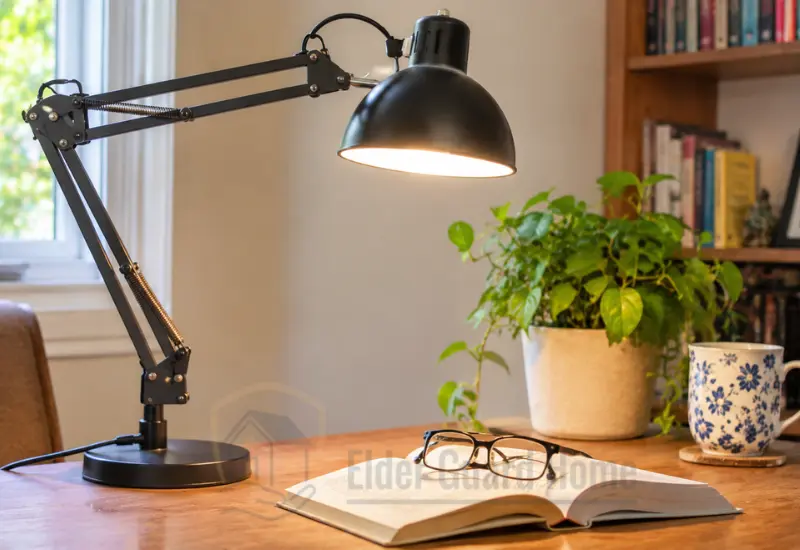
An adjustable-arm lamp is one of the most versatile choices for a reading or hobby area. Its arm moves so the user can direct light toward a book, notebook, or work surface.
Some models use hinged metal arms, while others have flexible goosenecks. Both designs allow the lamp head to move without relocating the entire fixture.
Why this style can be useful:
- The light can be moved closer to the reading material.
- The head can be angled to illuminate different areas.
- The lamp can serve several activities at the same desk.
- A shaded design can help keep the light source out of direct view.
- Some models offer adjustable brightness.
Before purchasing, check how easily the arm moves. A joint that is too stiff may be difficult for someone with arthritis, while a loose arm may gradually drop out of position.
Also examine the shade. A lamp that exposes a bright LED directly to the user’s eyes may cause discomfort even when its light output is high.
Best suited for: Reading, writing, puzzles, paperwork, and everyday close-up activities.
Buying tip: Choose a model with enough reach to illuminate the working area without requiring the user to lean forward or stretch.
Clamp-On Task Lamps for Small Tables and Craft Areas
A clamp-on task lamp attaches to the edge of a desk, shelf, or workbench. It can be useful when there is not enough room for a traditional lamp base.
Many models have adjustable arms, allowing the user to position the light above a book or craft project.
Advantages include:
- Frees up space on crowded tables.
- Can be positioned over a sewing or hobby station.
- Often provides flexible light direction.
- May be moved to another suitable surface when needed.
However, a clamp lamp needs a secure attachment point. Check the maximum table thickness specified by the manufacturer and make sure the clamp grips the surface firmly.
Look for protective padding where the clamp contacts furniture. This helps prevent scratches and may improve grip.
Do not assume that every clamp fits every table. A thick tabletop, rounded edge, glass surface, or delicate furniture may not provide a suitable mounting point.
The lamp should also remain stable when its arm is extended. If the clamp shifts or the arm swings unexpectedly, it can become frustrating or unsafe to use.
Best suited for: Sewing stations, craft tables, small desks, and workspaces with limited surface area.
Buying tip: If the person has difficulty tightening small knobs, look for a clamp mechanism that is simple to secure without excessive hand strength.
Magnifying Lamps for Reading and Detailed Work

Magnifying lamps combine a light source with a magnifying lens. They are designed to make small objects appear larger while illuminating the area being examined.
They can be helpful for activities such as embroidery, model building, examining small components, and reading certain labels.
However, a magnifying lamp is not automatically the best reading lamp for every older adult.
Important features to examine:
- Lens diameter and usable viewing area.
- Magnification strength.
- Distance between the lens and the object.
- Whether the lens distorts objects near its edges.
- Light distribution around the lens.
- Ease of moving and securing the arm.
- Whether the lens has a protective cover.
Higher magnification is not always better. Stronger magnification usually means a smaller viewing area or a shorter working distance. This can make it harder to keep a book or craft project in a comfortable position.
Some people may also find it difficult to coordinate their eyes with a magnifying lens. Others may prefer a separate stand magnifier or electronic magnifier.
The American Academy of Ophthalmology explains several types of low-vision aids, including illuminated stand magnifiers. It notes that stand-supported magnifiers can be useful when holding a magnifier steady is difficult.
Best suited for: Needlework, detailed crafts, small components, and selected close-up activities.
Buying tip: If possible, test the lens with the actual activity before purchasing. A lens that works for examining a small object may not be comfortable for reading a full page.
Tabletop and Portable Task Lamps
A tabletop task lamp is a practical choice for people who want focused lighting without a large floor fixture or complicated mounting system.
These lamps generally sit on a bedside table, desk, or other flat surface. Some have adjustable necks, folding arms, or rechargeable batteries.
Why older adults may prefer them:
- They are usually straightforward to set up.
- Many models have a compact footprint.
- Some can be moved between suitable work areas.
- They can provide convenient lighting for occasional reading.
- Rechargeable versions may reduce dependence on a nearby outlet.
The main limitation is reach. A compact lamp may not extend far enough to illuminate a large book or craft area. A lightweight base can also become unstable when the arm is extended.
Check the controls carefully. A small touch panel can be difficult to locate, especially for someone who cannot easily distinguish low-contrast buttons.
Best suited for: Bedside reading, occasional paperwork, and smaller work surfaces.
Buying tip: Choose a stable base and a lamp head that can direct light onto the page without requiring the person to move the entire fixture.
How to Choose the Right Task Lamp for the Activity
Instead of searching for one lamp that claims to do everything, start with the activity the older adult performs most often.
Different tasks require different light coverage, positioning, and sometimes magnification.
| Activity | Lamp style to consider | Important feature |
|---|
| Reading books and newspapers | Adjustable-arm or tabletop | Even illumination across the page |
| Sewing and needlework | Adjustable-arm or magnifying | Precise positioning and suitable working distance |
| Crafts and hobbies | Clamp-on or adjustable-arm | Secure mounting and flexible reach |
| Paperwork and bills | Adjustable desk lamp | Broad, controlled illumination |
| Reading small labels | Magnifying aid with task lighting | Comfortable viewing distance |
| Bedside reading | Stable tabletop lamp | Convenient, easy-to-reach controls |
Reading Books and Newspapers
For regular reading, look for a lamp that illuminates the entire page rather than producing one very bright spot.
An adjustable-arm lamp can be particularly useful because the user can move the light when turning pages or changing the reading position.
If the person uses large-print books, the lamp may not need a magnifier. A comfortable reading position and well-distributed light may be more important.
Sewing, Knitting, and Needlework
Detailed crafts often require light to reach a relatively small working area.
An adjustable-arm lamp can help illuminate the fabric, thread, and needle. A magnifying model may be useful when the person needs additional enlargement.
Check that the lamp arm does not interfere with hand movement. The light should reach the work without creating a bright reflection on shiny needles, scissors, or other tools.
Cooking and Recipe Reading
A small tabletop lamp may help illuminate a printed recipe or handwritten notes. However, electrical lamps should be kept away from water, heat, cooking splashes, and areas where they could be knocked over.
For regular food preparation, properly installed under-cabinet or fixed task lighting may be more suitable than a freestanding desk lamp.
Our guide to making a kitchen more accessible for seniors covers other practical changes that can make everyday kitchen activities easier.
Paperwork, Bills, and Medication Labels
For paperwork, choose a lamp that covers a reasonably wide area. A narrow beam may illuminate one line while leaving the rest of the document dark.
For medication labels, a lamp may improve illumination, but it cannot enlarge small print. A suitable magnifier, large-print instructions, or help from a pharmacist may be necessary.
Never rely on a magnifying lamp alone to identify medication when the label remains difficult to read.
What Features Should You Look for in a Task Lamp for Seniors?
A lamp may look attractive in a product photograph but still be inconvenient in everyday use. The following features deserve attention before making a purchase.
Adjustable Arm and Shade
The lamp should allow the user to direct light onto the work without moving the book, chair, or entire table.
Check:
Whether the arm reaches the intended working area.
Whether the head tilts and rotates easily.
Whether the joints stay in position.
Whether the shade blocks direct views of the light source.
Whether the arm can be adjusted without excessive force.
A flexible neck is not automatically better than a hinged arm. Some goosenecks require considerable effort to bend, while others may not hold their position reliably.
The best design is one the person can adjust comfortably and consistently.
Adjustable Brightness and Useful Light Levels
A dimmable lamp gives the user more control over illumination.
Someone reading a matte book may prefer a different setting from someone examining a glossy photograph or working with shiny craft materials.
Look for:
More than one useful brightness setting.
Controls that are easy to understand.
Smooth dimming when available.
A setting that can be reached without awkward stretching.
Do not judge a lamp by its wattage alone. Wattage describes electrical power consumption, not how much light reaches the page.
Even a lamp with high advertised output may produce poor results if its beam is narrow, its head is poorly positioned, or its light creates reflections.
Glare Control and Diffused Lighting
Glare is one of the most important issues to consider when choosing task lighting for someone with low vision.
It can come from a directly visible bulb, a shiny desk, glossy paper, glass, or a magnifying lens.
A lamp should illuminate the object rather than shine toward the user’s face.
Look for a shade that covers the light source and directs illumination downward. Diffused lighting may also help reduce harsh bright spots.
During setup, check the page from the person’s normal sitting position. If a bright reflection appears when the person looks down, move or angle the lamp until the reflection is reduced.
For additional guidance, the Macular Society’s home lighting advice explains why task lamps should be positioned below eye level and directed toward the activity.
Stable Base and Safe Construction
Stability matters because an older adult may adjust the lamp several times during a reading or craft session.
A wide or weighted base can help prevent tipping. However, a very heavy lamp may be difficult to move.
Consider the following:
A base wide enough for the lamp’s extended arm.
A firm clamp for clamp-on models.
A shade that does not become loose during adjustment.
A cord that can be routed away from walking paths.
A suitable location away from water and heat.
A lamp that does not obstruct access to the desk or chair.
Avoid placing a lamp close to the edge of a table where it could be knocked onto the floor.
Simple Controls That Are Easy to Reach
A complicated control panel can make an otherwise good lamp difficult to use.
Some models use touch controls, while others have switches, buttons, or rotary dimmers.
Consider whether the person can:
Find the power switch without searching.
Recognize the brightness settings.
Operate the control without a tight grip.
Reach the switch while seated.
Understand whether the lamp is on or off.
Large, clearly marked controls may be easier to use than small touch-sensitive panels.
If the user has reduced hand strength or finger sensitivity, test the actual control before buying. A lamp that requires pressing a tiny button several times may not be a practical choice.
How to Position a Task Lamp Without Creating Glare or Shadows
Even a well-designed lamp can be uncomfortable when positioned incorrectly. Its location affects how much light reaches the work and whether the user’s hands create distracting shadows.
A few simple adjustments can improve the setup.
Position the Light on the Opposite Side of Your Writing Hand
A useful starting point is to position the lamp opposite the hand used for writing or detailed work.
This arrangement can reduce shadows cast by the hand across the page.
It is only a starting point. The best position may change depending on the person’s seating arrangement, stronger-seeing eye, and the direction of the task.
The APH ConnectCenter lighting guide also recommends placing the light opposite the working hand and keeping the light source shielded from direct view.
Keep the Light Below Eye Level and Aim It at the Work
The lamp should illuminate the page or object rather than shine directly into the person’s eyes.
Start by positioning the shade below eye level. Angle the lamp head toward the task and adjust its distance until the work surface is comfortably illuminated.
Do not place the light so close that it becomes an obstacle or causes excessive brightness in one small area.
The person should be able to sit naturally without leaning forward, twisting their neck, or repeatedly moving the lamp.
Keep Some General Room Lighting On
A task lamp should not usually be the only source of light in a dark room.
A brightly illuminated page surrounded by a very dark room can create an uncomfortable contrast when the person looks away from the task.
Keep suitable general lighting on while using the task lamp. The aim is to provide comfortable illumination around the activity, not just one bright spot.
The Macular Society recommends combining task lighting with background lighting to help reduce glare and visual fatigue.
Test the Position Before Settling on It
Do not assume that a lamp is correctly positioned just because it looks good from across the room.
Try this simple test:
Place a book, document, or craft material where the person normally works.
Switch on the general room lighting and the task lamp.
Aim the lamp at the work surface, keeping the light source out of direct view.
Check for reflections, dark shadows, and uneven illumination.
Ask the person to read or work for several minutes.
Adjust the lamp until the position feels comfortable.
The person should be able to see the work without leaning awkwardly or repeatedly adjusting the fixture.
What Brightness and Color Temperature Should a Task Lamp Have?
There is no single brightness or color temperature that suits every older adult with low vision.
Some people need more illumination for close work. Others experience discomfort from bright light or glare and may prefer a lower setting.
A useful approach is to choose a lamp with adjustable brightness and test it during the actual activity.
Understand Light at the Work Surface
A lamp’s lumen rating describes the amount of light it produces. It does not tell you exactly how much illumination reaches a book or tabletop.
The distance between the light source and the work surface, the beam shape, the shade, and the direction of the light all affect the result.
For this reason, lux measurements at the working surface can be more useful than relying on a bulb’s wattage or a product’s brightness claim alone.
Prevent Blindness discusses a possible task-lighting range of approximately 1,000–2,000 lux at 12 inches in its low-vision lighting guidance. This should be treated as a reference for consideration, not a prescription for every person. Individual needs and comfort vary.
Choose a Comfortable Color Appearance
Some people prefer warmer light, while others find neutral or cooler light more useful for particular activities.
A dimmable lamp with suitable color options can provide flexibility. However, changing color temperature does not automatically solve glare or poor positioning.
If you want to understand lumens, Kelvin ratings, CRI, and bulb compatibility in more detail, read our guide to choosing the best LED light bulbs for seniors.
The most important test is whether the person can comfortably see the task without reflections, harsh brightness, or distracting shadows.
Best Task Lamps for Seniors — What to Compare Before Buying
Choosing a lamp is easier when you compare products by their intended use rather than by marketing claims.
The following are established product lines and models worth comparing. They represent different lamp styles; they are not a claim that one model has been clinically proven to improve vision or that every version has identical features.
Product specifications, available finishes, controls, and Amazon listings can change. Check the exact model and current manufacturer information before purchasing.
1. OttLite Soft Touch and LED Task Lamps
Category: Reading and general close-up work
OttLite offers several desk and task lamp designs. Some models provide adjustable positioning and integrated LED illumination.
These are worth comparing for someone who wants a dedicated desk lamp for reading, writing, or hobbies.
What to check before buying:
The exact model’s brightness settings.
Whether the neck or arm reaches the work comfortably.
Whether the shade shields the light source.
The location and ease of the power controls.
Whether the lamp has a suitable base for the intended table.
Buy OttLite LED task lamp
2. Daylight Company Duo LED Desk Lamp
Category: Adjustable desk lighting
The Daylight Company sells desk and task lighting intended for activities that require focused illumination.
Its Duo LED desk lamp is one model worth comparing for a reading or hobby area.
Before buying, confirm the precise version, its light settings, arm adjustment, base stability, and control arrangement. Do not assume that specifications from another Daylight model apply to this one.
Check Daylight Duo LED desk lamp
3. Luxo LS-1 Clamp-On Lamp
Category: Clamp-on task lighting
The Luxo LS-1 is a recognizable adjustable clamp-on lamp design. It may suit a workspace where a conventional base would occupy too much room.
Its main attraction is the ability to attach the lamp to a suitable work surface and position its arm over the activity.
What to check before buying:
Table thickness and clamp compatibility.
Available arm reach.
Ease of adjusting the lamp head.
Stability when the arm is extended.
Whether the light source is sufficiently shielded.
Search Luxo LS-1 clamp-on lamps
4. Daylight MAG S Magnifying Lamp
Category: Magnifying close-up work
The Daylight MAG S is a magnifying lamp model worth considering for detailed hobbies and close-up tasks.
A magnifying lamp combines illumination and enlargement, but the correct lens strength and working distance are important.
Before purchasing, check the exact lens specification, lens diameter, working distance, light settings, and whether the lamp can be positioned without creating reflections.
Buy Daylight MAG S magnifying lamp
5. Brightech LightView Magnifying Lamp
Category: Magnification and craft work
Brightech’s LightView range includes magnifying lamp designs intended for close-up activities.
These may be worth comparing for sewing, crafts, and other hobbies where the user needs both illumination and enlargement.
Pay particular attention to the lens strength, lens size, arm stability, and whether the base or clamp suits the workspace.
Buy Brightech LightView magnifying lamps
Comparison: Which Lamp Style Should You Choose?
| Lamp option | Main use | What to check |
|---|
| OttLite LED task lamp | Reading and everyday desk activities | Brightness controls and adjustable reach |
| Daylight Duo LED desk lamp | Reading and hobby work | Light settings and base stability |
| Luxo LS-1 | Small or crowded workspaces | Clamp fit and arm reach |
| Daylight MAG S | Detailed close-up work | Lens strength and viewing distance |
| Brightech LightView | Crafts and magnification | Lens size and positioning |
My buying recommendation: Start with an adjustable-arm task lamp if the older adult mainly reads, writes, or completes paperwork. Consider a magnifying lamp only when the activity genuinely requires enlargement. For a small craft table, a secure clamp-on model may be more practical than a large desk lamp.
Do not choose a product simply because it advertises the highest brightness or magnification. Comfort, positioning, and ease of operation matter just as much.
A 5-Minute Task Lamp Comfort Test Before You Buy
Product photographs cannot show whether a lamp will work comfortably in a particular home.
If possible, test the lamp with the person who will use it. This short check can reveal problems that are easy to overlook when shopping online.
Step 1: Use the Actual Reading or Craft Material
Place a newspaper, book, sewing project, or document on the table.
Use the same chair and working position the person normally uses. A lamp that works at one desk height may not work at another.
Step 2: Check the Light Coverage
Switch on the lamp and examine the entire work area.
Look for dark corners, narrow bright spots, and uneven illumination. The light should reach the area the person actually uses.
Step 3: Look for Glare and Reflections
Check the surface from the user’s normal viewing position.
If the light reflects off glossy paper, glass, or a shiny tabletop, change the lamp’s angle or position.
The light source should not shine directly into the person’s eyes.
Step 4: Adjust the Arm
Move the lamp head to several useful positions.
It should move without excessive force and stay where it is placed. If it drops, swings, or requires uncomfortable reaching, it may not be suitable.
Step 5: Test the Controls
Ask the person to switch the lamp on and off and change its brightness.
Check whether the buttons or switches are easy to find and operate. The person should not need to stand up, reach behind the lamp, or ask for assistance every time the light needs adjusting.
A lamp that passes these checks is more likely to be useful in everyday life than one chosen only by its advertised features.
Common Mistakes to Avoid When Buying a Task Lamp
A few purchasing mistakes can make an otherwise attractive lamp inconvenient for an older adult.
Buying the Brightest Lamp Without Checking Glare
More brightness does not guarantee better visibility.
A powerful lamp can produce uncomfortable reflections if its light is directed toward the eyes or a shiny surface.
Choose a model with adjustable output and a shade that controls the direction of the light.
Choosing a Fixed Lamp That Cannot Reach the Work Area
A fixed lamp may illuminate the wrong part of the table.
If the person changes activities, the light may not reach the new working position.
An adjustable arm or neck offers more flexibility.
Selecting a Magnifying Lamp Without Checking the Working Distance
A magnifying lens needs to be used at an appropriate distance.
If the user has to lean forward or hold the object in an uncomfortable position, the lamp may not be a good match.
Test the magnification with the actual activity whenever possible.
Buying a Clamp Lamp Without Measuring the Table
A clamp that does not fit the table securely can slip or become unstable.
Measure the table thickness and compare it with the manufacturer’s clamp specifications.
Ignoring the Size and Placement of Controls
Tiny buttons, poorly marked switches, and difficult touch panels can make daily use frustrating.
Check the control layout before purchasing.
Forgetting About Cords and Placement
A lamp cord should not hang across a walking route or create a snagging hazard.
Keep the lamp on a stable surface and route its cable safely.
Assuming One Lamp Will Solve Every Vision Problem
A task lamp can improve illumination, but it cannot correct every type of vision difficulty.
Some people need magnification, contrast adjustments, specialized devices, or professional vision rehabilitation.
When a Task Lamp Is Not Enough
Lighting changes can make certain activities easier, but persistent difficulty seeing should not automatically be treated as a lighting problem.
An older adult may continue struggling even after trying a brighter lamp, changing its position, or adding magnification.
Pay attention if the person:
Cannot read familiar print despite comfortable lighting.
Frequently loses their place while reading.
Has difficulty recognizing objects or faces.
Notices distorted, missing, or blurred areas of vision.
Experiences increasing sensitivity to light.
Cannot identify medication labels or everyday household items.
These problems may require an eye examination and an assessment of the person’s specific vision needs.
An eye-care professional or low-vision rehabilitation specialist can recommend suitable aids. Depending on the person’s needs, these may include handheld magnifiers, stand magnifiers, electronic video magnifiers, large-print materials, or contrast-enhancing tools.
The National Eye Institute’s low-vision information explains that low-vision services and assistive devices can help people make better use of their remaining sight.
Sudden vision loss, a sudden increase in flashes or floaters, a dark curtain-like shadow, or sudden severe eye pain needs urgent medical attention. Do not try to solve new or sudden symptoms by changing the lamp.
Improve Visibility Throughout the Home
A task lamp addresses one activity area. Other parts of the home may need different lighting arrangements.
For example, nighttime movement requires a different approach from reading at a desk. Our guide to night lights for elderly adults explains how to improve visibility along nighttime routes.
Similarly, bathroom lighting is only one part of preventing slips and falls. See our bathroom fall prevention guide for seniors for additional safety measures.
FAQ
Final Thoughts: Choose a Task Lamp Around the Person and the Task
The best task lamps for seniors are not necessarily the brightest, most expensive, or most complicated models. They are the ones that make a particular activity easier without creating new difficulties.
An adjustable-arm lamp can be a practical choice for regular reading and paperwork. A clamp-on model can save space at a craft table. A magnifying lamp may help with detailed hobbies, while a compact tabletop design can provide convenient light for occasional use.
Before buying, pay attention to the lamp’s reach, shade, brightness controls, stability, and ease of operation. If possible, test it with the actual activity and adjust its position until the light feels comfortable.
Most importantly, involve the older adult in the decision. Their vision, preferences, and daily routine should guide the choice.
Good task lighting can support independence and make familiar activities more enjoyable. When lighting alone does not solve the problem, an eye-care professional or low-vision specialist can help identify other useful options.