
Choosing a light bulb for an older adult may seem like a simple household task. However, the wrong bulb can make everyday activities less comfortable.
An older adult may struggle to read small labels, recognize objects, prepare meals, or see clearly in a dim room. Simply installing the brightest available bulb does not always solve these problems. Harsh light and direct glare can make visibility uncomfortable.
That is why choosing the best LED light bulbs for seniors requires more attention than checking the wattage printed on a package.
You should understand four important specifications: lumens, color temperature, color rendering index (CRI), and dimmer compatibility. These details help you compare bulbs and choose lighting that suits different rooms.
The right choice can make reading, cooking, dressing, and moving around the home more comfortable.
In this guide, we explain how to choose LED light bulbs for elderly adults, compare practical options from established manufacturers, and highlight mistakes worth avoiding before purchasing.
What Makes an LED Light Bulb Suitable for Seniors?
A suitable LED bulb should provide enough light for the activity without creating uncomfortable brightness. It should also distribute light appropriately and work safely with the existing fixture.
Older adults do not all have the same vision needs. Some prefer warmer lighting, while others find neutral white lighting easier for detailed tasks.
Consider these four features before buying.
Comfortable Brightness Without Harsh Glare
Many people need more light as they get older. However, increasing brightness without considering the fixture can create another problem.
A bare bulb may shine directly into someone’s eyes. A reflective surface can also produce uncomfortable glare.
Look for bulbs that work well with diffusers, lampshades, or enclosed fixtures. These can help spread light more comfortably.
A frosted bulb may be preferable to a clear bulb when the light source remains visible. However, the fixture’s design and bulb position also matter.
Even Light Distribution Throughout the Room
A room can have a bright ceiling light and still contain dark corners.
This happens when one fixture cannot distribute light evenly across the entire space. Furniture, wall colors, ceiling height, and fixture design all affect the result.
Multiple suitable light sources may provide better coverage than one extremely powerful bulb.
For example, a living room might benefit from a ceiling fixture and a separate reading lamp.
Good Color Rendering
Some LED bulbs make colors appear dull or slightly different from their natural appearance.
A higher color rendering index can help colors look more accurate. This can be useful when selecting clothing, preparing food, reading labels, or completing grooming tasks.
We explain CRI in more detail below.
Simple and Reliable Operation
Older adults may find complicated lighting controls frustrating.
A standard bulb with an ordinary wall switch may be more practical than a smart bulb requiring an application and internet connection.
If dimming is important, choose a compatible dimmable bulb and control. Do not assume every LED works with an existing dimmer.
How Bright Should LED Light Bulbs Be for Seniors?
There is no single brightness level that works for every older adult or every room.
The most useful measurement when comparing bulbs is lumens. Lumens describe the amount of visible light produced by a bulb.
A higher lumen rating generally means more light output.
Understand Lumens Instead of Relying on Watts
Many people grew up choosing incandescent bulbs by wattage.
For example, someone might ask for a 60-watt bulb when replacing an old household light. With LEDs, this approach can be confusing.
Watts measure electricity consumption, not brightness. Lumens measure light output.
An LED bulb using approximately 8–10 watts may provide brightness similar to an older 60-watt incandescent bulb.
Here is a simple reference:
| Incandescent equivalent | Approximate LED brightness |
|---|---|
| 40 watts | 450 lumens |
| 60 watts | 800 lumens |
| 75 watts | 1,100 lumens |
| 100 watts | 1,600 lumens |
These are approximate comparisons. Always check the actual lumen rating on the product packaging.
For example, an 800-lumen bulb is a common replacement for a traditional 60-watt household bulb.
If an older adult finds the existing room too dim, replacing an old bulb with a suitable higher-lumen option may help. However, first check the fixture’s maximum rating and the manufacturer’s instructions.
Choosing Brightness for Different Rooms
Different activities need different lighting arrangements.
The following suggestions are starting points, not medical requirements.
| Room | Practical consideration |
|---|---|
| Living room | Comfortable ambient lighting with additional reading light |
| Bedroom | Softer general lighting and a separate bedside lamp |
| Kitchen | Sufficient light for food preparation and reading labels |
| Bathroom | Even illumination around mirrors and grooming areas |
| Hallway | Consistent lighting without dark gaps |
| Entryway | Clear visibility around doors, steps, and obstacles |
Do not assume that one 1,600-lumen bulb is automatically better than two appropriately positioned 800-lumen bulbs.
The second arrangement may distribute light more evenly, depending on the room and fixtures.
Why Multiple Light Sources May Work Better Than One Powerful Bulb
Imagine an older adult reading in a living room.
The ceiling light illuminates the room, but the person’s book remains difficult to see. Installing a much brighter ceiling bulb might create glare without improving the reading experience enough.
A better solution may be a comfortable ceiling light combined with an adjustable reading lamp.
This provides light where it is needed without making the entire room unnecessarily bright.
For more ideas about room-by-room lighting improvements, see our guide to safe home lighting design for seniors.
What Color Temperature Is Best for Seniors?
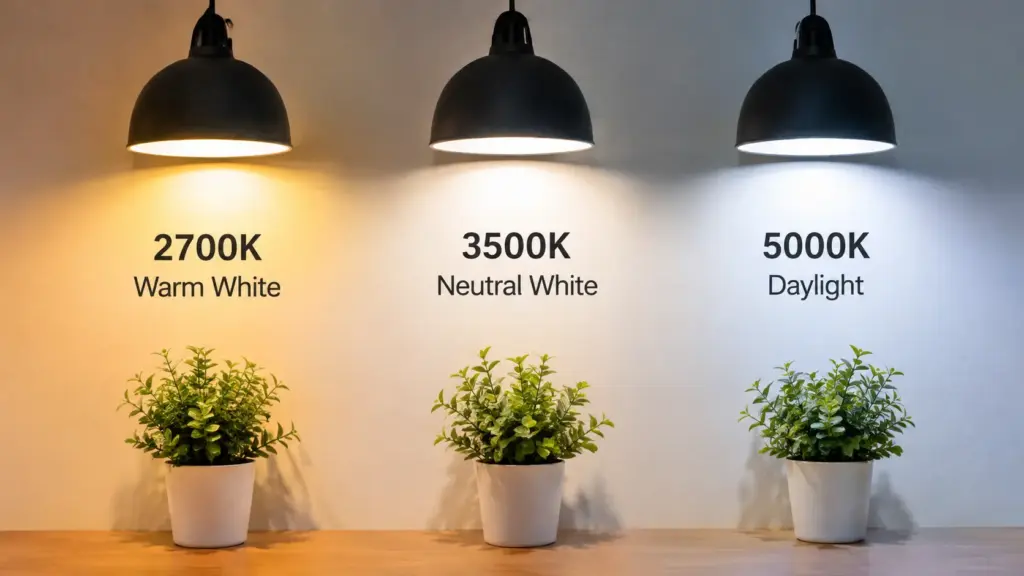
Color temperature describes whether a bulb produces warm, neutral, or cool-looking white light.
It is measured in Kelvin (K).
A lower Kelvin number produces a warmer, more yellow appearance. A higher number produces a cooler, whiter appearance.
Choosing the right color temperature can improve personal comfort. However, no single Kelvin rating is best for every older adult.
Warm White LED Bulbs (2700K–3000K)
Warm white lighting has a soft yellowish appearance.
Many people prefer it in living rooms, bedrooms, and dining areas because it creates a familiar, comfortable atmosphere.
Warm white bulbs can also work well in table lamps and floor lamps with suitable shades.
For an older adult who finds cool lighting unpleasant, starting with 2700K or 3000K may be worth considering.
However, warm lighting is not automatically better for everyone. Personal preference and the actual task matter.
Neutral White LED Bulbs (3500K–4000K)
Neutral white light appears less yellow than warm white lighting.
Some people prefer it for kitchens, work areas, and spaces where they need to distinguish details.
It can provide a useful middle ground between warm and cool lighting.
For example, a caregiver might choose 3000K lighting for a living room and 4000K lighting for a kitchen work area.
Cool White and Daylight Bulbs (5000K and Above)
Daylight bulbs produce a cooler, whiter appearance.
Some people find this useful for particular work areas. Others find it harsh or uncomfortable, especially when the bulb is exposed or positioned directly within their field of vision.
Do not assume that a 5000K bulb provides better visibility simply because it looks whiter.
A comfortable 3000K bulb with good placement may work better for one person than a cooler bulb with direct glare.
2700K vs. 3000K vs. 4000K: Which Should You Choose?
Use this comparison as a starting point:
| Color temperature | Appearance | Possible applications |
|---|---|---|
| 2700K | Warm, yellowish white | Bedrooms, living rooms, table lamps |
| 3000K | Soft warm white | General household lighting |
| 3500K | Balanced white | Kitchens and multipurpose spaces |
| 4000K | Neutral white | Work surfaces and detailed activities |
| 5000K | Cool daylight white | Selected task areas where preferred |
The best approach is to test one bulb before replacing every light in the house.
Pay attention to how the light looks from normal sitting and standing positions. Also check whether it creates reflections on televisions, glossy countertops, mirrors, or other surfaces.
Why CRI Matters When Choosing LED Bulbs for Older Adults

Brightness is not the only factor affecting how clearly people see objects.
Color rendering also matters.
A bulb may produce plenty of light but still make colors appear less natural.
What Is Color Rendering Index?
Color Rendering Index, commonly called CRI, measures how accurately a light source reveals colors compared with a reference light source.
The scale generally runs from 0 to 100. Higher values indicate more accurate color rendering.
For ordinary household lighting, CRI 80 or above is a reasonable starting point.
For activities where accurate color recognition matters, a CRI of 90 or above may be worth considering.
Is CRI 80 or CRI 90 Better?
Both can be suitable, depending on the activity and budget.
A CRI 80 bulb may work well for general room illumination.
A higher-CRI bulb can make colors appear more natural. This may be useful in kitchens, bathrooms, wardrobes, and reading areas.
For example, a person choosing clothing may appreciate lighting that shows fabric colors more accurately.
However, CRI does not measure brightness. A 90-CRI bulb is not necessarily brighter than an 80-CRI bulb.
Always compare both specifications separately.
When Better Color Rendering Is Particularly Useful
Consider higher-CRI lighting in places where color recognition matters:
Reading food packaging and labels
Choosing clothing
Preparing meals
Matching household items
Grooming and applying makeup
Completing crafts and hobbies
For these activities, color accuracy can make everyday tasks easier to manage.
How to Choose LED Bulbs That Reduce Glare and Flicker
A bulb may have excellent specifications but still create an uncomfortable lighting experience.
Glare and flicker deserve attention when choosing LED light bulbs for seniors.
Choose Frosted Bulbs Instead of Exposed Bright LEDs
A clear bulb can expose the bright LED light source directly.
This may be uncomfortable when the bulb is visible from a chair, bed, or walking route.
Frosted bulbs can diffuse light and reduce the harsh appearance of individual light sources.
A suitable lampshade or diffuser can also help.
Before buying, consider where the bulb will sit and whether someone will look directly toward it during ordinary activities.
Check for Flicker and Poor Light Quality
Some LED bulbs produce noticeable or less noticeable fluctuations in light output.
This is commonly described as flicker or temporal light modulation.
A bulb may appear steady to the eye while still producing measurable fluctuations.
Poor-quality electronics, unsuitable dimmers, and incompatible controls can contribute to lighting problems.
When comparing bulbs:
Choose products from manufacturers that provide clear specifications.
Look for credible independent testing where available.
Check manufacturer information about flicker performance.
Pay attention to buzzing, visible pulsing, or inconsistent brightness.
Replace a bulb that repeatedly behaves abnormally after checking compatibility.
Avoid treating the words “flicker-free” on a product listing as proof of zero light modulation under every operating condition.
Match LED Bulbs With Compatible Dimmer Switches
Not every LED bulb works properly with every dimmer.
An older dimmer designed for incandescent bulbs may cause a new LED to flicker, buzz, or fail to dim smoothly.
Before purchasing a dimmable LED bulb, check:
Whether the bulb is explicitly marked dimmable.
Whether the existing dimmer supports LED loads.
Whether the bulb manufacturer lists compatible dimmer models.
Whether the minimum and maximum load requirements are satisfied.
If the problem continues, ask a qualified electrician to inspect the dimmer and wiring.
Do not open a switch or attempt electrical repairs yourself.
Check Bulb Shape, Base, and Fixture Compatibility Before Buying
A bulb with excellent lighting specifications may still be unsuitable for an existing fixture.
Check its shape, base, voltage, and fixture requirements before ordering.
Common LED Bulb Shapes and Their Uses
These are common bulb styles found in U.S. homes.
A19 bulbs: Standard household bulbs commonly used in table lamps, floor lamps, and ceiling fixtures.
BR30 bulbs: Often used in recessed ceiling fixtures where a wider, directional light pattern is needed.
PAR bulbs: Directional bulbs commonly used in spotlights and selected outdoor or indoor fixtures.
Globe bulbs: Rounded bulbs frequently used in bathroom vanity fixtures and decorative fittings.
Candelabra bulbs: Smaller bulbs used in chandeliers and decorative fixtures.
Check the fixture instructions before selecting a replacement. Similar-looking bulbs may have different dimensions or light distribution.
Check the Bulb Base and Socket
E26 is a common medium screw base used in U.S. household fixtures.
However, not every fixture uses E26.
Some lamps use smaller E12 candelabra bases, while others use different fittings.
Check the existing bulb or fixture label before purchasing.
Never force a bulb into a socket that does not match.
Check Enclosed Fixture and Wattage Requirements
Some LED bulbs are not suitable for fully enclosed fixtures.
Heat can build up inside an enclosed fitting and may affect bulb performance or lifespan.
If the fixture is enclosed, choose a bulb explicitly rated for that use.
Also check the fixture’s maximum wattage and electrical requirements. Follow the manufacturer’s instructions rather than assuming that every LED replacement is suitable.
The Best LED Light Bulbs for Seniors: Our Recommended Options
There is no single best bulb for every older adult.
The following options cover different household needs, including warm lighting, higher color rendering, greater brightness, and adjustable color temperature.
Product specifications and Amazon listings can change. Check the exact model and variant before purchasing.
1. Philips Ultra Definition A19 LED — Best for Warm, Natural-Looking Light
Best for: Living rooms, bedrooms, and everyday household fixtures.
The Philips Ultra Definition A19 is worth considering for people who prefer warm white lighting with good color rendering.
The 60-watt-equivalent version produces approximately 850 lumens, uses a standard E26 base, and has a 2700K color temperature.
The published specifications for the EJD3013941 version include a CRI of 95 and dimmable Warm Glow performance.
Why consider it:
Warm 2700K light
Approximately 850 lumens
High CRI rating
Dimmable Warm Glow feature
Standard A19 shape and E26 base
Possible limitation: Its 800-lumen output may not provide enough light by itself in a large room. A different bulb or additional lighting may be necessary.
Amazon: Find Philips Ultra Definition A19 LED bulbs on Amazon
Check that the listing matches the intended 800-lumen, 2700K, high-CRI version.
2. GE Relax HD A19 LED — Best for Comfortable Bedroom and Living Room Lighting
Best for: Bedrooms, family rooms, and dining areas.
The GE Relax HD A19 is another option for people who prefer soft white lighting.
The 60-watt-equivalent model is specified at approximately 800 lumens and 2700K. GE lists a CRI of 90 for the referenced model.
It is also designed to work with compatible dimmer switches.
Why consider it:
Soft white 2700K appearance
Approximately 800 lumens
CRI 90 specification
Dimmable versions available
Familiar household bulb design
Possible limitation: The warm appearance may not be everyone’s preference for kitchen preparation or detailed work.
Amazon: Find GE Relax HD A19 LED bulbs on Amazon
Confirm the package quantity and exact model specifications before ordering.
3. Cree Lighting A19 100W Equivalent LED — Best for Higher Light Output
Best for: Larger rooms and areas where a higher lumen output is appropriate.
Some older adults need more light for everyday activities.
The Cree Lighting A19 100-watt-equivalent model offers approximately 1,600 lumens, a 5000K daylight color temperature, and a published CRI rating above 90.
It is a dimmable LED option for compatible fixtures.
Why consider it:
Approximately 1,600 lumens
Higher output than a standard 800-lumen bulb
5000K daylight appearance
CRI above 90
Dimmable design
Possible limitation: Its cool daylight appearance may feel too harsh for some people, especially in bedrooms or living rooms. It is also important to check whether the fixture can accommodate this bulb.
Amazon: Find Cree Lighting A19 100W equivalent LED on Amazon
Do not choose this bulb simply because it has more lumens. Consider the room, fixture, and user’s comfort first.
4. Philips WiZ Tunable White A19 — Best for Adjustable Color Temperature
Best for: People who want to change the light appearance for different activities.
A tunable white smart bulb allows users to select different color temperatures rather than staying with one fixed shade of white.
The Philips WiZ A19 range includes options with adjustable white light. The specific model and generation determine its lumen output, CRI, connectivity, and dimming features.
This can be useful when someone prefers warmer light in the evening but a more neutral appearance for daytime activities.
Why consider it:
Adjustable white-light settings
Convenient brightness controls
Different lighting preferences throughout the day
Smart-home control options on compatible models
Possible limitation: Smart bulbs may require an application, network connection, and setup. They may not be suitable for someone who prefers simple wall-switch operation.
Also, check whether the bulb retains its settings after the wall switch is turned off.
Amazon: Find Philips WiZ tunable white A19 bulbs on Amazon
Check the exact generation, brightness, and color-temperature range before purchasing.
Product Comparison at a Glance
| Product | Best for | Brightness | Color temperature | Notable feature |
|---|---|---|---|---|
| Philips Ultra Definition A19 | Warm everyday lighting | 800 lm | 2700K | CRI 95 |
| GE Relax HD A19 | Bedrooms and living rooms | 800 lm | 2700K | CRI 90 |
| Cree Lighting A19 | Higher light output | 1,600 lm | 5000K | CRI 90+ |
| Philips WiZ Tunable White A19 | Adjustable white lighting | Model-dependent | Adjustable | Smart control |
These are product-specific examples, not medical recommendations. Confirm all specifications against the exact product listing.
How to Choose the Right LED Bulb for Each Room
The best LED bulb for an older adult’s home depends on how each room is used.
You do not necessarily need the same color temperature or brightness throughout the house.
Living Room and Bedroom
Living rooms and bedrooms often benefit from comfortable ambient lighting.
A 2700K or 3000K bulb may suit someone who prefers warm white light.
Consider frosted bulbs and lampshades to reduce direct glare.
A separate reading lamp can provide additional light without making the entire room brighter.
For nighttime movement, ordinary household bulbs may not provide enough convenient illumination. See our guide to the best night lights for elderly adults for automatic lighting options along bedroom-to-bathroom routes.
Kitchen and Dining Area
Kitchen lighting should help people see food, utensils, labels, and work surfaces clearly.
A neutral 3500K–4000K bulb may suit someone who prefers a less yellow appearance.
Good color rendering can also help people distinguish food and household items.
However, a ceiling bulb alone may not illuminate the countertop properly.
Under-cabinet lighting or a suitable task light may provide better coverage.
Better lighting is only one part of an accessible kitchen. Families should also consider counter height, reachable storage, and clear walking space. Our guide to accessible kitchen design for seniors explains these practical improvements.
Bathroom and Vanity
Bathroom lighting should provide even illumination around mirrors and grooming areas.
Avoid placing a bright, exposed bulb where it shines directly into someone’s eyes.
A suitable vanity fixture can distribute light more evenly across the face.
Also check the fixture’s damp-location or wet-location rating as required by its installation location.
Do not install an ordinary indoor bulb or fixture where the manufacturer does not permit it.
Lighting improvements should be considered alongside other bathroom safety measures. Read our bathroom fall prevention guide for seniors for additional ways to reduce household hazards.
Hallways and Entryways
Hallways and entryways should not have sudden changes between bright and dark areas.
Choose bulbs that provide suitable coverage for the fixture and surrounding space.
A combination of regular lighting and motion-activated night lighting may be useful.
Check that the bulb does not create shadows around doorways, steps, or other walking routes.
Common LED Bulb Buying Mistakes to Avoid
A little checking before purchasing can prevent unnecessary replacements.
Here are some common mistakes families should avoid.
1. Buying by watts instead of lumens
Wattage measures electricity use. Compare lumen output to understand brightness.
2. Choosing the brightest bulb available
More light is not always more comfortable. Consider glare, room size, and fixture design.
3. Assuming daylight bulbs are always better
Some people prefer cooler light, while others find it uncomfortable. Test personal preferences.
4. Ignoring CRI
A bulb with good color rendering may be more useful for reading labels, choosing clothing, and preparing food.
5. Buying non-dimmable bulbs for dimmer-controlled fixtures
Always check compatibility before purchasing.
6. Ignoring enclosed-fixture requirements
Choose an LED specifically rated for enclosed fixtures when the fixture requires it.
7. Buying the wrong bulb base
Check whether the fixture uses E26, E12, or another fitting.
8. Replacing bulbs without checking the whole room
Sometimes the problem is poor fixture placement rather than the bulb itself.
When Changing Bulbs Is Not Enough
Replacing an old bulb can improve lighting, but it cannot solve every visibility problem.
Some homes need better fixture placement, additional task lighting, improved shades, or more even light distribution.
For example, a dark hallway may need another light source rather than a more powerful bulb in the existing fixture.
Similarly, an older adult who struggles to read may benefit more from an adjustable reading lamp than from brighter ceiling lighting.
A safer home needs more than suitable bulbs. Our guide to complete home lighting design for seniors explains how fixture placement, shadows, glare, and room-to-room lighting affect visibility.
Persistent or sudden changes in vision should also be discussed with an eye-care professional. Do not assume that changing light bulbs will correct an underlying vision problem.
FAQ
What are the best LED light bulbs for seniors?
The best LED bulbs for seniors provide suitable brightness, comfortable color temperature, good color rendering, and compatibility with the existing fixture. Philips Ultra Definition and GE Relax HD are examples of warm-white options. The right choice depends on personal preference and the room.
How many lumens should an LED bulb have for an older adult?
There is no universal lumen requirement. An 800-lumen LED is a common replacement for a traditional 60-watt incandescent bulb. Larger rooms or detailed activities may need additional light sources or higher output.
Is 2700K or 3000K better for seniors?
Both can be suitable. A 2700K bulb produces warmer light, while 3000K appears slightly less yellow. Personal comfort and room use should guide the decision.
Are 5000K daylight bulbs too harsh for older adults?
Not necessarily. Some people prefer daylight lighting for particular tasks, while others find it uncomfortable. Direct glare, fixture design, and personal sensitivity matter as much as the Kelvin rating.
What CRI is best when choosing LED bulbs?
CRI 80 or above is a reasonable starting point for general household lighting. CRI 90 or above may be useful where accurate color recognition matters, such as kitchens, wardrobes, and grooming areas.
Do all LED bulbs work with dimmer switches?
No. Some LED bulbs are non-dimmable, and dimmable models may only work properly with compatible dimmers. Check the manufacturer’s compatibility information before purchasing.
Why do some LED light bulbs flicker?
Flickering can result from poor-quality electronics, incompatible dimmers, loose connections, or electrical problems. If a bulb flickers repeatedly, stop using it until the cause is checked. Ask a qualified electrician to inspect persistent electrical issues.
Are frosted LED bulbs better for reducing glare?
Frosted bulbs diffuse the light source and can reduce the harsh appearance of exposed LEDs. However, the fixture, lampshade, positioning, and brightness also affect glare.
Can brighter light bulbs help people with low vision?
Appropriate lighting can help some people with low vision perform everyday tasks. However, brightness alone does not solve every vision problem. Adjustable task lighting, good contrast, and glare control may also help.
Should seniors replace all household bulbs with LEDs?
Not necessarily all at once. Start with frequently used rooms and areas where lighting is inadequate. Check fixture compatibility and personal comfort before replacing additional bulbs.
Conclusion: Choose Comfortable, Reliable Lighting for Everyday Independence
Choosing the best LED light bulbs for seniors is about more than buying the brightest option.
Lumens help you compare brightness. Kelvin describes the appearance of the light. CRI indicates how accurately colors appear, while dimmer compatibility helps prevent operating problems.
Start by identifying the lighting problem in each room. Then choose a suitable bulb that fits the fixture and provides comfortable illumination.
If possible, test one bulb before replacing every light in the house. Pay attention to glare, reflections, and how comfortably the room can be used.
Small lighting improvements can make everyday activities easier and help older adults remain comfortable in their homes.