
Editorial Process
- By Nisha Sharma
- Last Updated: September 12, 2026
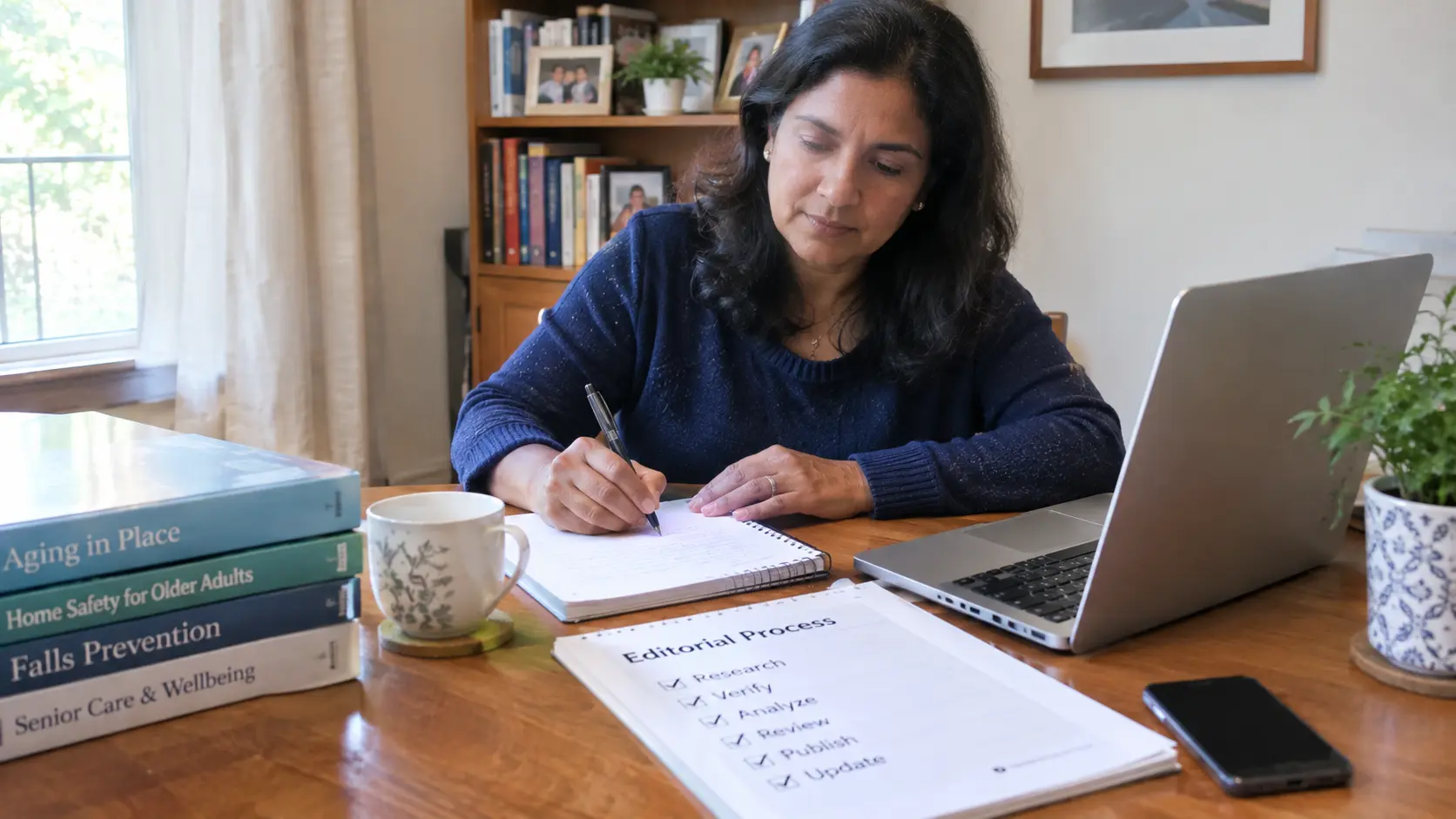
How ElderGuardHome researches, writes, reviews, and updates senior home safety guides
ElderGuardHome creates practical home safety guides for older adults, caregivers, and families making decisions about aging in place.
Our goal is simple: help readers understand a safety problem, evaluate realistic solutions, and decide what to do next.
We do not create articles by rewriting another website’s content. Each guide begins with a specific reader need and is developed through research, source checking, product documentation, safety information, and practical analysis.
When we review products, we also distinguish between information we can verify from documentation and experiences that require hands-on testing.
What Our Editorial Process Is Designed to Do
Senior home safety information can affect everyday decisions about mobility, falls, bathrooms, kitchens, bedrooms, emergency response, and independent living.
That makes accuracy and clarity important.
Our editorial process is designed to:
- Explain safety problems in practical language.
- Identify the most important risks without creating unnecessary fear.
- Compare possible solutions fairly.
- Use reliable sources for factual and safety-related claims.
- Check manufacturer information when researching products.
- Separate verified facts from our own analysis.
- Identify limitations that may affect a product or recommendation.
- Update information when important details change.
- Give readers enough context to make informed decisions.
We aim to provide useful analysis, not simply a collection of product links or rewritten information.
Step 1: We Start With a Real Reader Problem
Every guide starts with a specific problem that an older adult or caregiver may encounter.
Examples include:
- Difficulty getting safely in and out of bed.
- Slippery bathroom surfaces.
- Kitchen appliances that are difficult to handle.
- Trip hazards around the home.
- Choosing an appropriate medical alert system.
- Improving lighting for safer movement.
- Making a home easier to navigate while aging in place.
We first define what the reader needs to understand.
Then we determine what information would actually help them make a better decision.
This prevents the guide from becoming a general collection of facts.
Step 2: We Research the Topic
We gather information from relevant and reliable sources before developing the guide.
Depending on the topic, research may include:
- Government health and safety information.
- Recognized safety organizations.
- Accessibility standards and guidance.
- Manufacturer documentation.
- Product manuals and specifications.
- Official product support pages.
- Academic or professional sources.
- Published research when relevant.
- First-hand information when it is genuinely available.
The sources depend on the subject.
For example, a bathroom safety guide may require different sources than a medical alert product review.
We do not treat every website as an equally reliable source.
Step 3: We Check Important Claims
Research is not complete simply because a statement appears online.
For important claims, we try to identify the original or most authoritative source.
We pay particular attention to:
- Safety claims.
- Product specifications.
- Compatibility information.
- Certifications.
- Dimensions.
- Installation requirements.
- Warranty information.
- Pricing.
- Subscription requirements.
- Emergency response features.
- Fall detection features.
- Accessibility information.
If information cannot be verified, we avoid presenting it as an established fact.
When a product specification can change, readers should also check the manufacturer’s current information before purchasing.
Step 4: We Analyze Products Beyond Their Marketing Claims
Product research is an important part of ElderGuardHome.
We do not want product pages to simply repeat manufacturer descriptions.
When researching a product, we look at practical questions such as:
Who is the product suitable for?
An item that works well for one older adult may not suit someone with different mobility, strength, vision, hearing, or dexterity needs.
What problem does it actually solve?
A product should have a clear purpose rather than being recommended simply because it is popular.
What limitations should readers know?
Every product has limitations.
We try to identify installation requirements, compatibility restrictions, recurring costs, maintenance needs, or other considerations that could affect a buying decision.
What should the buyer verify before purchasing?
Where appropriate, we explain which specifications readers should confirm before ordering.
Step 5: We Separate Product Facts From Our Analysis
This is an important part of our editorial process.
A manufacturer may state that a product has a particular feature.
That is a product fact when the information can be verified from appropriate documentation.
Our assessment of whether that feature is useful for a particular type of user is analysis.
We try to keep these two things clear.
For example, a product may have a wide handle.
The manufacturer’s specification can establish the handle’s design.
Our analysis can explain why that design may be easier for someone who has difficulty gripping small handles.
We do not present our interpretation as a manufacturer’s claim.
Step 6: We Are Transparent About Product Testing
We believe product-testing claims should be specific and accurate.
If ElderGuardHome has personally handled, used, installed, or evaluated a product, we describe that experience only when it is genuinely available.
We do not describe a product as “hands-on tested” simply because we researched it online.
When hands-on testing is not available, we rely on verifiable information such as manufacturer documentation, product specifications, manuals, safety information, and other appropriate sources.
This distinction matters because readers should know what we personally experienced and what we learned through research.
Step 7: We Look at the Product From the User’s Perspective
Specifications alone do not tell the entire story.
For senior home safety products, practical usability can matter just as much.
Depending on the product, we consider questions such as:
- Is it easy to understand?
- Is it difficult to install?
- Does it require regular maintenance?
- Is the control easy to reach?
- Could the design create another hazard?
- Does the product require a subscription?
- Does it depend on Wi-Fi, cellular service, or another connection?
- Is it suitable for the intended user?
- What limitations should a caregiver understand?
The exact questions vary by product.
Our purpose is to help readers think about real-world suitability, not simply product specifications.
Step 8: We Build the Guide Around Decisions
A useful safety guide should help a reader decide what to do.
For that reason, our articles generally move beyond definitions.
Depending on the topic, a guide may explain:
- What the safety problem is.
- Why it can matter.
- What to look for.
- Which changes can be made first.
- When a product may help.
- What limitations to consider.
- When additional assessment may be appropriate.
- Where readers can find more detailed information.
This structure helps readers move from understanding a problem to taking a practical next step.
Step 9: We Avoid One-Size-Fits-All Safety Advice
Older adults do not all have the same needs.
A recommendation that works for one person may be unsuitable for another.
Mobility, balance, vision, hearing, strength, dexterity, home layout, caregiver availability, and daily routines can all affect the right solution.
Therefore, we avoid presenting every product or modification as appropriate for everyone.
Our guides provide decision-making information rather than pretending that one solution fits every home.
Step 10: We Review the Article Before Publication
Before publishing a guide, we review it for more than spelling and grammar.
Our editorial check includes:
- Accuracy of important claims.
- Source quality.
- Product specifications.
- Clear explanations.
- Practical usefulness.
- Internal links.
- Broken or outdated information.
- Overly broad claims.
- Unsupported statistics.
- Product limitations.
- Disclosure of relevant commercial relationships.
- Whether the article actually answers the reader’s question.
We also look for information that sounds stronger than the evidence supports.
When a claim cannot be adequately supported, we revise it, qualify it, or remove it.
How We Handle Product Recommendations
ElderGuardHome may discuss products that could help with senior home safety.
A product is not included simply because it is available through an affiliate retailer or because it has a high sales volume.
We consider whether the product is relevant to the safety problem being discussed.
Our research may consider:
- Intended use.
- Important features.
- Usability.
- Installation.
- Compatibility.
- Maintenance.
- Recurring costs.
- Limitations.
- Manufacturer information.
- Available alternatives.
A product recommendation should provide additional decision-making value rather than simply sending a reader to a retailer.
Affiliate Links and Commercial Relationships
Some ElderGuardHome pages may contain affiliate links.
If a reader purchases through an affiliate link, ElderGuardHome may receive a commission at no additional cost to the reader.
Affiliate relationships do not determine whether a product is relevant to an article.
We aim to make commercial relationships clear while keeping the editorial purpose of the page focused on helping readers.
Our goal is to explain why a product may or may not be appropriate, rather than encouraging a purchase simply to generate a commission.
How We Handle Product Pricing and Availability
Product prices, availability, warranties, subscriptions, and specifications can change.
For that reason, information displayed in an article should not be treated as a permanent price guarantee.
When price is important to a buying decision, readers should confirm the current price and terms before purchasing.
We also avoid treating temporary discounts as permanent product pricing.
How We Handle Safety and Medical Information
ElderGuardHome focuses on practical home safety and aging-in-place information.
Our guides are intended to support informed decisions.
They are not a substitute for individualized medical, occupational therapy, physical therapy, engineering, or other professional advice.
When a situation involves significant mobility problems, repeated falls, major home modifications, or an individual’s specific medical needs, professional assessment may be appropriate.
We avoid making medical diagnoses or promising that a particular product will prevent an injury.
Safety information should be used together with the needs and circumstances of the individual person.
How We Update Existing Guides
An article is not considered finished forever after publication.
We may revisit a guide when important information changes.
Updates can include:
- New product specifications.
- Discontinued products.
- Changed product features.
- Updated manufacturer information.
- Changed pricing or subscription details.
- New safety information.
- Broken links.
- Improved explanations.
- Corrections to factual errors.
- Better alternatives for readers.
When a meaningful update is made, we aim to keep the article’s information current and useful.
A visible Last Updated date may be included when appropriate.
What Happens When We Find an Error?
Accuracy matters more than protecting an old statement.
If we identify a factual error or outdated claim, we review the underlying information and correct the page when appropriate.
We may also remove a statement when reliable evidence no longer supports it.
For product information, we may replace outdated specifications with current manufacturer information.
Readers can also contact us if they believe an article contains inaccurate or outdated information.
What We Do Not Do
Our editorial process has several important boundaries.
We do not copy articles from other websites and present them as original work.
We do not claim hands-on product testing when hands-on testing did not occur.
We do not treat manufacturer marketing claims as independent testing.
We do not guarantee that a product will prevent falls, injuries, or other safety events.
We do not recommend a product solely because it contains an affiliate link.
We do not intentionally publish unsupported statistics simply because they make an article more persuasive.
We do not use a single recommendation as a universal solution for every older adult.
These boundaries help keep our guides useful, transparent, and responsible.
How We Use Research, Tools, and Editorial Assistance
ElderGuardHome may use research tools, software, and editorial assistance during the content-development process.
Tools can help with research organization, drafting, editing, formatting, and reviewing information.
However, tools do not replace editorial responsibility.
Published content is reviewed for relevance, accuracy, clarity, and usefulness before it becomes part of the site.
The responsibility for what ElderGuardHome publishes remains with ElderGuardHome.
Our Standard for Publishing a Guide
Before we publish a guide, we ask a simple question:
Does this page give the reader something useful that goes beyond a basic collection of information?
A strong guide should help the reader understand the problem, evaluate realistic options, and decide what to investigate next.
If a page does not provide enough useful information, we should improve it before treating it as finished.
This standard is particularly important because senior home safety information is widely available online.
Our goal is not to publish another version of the same generic article.
Our goal is to make each ElderGuardHome guide clear, practical, transparent, and useful for the person who needs it.
Our Commitment to Readers
ElderGuardHome exists to help families make safer and more informed decisions about aging at home.
That means our editorial process must remain focused on the reader.
We will continue to improve our research methods, correct information when necessary, distinguish verified facts from analysis, and be transparent about product research and testing.
We believe useful senior home safety content should earn trust through evidence, clarity, transparency, and practical value.
Questions About Our Editorial Process?
If you notice an outdated product specification, broken source, factual error, or other issue in an ElderGuardHome guide, please contact us.
We welcome constructive feedback that helps us make our safety guides more accurate and useful.
Editorial Process: Research → Verify → Analyze → Review → Publish → Update