
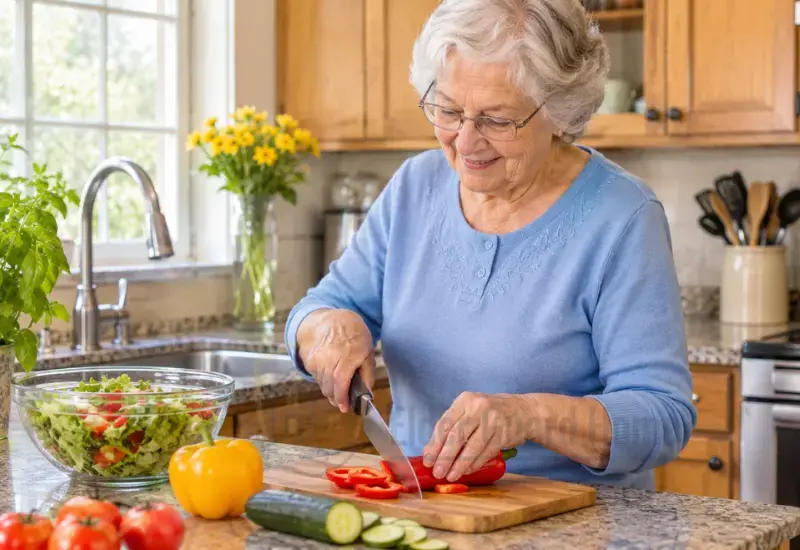
Cooking with arthritis can turn familiar kitchen tasks into tiring activities. Opening a jar, peeling vegetables, or lifting a saucepan may cause discomfort when the hands and wrists are stiff or painful.
These difficulties can affect confidence. An older adult who once enjoyed preparing meals may begin avoiding certain tasks. Some may depend on family members even when they would prefer to remain involved.
However, giving up cooking is not the only option. Simple kitchen adaptations can reduce unnecessary gripping, twisting, and lifting. The right equipment can also make food preparation more comfortable.
The goal is not to buy every product marketed for seniors. It is to identify the tasks that cause the most difficulty and choose practical solutions.
This guide explains how to make cooking easier and safer for seniors with arthritis or reduced grip strength. It covers useful kitchen aids, safer preparation methods, and affordable changes that support everyday independence.
Why Cooking Becomes Difficult with Arthritis and Weak Grip
Arthritis can affect the joints in the fingers, thumbs, wrists, and hands. Pain, stiffness, reduced movement, and fatigue may make ordinary kitchen activities harder.
Some people struggle most in the morning when their hands feel stiff. Others notice discomfort after repeated chopping, stirring, or gripping.
Even a simple task may involve several movements. Opening a jar requires holding the container while turning its lid. Peeling vegetables involves repeated gripping and wrist movement. Carrying cookware requires enough strength to control its weight.
Common kitchen difficulties include:
Opening tightly sealed jars and bottles.
Turning small faucet or appliance controls.
Holding thin knife and utensil handles.
Peeling and chopping vegetables.
Lifting heavy pots and pans.
Carrying filled cups or serving dishes.
Scrubbing cookware after meals.
Reduced grip strength can create an additional safety concern. A person may lose control of a knife, hot container, or slippery dish.
These challenges do not affect everyone in the same way. One person may need help opening jars but manage chopping comfortably. Another may have difficulty lifting cookware but still use ordinary utensils.
That is why the best approach is to identify the specific task causing trouble. A suitable adaptation should make that task easier without creating another problem.
Make Opening Jars, Bottles, and Containers Easier
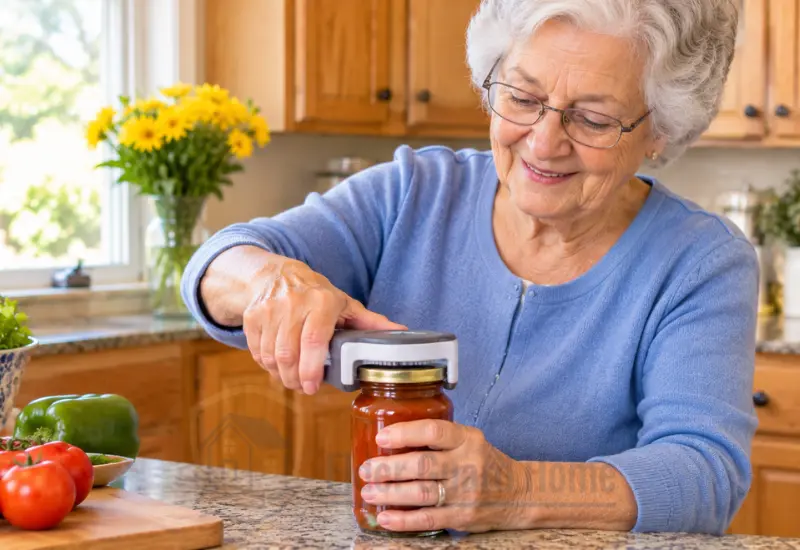
Opening jars is one of the most frustrating kitchen tasks for people with hand arthritis. Tight lids often require strong gripping and twisting movements.
Trying harder can increase discomfort. It may also cause the jar to slip unexpectedly.
A suitable opener can provide additional grip or leverage.
Use the Right Jar and Bottle Openers
Different jar openers work in different ways.
Consider these common options:
Rubber jar-opening grips: These flexible pads improve friction between the hand and lid. They are inexpensive and take little storage space.
Handheld jar openers: These devices grip the lid and provide additional leverage. Some designs have long handles that reduce the effort needed to turn.
Under-cabinet jar openers: These attach beneath a cabinet and hold the lid while the user turns the jar. They can be useful when hand strength is limited.
Electric jar openers: These powered devices grip and turn compatible lids with less manual effort. Check the lid-size range and operating controls before buying.
Multi-purpose bottle openers: Some models help with bottle caps, pull tabs, and different container lids.
The best option depends on the person’s hand strength and dexterity. A simple rubber grip may be enough for mild difficulty. Someone with more significant limitations may prefer a mounted or electric device.
Before purchasing, check whether the person can position the opener independently. Also consider cleaning, storage, and the types of containers used most often.
Choose Easy-Open Food Packaging
The packaging itself can make cooking easier.
Whenever possible, choose containers with practical opening features.
Look for:
Pull-tab cans that do not require a separate manual can opener.
Bottles with larger, easier-to-grip caps.
Food containers with simple locking mechanisms.
Packaging that does not require repeated pinching.
Reusable storage containers with easy-release lids.
An electric can opener may help when operating a traditional opener causes hand discomfort.
Avoid using a knife to pry open lids or forcing a tightly sealed container with excessive effort. These shortcuts can cause cuts or sudden slips.
For additional ideas, the Arthritis Foundation’s guide to arthritis-friendly kitchen tools explains how different kitchen aids can address common cooking difficulties.
Choose Safer Knives and Food Preparation Tools
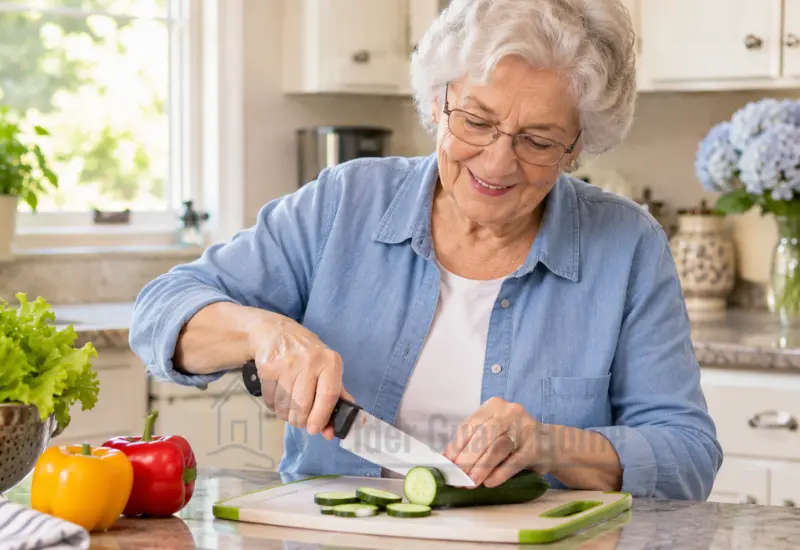
Chopping and peeling vegetables require repeated hand movements. Thin handles may also force the user to grip tightly.
Choosing comfortable tools can reduce unnecessary effort.
Consider Rocker Knives and Easy-Grip Knives
A rocker knife has a curved blade and is used with a rocking motion. Some designs have a handle positioned to reduce the need for repeated wrist bending.
An ergonomic knife may have a wider handle that is easier to hold than a thin traditional handle.
Possible options include:
Rocker knives for suitable chopping tasks.
Angled knives designed to support a more comfortable wrist position.
Knives with larger, cushioned handles.
Lightweight knives that are easier to control.
A rocker knife is not automatically safer for everyone. The user needs enough control to position and move the blade properly.
Choose a knife that feels stable in the hand. If the person has difficulty controlling a blade, consider a safer alternative such as a food processor or pre-cut ingredients.
Never encourage someone to use a knife independently if their grip or coordination makes blade control unreliable.
Use Food Preparation Tools That Reduce Hand Effort
Some kitchen tools can handle repetitive work that might otherwise strain the hands.
Useful options include:
Wide-handled peelers: Larger handles may be more comfortable than narrow metal handles.
Food processors: These can chop, slice, and grate ingredients with less repetitive hand movement.
Mini choppers: Smaller models may be convenient for preparing modest quantities.
Vegetable choppers: These can reduce repeated knife work when the food is positioned securely.
Non-slip cutting boards: These help prevent the board from moving during preparation.
Cutting-board stabilizers: These can hold a board in place when extra stability is needed.
A stable cutting surface is important. A cutting board that slides can make even a comfortable knife difficult to control.
Choose equipment that is simple to operate and clean. Complicated devices may create additional work instead of solving the problem.
If chopping is painful, using frozen or pre-cut vegetables is also a reasonable option. Convenience foods can help preserve energy for other parts of meal preparation.
Reduce the Effort Needed to Lift Pots and Pans
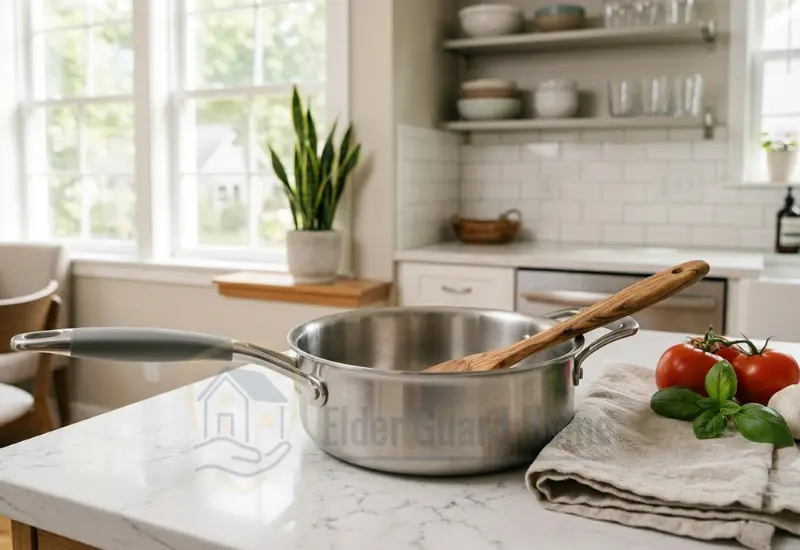
Heavy cookware can be difficult to manage when arthritis affects the hands and wrists.
A filled saucepan is heavier than an empty one. It may also contain hot water or food, making an accidental drop particularly dangerous.
The goal is to reduce lifting wherever possible.
Choose Lightweight Cookware with Comfortable Handles
Lightweight pans may be easier to move than heavy cast-iron or thick stoneware cookware.
Look for:
Manageable overall weight.
Handles that are comfortable to hold.
Secure handle attachments.
Stable bases that sit properly on the cooktop.
Two-handled designs where they suit the user’s abilities.
Two handles can help distribute the load between both hands. However, the person must still be able to grip and control them comfortably.
Do not choose cookware based only on its empty weight. Consider how heavy it becomes when filled with food or water.
A smaller saucepan may be more practical than a large pot. Preparing food in manageable quantities can reduce the need to lift heavy cookware.
Reduced grip strength can make handling hot cookware especially challenging. Avoid carrying heavy pots filled with boiling water, and use dry oven mitts when handling hot dishes. Our guide to kitchen burn prevention for seniors covers safer cookware handling, hot liquids, and steam burns.
Slide Cookware Instead of Carrying It When Safe
For some kitchen tasks, sliding a suitable pan along a clear worktop may require less effort than lifting it.
This technique is only appropriate when the surface, cookware, and route make sliding safe. Never slide hot cookware where it could tip, catch, or spill.
Other useful changes include:
Prepare ingredients near the cooking area.
Avoid carrying large pots of boiling water.
Use a cooking basket to lift food from water when appropriate.
Use a suitable trolley to move dishes when the route is clear.
Ask for help with heavy or hot cookware when needed.
A kettle tipper or hot-water dispenser may also help someone who struggles to lift and pour a full kettle. These options still require safe filling and operation.
Pouring a full kettle can be particularly difficult when someone has weak hands or struggles to maintain a secure grip. A suitable no-lift or tipping kettle may help reduce the need to lift and pour. See our guide to the best electric kettles for elderly people with tremors for options and features to consider.
For more ideas about reducing kitchen lifting and gripping, see the Arthritis Foundation’s kitchen tips.
Make Faucets and Appliance Controls Easier to Use
Small controls can create surprisingly difficult tasks.
Traditional faucet handles may require twisting. Appliance buttons may be too small to press comfortably.
Replacing or adjusting difficult controls can make everyday kitchen use easier.
Consider Lever-Handle Faucets
A small round faucet knob may be uncomfortable for someone with stiff fingers.
A lever-style faucet can often be operated with a broader hand movement instead of a tight twisting grip.
Other possibilities include:
Single-lever faucets.
Suitable touch-activated faucets.
Faucet handles with easier-to-grip shapes.
Tap turners designed for compatible controls.
Touch-activated models are not automatically better. They may require a particular hand movement or depend on electrical power.
Choose a control the person can understand and operate reliably. Also make sure they can adjust water temperature safely.
Look for Appliances with Simple Controls
A complicated appliance can be frustrating when the user has limited finger movement.
Before buying a new appliance, consider whether its controls are comfortable to operate.
Look for:
Large, clearly marked buttons.
Easy-to-turn knobs.
Readable displays.
Simple operating steps.
Controls positioned within comfortable reach.
A touchscreen may look modern but can be difficult for someone who prefers physical buttons.
The best appliance is not necessarily the one with the most features. It is the one the person can operate confidently.
For microwave placement, controls, and everyday precautions, read our guide to microwave safety for seniors.
Arthritis-related difficulties can sometimes make appliance controls harder to operate, but difficulty gripping a control is different from forgetting to switch off a burner. If unattended cooking is also a concern in the household, explore automatic stove shut-off devices for elderly people. These devices address a separate cooking safety risk.
Choose Comfortable Cups, Plates, and Eating Utensils
Kitchen accessibility does not end when the food is prepared. Holding cups, serving meals, and eating can also become difficult when hand strength is reduced.
The right tableware can make these activities more comfortable.
Look for Easy-Grip Cups and Mugs
A heavy cup with a small handle may be difficult to hold.
Consider:
Lightweight mugs with larger handles.
Two-handled cups where appropriate.
Cups with textured surfaces.
Insulated mugs with comfortable grips.
Lightweight drinking glasses that are easy to control.
Two-handled mugs may help distribute weight between both hands. However, they are not suitable for everyone.
Check whether the person can lift the cup comfortably when it contains a drink. A large handle does not automatically make a heavy mug easier to use.
For hot drinks, make sure the cup is stable and suitable for the intended temperature.
Choose Utensils with Comfortable Handles
Standard cutlery often has narrow handles that require a firm grip.
Adaptive cutlery may have wider, cushioned, or angled handles. These designs can make holding a spoon or fork more comfortable.
Other useful options include:
Enlarged-handle spoons and forks.
Lightweight serving utensils.
Angled cutlery for suitable users.
Non-slip placemats.
Plates with raised edges.
Raised-edge plates may help someone move food onto a utensil without pushing it off the plate.
The right design depends on the person’s hand movement and coordination. Try different handle sizes before buying a complete set.
Reduce Standing Time and Physical Strain While Cooking
Long periods of standing can make cooking tiring. Hand discomfort may become worse when someone is already fatigued.
Changing how a meal is prepared can reduce unnecessary effort.
Create a Suitable Seated Preparation Area
Some food preparation tasks can be completed while sitting.
Washing vegetables, sorting ingredients, measuring portions, and mixing food may be easier at a suitable table or counter.
Consider:
A stable chair with appropriate support.
A work surface at a comfortable height.
Enough room for the person’s legs.
Tools placed within easy reach.
Clear space around the chair.
Avoid unstable stools or chairs that move unexpectedly.
A seated workstation should be arranged so the person does not need to twist repeatedly or reach across a hot cooking surface.
Prepare Food in Shorter Stages
A large meal does not need to be prepared all at once.
Breaking cooking into smaller tasks can reduce repeated hand movements and fatigue.
For example:
Wash and sort vegetables earlier.
Prepare ingredients in manageable quantities.
Take a break before starting the cooking stage.
Use a food processor for repetitive chopping when appropriate.
Clean utensils gradually instead of leaving all the work until the end.
Some people find batch cooking useful on days when their hands feel more comfortable. Extra portions can be stored safely for later meals.
Frozen vegetables and prepared ingredients can also reduce chopping and peeling.
The aim is to make cooking manageable, not to follow a rigid routine.
Keep Frequently Used Tools Close to the Work Area
Repeatedly walking across the kitchen or reaching into deep cupboards adds unnecessary work.
Keep commonly used utensils, ingredients, and small appliances near the preparation area.
However, avoid overcrowding the counter. A cluttered surface can make food preparation and movement more difficult.
Organize the Kitchen to Avoid Painful Reaching and Bending
Kitchen organization can make a significant difference when arthritis affects hand strength and movement.
Frequently used items should be easy to retrieve without repeated lifting or stretching.
Smaller, lightweight food containers can also make refrigerator use easier for someone with limited hand strength. However, convenient storage should not compromise safe food handling. Read our guide to refrigerator food safety for seniors for advice on storage temperatures, leftover containers, and safe food organization.
Store Everyday Items at Comfortable Heights
Place commonly used dishes, glasses, ingredients, and utensils where the person can reach them comfortably.
Keep heavy cookware away from high shelves. Avoid storing everyday items at the back of deep cabinets.
A simple arrangement may include:
Plates and bowls near the dishwasher or sink.
Cooking utensils near the preparation area.
Frequently used ingredients in an accessible cupboard.
Heavy pans in a suitable drawer.
Rarely used appliances in less convenient storage.
The best arrangement depends on the person’s height, mobility, and reach.
Use Pull-Out Drawers and Easy-Open Storage
Pull-out shelves can bring stored items closer to the cabinet opening.
Full-extension drawers may also reduce the need to reach deep inside a cupboard.
Larger cabinet handles can be easier to grasp than small round knobs.
Choose storage systems that move smoothly and remain stable when extended. Check their weight limits before placing heavy cookware inside.
For more detailed ideas about accessible storage, counter space, and kitchen layout, read our guide on how to make a kitchen more accessible for seniors aging in place.
Low-Cost Kitchen Adaptations That Can Make a Difference
Improving kitchen accessibility does not always require expensive equipment.
A few carefully chosen changes may solve the tasks that cause the most frustration.
Consider these affordable starting points:
Rubber jar grips: Add friction when opening suitable jars and bottles.
Non-slip mats: Help keep mixing bowls and suitable containers from moving.
Wider utensil handles: Make some spoons, peelers, and other tools easier to hold.
Lightweight mixing bowls: Reduce the effort needed to lift and handle ingredients.
Easy-grip peelers: Offer a more comfortable alternative to narrow handles.
Cabinet handle replacements: Make storage easier to open.
Smaller cookware: Reduce the weight of individual meals.
Pre-cut ingredients: Reduce repetitive chopping and peeling.
Better kitchen organization: Keep frequently used items within comfortable reach.
A suitable seated workstation: Reduce the need to stand throughout food preparation.
Some changes cost very little. Others may require a professional installation.
Start with the task that causes the greatest difficulty. Buying several gadgets at once may waste money if only one or two solve the actual problem.
How to Choose the Right Kitchen Tools for Arthritis
Kitchen products often use labels such as ergonomic, senior-friendly, or arthritis-friendly. These descriptions do not guarantee that a tool will suit every person.
The most useful product is one that addresses a specific difficulty and feels comfortable during actual use.
The table below can help narrow down the choices.
| Kitchen difficulty | Helpful tool | What to check before buying |
|---|---|---|
| Opening tight jars | Rubber, mechanical, or electric jar opener | Grip comfort, lid sizes, stability, and operating effort |
| Opening cans | Electric or easy-grip can opener | Button operation, can compatibility, and cleaning |
| Peeling vegetables | Wide-handled or palm-style peeler | Handle comfort, blade control, and ease of cleaning |
| Chopping ingredients | Rocker knife or food processor | Control, stability, blade safety, and operating effort |
| Lifting cookware | Lightweight saucepan with suitable handles | Weight when filled, handle security, and balance |
| Holding cups | Lightweight or two-handled mug | Overall weight, handle shape, and stability |
| Holding utensils | Enlarged-handle or adapted cutlery | Grip size, comfort, and ease of cleaning |
| Moving bowls during preparation | Non-slip mat or stable bowl | Surface grip, size, and suitability for the counter |
Before purchasing, consider these points:
Can the person use the product without assistance?
Does it reduce the movement or grip that causes difficulty?
Is it comfortable to hold?
Can it be cleaned and stored easily?
Does it introduce a new safety concern?
Is there a simpler, less expensive alternative?
If possible, try the tool before buying it. A product that looks comfortable online may feel awkward in the hand.
The Arthritis Foundation also provides guidance on choosing arthritis-friendly products. Its recommendations emphasize comfort, grip, manageable weight, and ease of operation.
When to Ask an Occupational Therapist for Kitchen Advice
Some people can manage with simple kitchen aids. Others need a more individual assessment.
An occupational therapist can observe how someone performs everyday activities and recommend suitable adaptations.
Consider asking for professional advice when:
Opening containers remains difficult despite using suitable aids.
The person frequently drops utensils or cookware.
Holding a knife safely has become a problem.
Hand discomfort interferes with several daily activities.
The person struggles to prepare meals independently.
Existing kitchen equipment no longer suits their abilities.
The family is unsure which adaptations would be safest.
An occupational therapist may suggest different tools, changes to working methods, or modifications to the kitchen layout.
A healthcare professional should also assess new, worsening, or unexplained hand pain, swelling, weakness, or changes in movement. Kitchen equipment can make tasks easier, but it does not treat the underlying condition.
The goal is to help the person continue participating in everyday activities as comfortably and safely as possible.
FAQ
How can I make cooking easier with arthritis?
Use tools that reduce tight gripping, twisting, and repeated hand movements. Jar openers, wide-handled utensils, lightweight cookware, and food processors may help. Keep frequently used items nearby, prepare food in smaller stages, and take breaks when your hands become tired.
What are the best kitchen tools for seniors with arthritis?
Useful options include jar openers, electric can openers, wide-handled peelers, rocker knives, food processors, non-slip cutting boards, and enlarged-handle cutlery. The best choices depend on which tasks cause difficulty and how comfortably the person can operate each tool.
How can someone with weak hands open jars?
A rubber grip pad can improve friction between the hand and lid. A mechanical jar opener can provide extra leverage, while an electric model may reduce manual twisting. Choose an opener that fits the containers used at home and can be positioned safely.
Are rocker knives good for people with arthritis?
A rocker knife uses a curved blade and rocking movement. Some designs may reduce repeated wrist bending during suitable cutting tasks. However, the user still needs enough control to handle the blade safely. A food processor or prepared ingredients may be a better option for someone with limited coordination.
What cookware is easiest for seniors with weak grip?
Lightweight cookware with comfortable, secure handles may be easier to manage. Smaller pans can also reduce the weight of each meal. Consider the weight when the pan is filled, not just when it is empty. Two-handled designs may help some users distribute the load.
How can older adults chop vegetables more safely with arthritis?
Use a stable cutting board and a knife that feels comfortable to control. A suitable food processor or vegetable chopper may reduce repetitive cutting. If gripping a knife is difficult or unreliable, use prepared vegetables instead of risking an injury.
Can kitchen modifications help someone with severe arthritis?
Yes, suitable adaptations may make everyday tasks more manageable. These could include electric openers, adapted utensils, easier faucet controls, and changes to storage. Someone with significant difficulty may benefit from an occupational therapy assessment to identify equipment and techniques suited to their abilities.
Conclusion: Make Cooking More Comfortable Without Losing Independence
Cooking with arthritis does not have to mean giving up the kitchen. The right tools and small changes can make everyday preparation more manageable.
Start with the tasks that cause the most difficulty. A jar opener may solve one problem, while lightweight cookware or wider utensil handles may help with another.
Better organization can also reduce unnecessary reaching, bending, and lifting. Preparing meals in shorter stages may help manage fatigue.
Most importantly, involve the older adult when choosing adaptations. A tool is useful only when the person finds it comfortable and can use it safely.
With practical adjustments, seniors can continue enjoying familiar meals and participating in everyday kitchen activities with greater confidence.