Can You Make a Rug Safe for an Elderly Parent?
Yes, some rugs can become safer without removing them completely.
The important question is not whether the rug looks attractive or feels comfortable. The question is whether your parent can cross it, turn on it, and use mobility equipment without catching an edge.
The National Institute on Aging recommends keeping carpets firmly secured and avoiding throw rugs because loose floor coverings can contribute to falls.
That does not mean every existing rug must immediately go into the trash.
A practical caregiver approach is to inspect the rug first. Then determine whether you can correct the specific problem without creating another hazard.
A rug may be a reasonable candidate to keep when:
- It lies flat against the floor.
- It does not slide when stepped on.
- Its corners remain flat.
- Its edges do not curl upward.
- A walker or cane can cross it easily.
- Doors do not catch the rug.
- The backing remains in good condition.
- Your parent feels comfortable walking across it.
If several of these conditions fail, securing the rug may not provide enough improvement.
Why Can Rugs Become Unsafe for Older Adults?
A rug can create several different problems around the home.
The most obvious problem is movement. A rug that slides underfoot can change position when someone steps, turns, or pushes a mobility aid across it.
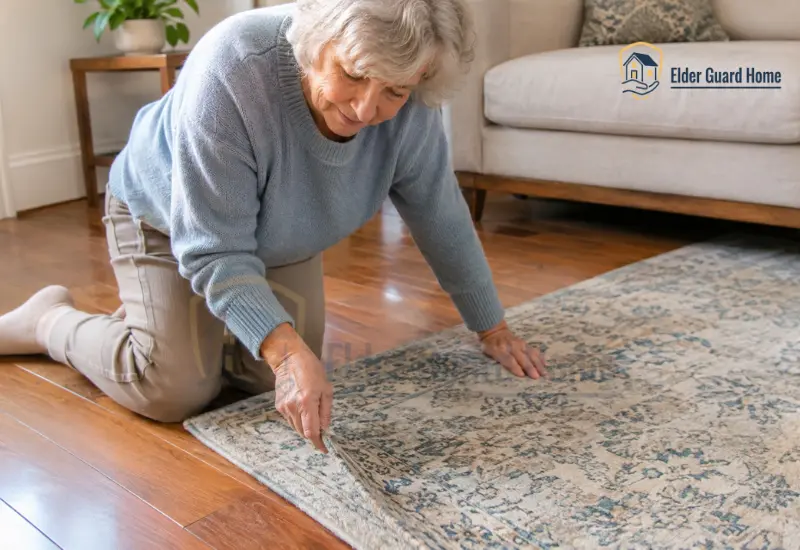
Curling edges create another problem. A raised corner or edge can catch footwear, cane tips, or walker wheels.
Rug thickness can also matter. A thick rug creates a transition between floor surfaces that may be difficult for someone using a walker or rollator.
Poor placement creates additional problems. A rug beside a bed, near a bathroom, or across a doorway deserves especially careful inspection.
The CDC identifies throw rugs and clutter as home hazards that can contribute to falls among older adults.
First Decide Whether the Rug Is Worth Keeping
Before buying anything, inspect the rug itself.
You do not need to spend money securing a rug that has already become structurally unsafe.
Signs the Rug May Be Suitable for Securing
Consider keeping the rug when:
- The rug lies reasonably flat.
- The backing remains intact.
- The edges are not badly damaged.
- The rug has a relatively low profile.
- The rug does not interfere with doors.
- Your parent can cross it comfortably.
- The floor underneath can support a suitable rug pad.
Signs the Rug May Need Removal
Removal may be safer when:
- The rug repeatedly moves after securing.
- Multiple edges remain curled.
- The backing is deteriorating.
- The rug has deep, unstable pile.
- Walker wheels repeatedly catch.
- A wheelchair cannot cross it comfortably.
- A door catches the rug.
- The rug creates a significant height difference.
- Your parent avoids crossing it because they feel unstable.
Do not force a favorite rug into a location where it cannot be made reasonably stable.
Step 1: Find Out Why the Rug Is Unsafe
Do not automatically buy a rug pad.
First identify the actual problem.
A non-slip pad may stop movement, but it cannot make a damaged rug structurally sound.
| Problem | What to Check | Possible Response |
|---|
| Rug slides | Push the rug from different directions | Use a suitable non-slip pad |
| Corners curl | Inspect every corner | Use compatible corner securing products |
| Edges lift | Check the entire rug perimeter | Replace the damaged rug or improve support |
| Rug bunches | Look for waves, folds, or wrinkles | Use a correctly sized full rug pad |
| Rug feels too thick | Compare its edge with the surrounding floor | Consider a lower-profile rug |
| Door catches rug | Open and close the nearby door | Move or replace the rug |
| Walker catches edge | Test the rug with the actual walker | Lower the transition or remove the rug |
| Backing deteriorates | Look for cracking, flaking, or powdering | Replace the rug |
| Wheelchair struggles | Test forward movement and turning | Consider removing the rug |
Do not treat every rug problem as a sliding problem.
A non-slip pad may reduce movement, but it cannot correct a damaged rug or an unsuitable height transition.
Step 2: Use a Properly Fitted Non-Slip Rug Pad
For many movable rugs, a correctly fitted rug pad is the most practical first solution.
The pad sits between the rug and floor. It can help reduce movement while also supporting the rug.
Our detailed guide to non-slip rug pads for seniors explains different pad materials, profiles, and installation considerations.
Choose the Pad Based on the Rug and Floor
Do not choose a pad based only on price or thickness.
Check:
- Rug dimensions.
- Rug backing material.
- Floor material.
- Pad thickness.
- Door clearance.
- Mobility equipment.
- Manufacturer compatibility instructions.
A pad should normally sit beneath the rug rather than extend beyond its edges.
An oversized pad can create its own raised edge.
For a parent using a walker, pay particular attention to the transition between the rug and surrounding floor.
A very thick pad may make the transition more noticeable. Test the finished setup instead of assuming thicker means safer.
Step 3: Make Sure the Rug Pad Fits Correctly
A poorly fitted pad can create problems even when the material itself is suitable.
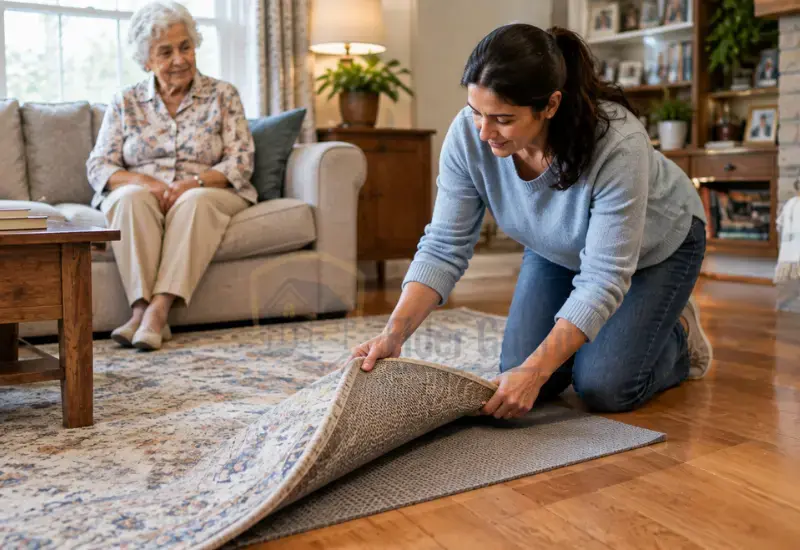
Start by measuring the rug.
The pad should generally be slightly smaller than the rug. This keeps the pad from extending beyond the visible rug perimeter.
After placing the pad, check every edge.
Look for:
- Pad edges showing outside the rug.
- Raised sections.
- Wrinkles.
- Folds.
- Uneven areas.
- Corners extending beyond the rug.
- Door interference.
Then place the rug over the pad.
Walk around the perimeter yourself before asking your parent to test it.
The rug should transition smoothly into the surrounding floor.
Step 4: Secure Curling Corners and Raised Edges
A rug can remain dangerous even when its center stays firmly in place.
Corners can curl after repeated vacuuming, folding, storage, moisture exposure, or normal wear.
Start by determining why the corner curls.
If the rug itself is permanently damaged, replacing it may be better than repeatedly securing it.
For a rug that remains structurally sound, compatible corner grippers or other manufacturer-approved securing products may help.
Never assume that securing one corner fixes the entire rug.
Check all four corners and the longer edges.
Pay particular attention to the areas where your parent normally approaches the rug.
Step 5: Check the Rug’s Height
Rug safety is not only about sliding.
The height difference between the rug and surrounding floor can also matter.
This becomes particularly important when your parent uses:
- A cane.
- A walker.
- A rollator.
- A wheelchair.
- A transfer device.
A walker wheel can respond differently to a rug edge than a person’s foot.
A parent may also lift their feet less when walking, making raised edges more difficult to manage.
Test the actual rug after installation instead of judging its safety visually.
If the rug creates an uncomfortable transition, consider a thinner rug or a different location.
Step 6: Test the Rug With Your Parent’s Mobility Aid
This is one of the most important steps.
Do not test the rug only with your own feet.
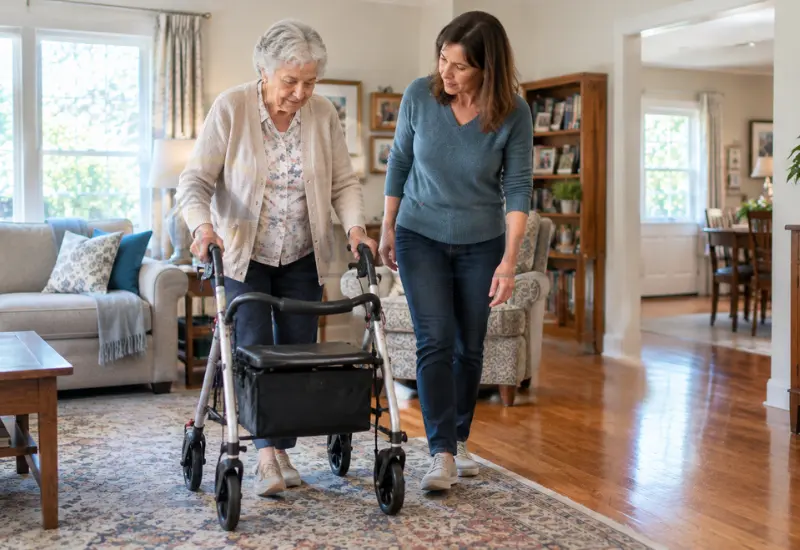
If your parent uses a walker, bring the walker to the rug.
Have them approach slowly under normal supervision.
Test:
- Walking onto the rug.
- Walking across the rug.
- Walking off the rug.
- Turning on the rug.
- Approaching from another direction.
- Crossing the rug with the walker.
- Backing away from the rug if normally required.
Watch the equipment closely.
Does a wheel catch the edge?
Does the rug bunch?
Does the parent hesitate?
Does the mobility aid become harder to control?
Does your parent change their walking pattern?
If the rug creates uncertainty during the test, do not assume they will adapt safely.
Step 7: Check the Rug From Every Direction
Caregivers often test rugs from only one direction.
That can miss problems.
Walk around the room and approach the rug from different angles.
Check:
- Straight approaches.
- Diagonal approaches.
- Side approaches.
- Turning movements.
- Entry and exit points.
- Common nighttime routes.
This matters because your parent may rarely approach the rug exactly as you did during your first test.
Pay Special Attention to Bedroom Rugs
Bedside rugs deserve extra attention.
A parent may step onto them immediately after getting out of bed. That first movement can happen while the room is dark or before the person feels fully steady.
Our guide to night lights for elderly adults covers ways to improve nighttime visibility around bedrooms and walking routes.
A secure rug still needs adequate lighting around it.
Different Rugs Need Different Safety Checks
Not every rug creates the same problem.
Living Room Area Rugs
Large living room rugs can cover substantial walking areas.
Check the entire perimeter rather than only the corners.
Pay attention to furniture placement too.
A sofa or chair should not force your parent to step onto the rug at an awkward angle.
If the rug creates a narrow walking path, rearranging the furniture may help.
Bedroom Rugs
Bedroom rugs require careful nighttime testing.
Check the route between the bed and bathroom.
Make sure the rug does not move when your parent gets out of bed.
Also check whether the rug catches slippers or mobility equipment.
Hallway Runners
Hallway runners can create long transition zones.
Check both long edges and both ends.
Make sure the runner does not move when your parent turns around.
If the runner remains unstable despite securing attempts, removing it may provide a clearer walking route.
Kitchen Rugs
Kitchen rugs face additional exposure to spills and debris.
Check the rug frequently.
Keep the surrounding walking area clear.
If you use a small rug near the sink, it should remain firmly secured.
Our guide on preventing seniors from leaving the stove on also discusses kitchen floor safety around small rugs.
Do not let a decorative kitchen rug become an obstacle around cooking areas.
What If Your Elderly Parent Refuses to Remove the Rug?
This is a common caregiver challenge.
The rug may have sentimental value. It may also make the room feel warmer or more familiar.
Arguing about the rug can create resistance without solving the safety issue.
Instead, identify the specific problem.
Ask:
“What do you think makes this rug unsafe?”
Then test that issue together.
If the rug slides, address the sliding.
If the corner curls, address the corner.
If the rug is too thick for the walker, explain the transition problem.
This approach can make the conversation less confrontational.
The goal is not to win an argument about rugs. The goal is safer movement.
What Not to Do When Securing a Senior's Rug
Some quick fixes can create new problems.
Do Not Assume a Heavy Rug Cannot Move
Weight does not guarantee stability.
Test the rug rather than judging it by appearance.
Do Not Use a Very Thick Pad Automatically
A thick pad may feel comfortable but can increase the height difference at the rug edge.
Check the finished transition.
Do Not Secure Only One Corner
A rug can remain unstable along its sides even when one corner stays flat.
Inspect the entire perimeter.
Do Not Ignore a Damaged Backing
A deteriorating backing can cause bunching, cracking, or uneven surfaces.
A new pad cannot necessarily correct a structurally failing rug.
Do Not Test Only With Your Own Shoes
Your parent may use different footwear or mobility equipment.
Their movement pattern may also differ considerably.
Do Not Ignore Door Clearance
Open every nearby door after installing the pad and rug.
The door should move freely without catching the rug.
How to Make a Rug Safer Without Damaging Hardwood
Hardwood floors require another consideration.
Some securing products may not suit every floor finish.
Before using any adhesive or gripping product, check its manufacturer instructions.
Confirm that the product is compatible with your specific flooring.
Also inspect the floor underneath the rug periodically.
Look for:
- Moisture.
- Residue.
- Discoloration.
- Surface changes.
- Debris.
- Pad deterioration.
Our guide to non-slip rug pads for hardwood floors provides more detailed information about selecting and installing rug pads.
Do not sacrifice the floor finish while trying to solve a rug-safety problem.
When Should You Remove the Rug Instead?
Sometimes removal remains the safest option.
The NIA specifically advises older adults to avoid throw rugs as part of home fall prevention guidance.
Consider removing the rug when:
- It continues moving after securing.
- Corners continue curling.
- The rug has damaged backing.
- Walker wheels catch repeatedly.
- A wheelchair cannot cross comfortably.
- The rug interferes with a door.
- The transition remains too high.
- Your parent feels nervous crossing it.
- The rug creates a narrow walking route.
- You cannot confidently secure the entire rug.
A favorite rug is replaceable. A serious fall can have much greater consequences.
If your parent has experienced repeated falls or major mobility changes, a broader home assessment may be appropriate.
The ElderGuardHome printable home safety checklist can help you review rugs alongside other hazards throughout the home.
A Five-Minute Rug Safety Check
Use this simple check whenever you secure an existing rug.
Check 1: Push It
Stand beside the rug and gently push it in several directions.
Does it move?
Check 2: Inspect the Corners
Look at every corner.
Are any edges raised?
Check 3: Inspect the Long Edges
Run your eyes along both sides.
Look for waves, folds, or raised sections.
Check 4: Test the Mobility Aid
Use the actual cane, walker, or rollator.
Cross the rug slowly.
Check 5: Check the Door
Open and close nearby doors.
Make sure nothing catches.
Check 6: Ask Your Parent
Ask how the rug feels.
Do not dismiss hesitation simply because the rug looks secure.
Check 7: Recheck After Use
Inspect the rug again after several days.
A setup that initially looks stable may shift during normal use.
How Often Should You Check a Secured Rug?
There is no universal inspection interval that guarantees a rug remains safe.
Instead, inspect it whenever something changes.
Check the rug after:
- Moving furniture.
- Cleaning the floor.
- Washing the rug.
- Replacing the rug pad.
- A fall or near-fall.
- A change in mobility equipment.
- A noticeable change in walking ability.
- Heavy vacuuming.
- Moving the rug to another room.
Regular observation matters more than following an arbitrary calendar.
If you notice new instability, stop using the rug until you identify the cause.
How This Fits Into a Larger Home Safety Plan
A rug is only one part of the walking environment.
Your parent may also encounter poor lighting, clutter, uneven flooring, difficult furniture placement, or unsafe bathroom surfaces.
For a broader review, use the ElderGuardHome aging in place safely guide to work through different areas systematically.
You can also use the printable senior home safety checklist for a room-by-room review. If nighttime movement is the concern, combine rug inspection with better lighting.
Our guide to safe home lighting design for seniors covers broader lighting considerations. The goal is a safer route through the home, not simply a safer rug.
Frequently Asked Questions
Final Thoughts
You do not always have to remove a favorite rug immediately. First determine what makes the rug unsafe.
Then address the specific problem with an appropriate solution. A suitable rug pad may help with movement, while corner securing products may help with isolated curling.
However, some rugs should still be removed. If the rug remains unstable, interferes with mobility equipment, catches doors, or makes your parent uncomfortable, keeping it may not be worth the risk.
For a complete home review, continue with the ElderGuardHome guide to aging in place safely or use the printable home safety checklist for seniors.
The best solution is the one that gives your parent a clear, predictable path through the home.
Sources and Further Reading
The following sources provide additional guidance on rugs, home hazards, and fall prevention for older adults.
- National Institute on Aging: Preventing Falls at Home, Room by Room — Covers home fall hazards, including carpets, throw rugs, lighting, stairs, bathrooms, bedrooms, and walking areas.
- National Institute on Aging: Home Safety Tips for Older Adults — Provides practical home-safety recommendations, including removing area rugs and securing carpets firmly to the floor.
- CDC STEADI: Check for Safety Home Fall Prevention Checklist — Includes floor-safety guidance for throw rugs, including removing them or using double-sided tape or non-slip backing to reduce movement.
- CDC: Preventing Falls Among Older Adults — Includes recommendations for making the home safer, such as removing throw rugs or securing them to reduce slipping and tripping hazards.
- NIA: Home Safety Checklist for Older Adults — Provides a room-by-room checklist for identifying potential hazards and reviewing needed home-safety changes.