
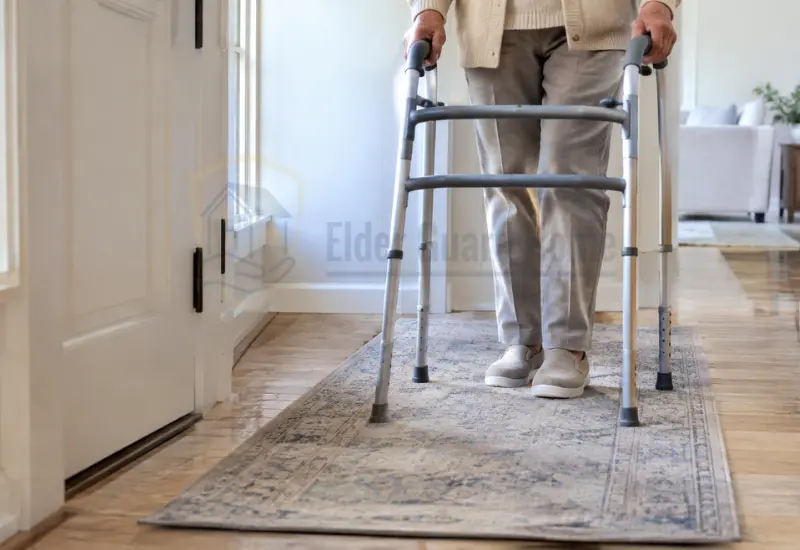
Choosing the best floor mats for seniors requires more than checking reviews. A mat can reduce slipping concerns but create a dangerous raised edge. Soft foam can improve comfort but affect walker movement. The safest choice balances traction, stability, comfort, and easy movement. This guide focuses on those details instead of simply listing popular mats.
Why Can a Floor Mat Become a Trip Hazard?
A floor mat creates another transition between two floor surfaces. That transition can become noticeable when the mat is thick. Raised corners create another potential obstacle. Curling edges can catch footwear, canes, walker legs, or wheels. A mat can also move when someone steps onto it. That movement can change balance unexpectedly.
The CDC identifies throw rugs as home hazards that can contribute to falls. It recommends removing them or securing them appropriately. Research also found many rug-related fall injuries involved transitions. Wet rugs and curled or unsecured edges were also identified. Therefore, a “non-slip” label does not make every mat safe. The complete installation must be considered.
What Makes a Floor Mat Safe for Seniors?
A senior-safe mat should work with the person’s normal movement. It should also work with their footwear and mobility equipment. Consider these features before buying.
Low Profile
A low profile reduces the height difference between surfaces. That can make the transition easier to notice and cross. However, there is no universal safe thickness for every senior.
A very thin mat can still become unsafe if its edge curls. A thicker mat can sometimes work when its edge tapers smoothly. Therefore, consider the entire edge rather than thickness alone.
Beveled or Tapered Edges
A beveled edge slopes gradually toward the surrounding floor. This creates a smoother transition than a blunt vertical edge. It can also help mobility devices cross the edge more easily.
GelPro, for example, uses no-curl beveled edges on its NewLife mat. Look closely at the actual edge before buying. Do not assume every product described as “low profile” has a beveled edge.
Stable Non-Slip Backing
The backing should keep the mat from moving during normal use. This becomes especially important on smooth floors. Hardwood, vinyl, and tile can behave differently. A backing that grips tile may behave differently on finished hardwood. Check the manufacturer’s flooring compatibility before installation.
Firm Construction
Very soft foam can compress under body weight. That may feel comfortable while standing. However, soft surfaces can behave differently under walker wheels.
They may also make turning less predictable. For mobility equipment, firmness deserves careful consideration.
Smooth Surface Transition
The mat should lie flat against the surrounding floor. Avoid visible waves, folds, or raised corners. Check the perimeter after washing the mat. Repeated washing can sometimes change how a mat lies. Replace a mat when its edges no longer remain flat.
Walker and Rollator Compatibility
A walker changes how the mat should be evaluated. The user’s feet are not the only things crossing the mat. Walker legs and rollator wheels must cross the edge too.
Test the mat with the actual mobility device whenever possible. Do not rely only on product photographs.
Best Low-Profile Floor Mats for Seniors
The best choice depends on where the mat will be used. A kitchen standing mat has different requirements than a hallway rug. A walker user may also need a firmer and lower transition. We recommend judging each product by its intended use.
Best Low-Profile Rug-Style Option: BYYVOO 3×5 Washable Entryway Rug
Buy BYYVOO Washable Entryway Rug
The BYYVOO 3×5 washable rug is a strong low-profile choice for seniors. Its 0.17-inch thickness creates a relatively small floor transition.
The flat-woven construction also keeps the profile lower than thicker rugs. Its TPR backing helps keep the rug positioned on hard floors. The washable design makes routine cleaning easier for busy households.
Best for: bedrooms, entryways, bedside areas, and selected living spaces.
Main advantage: very low 0.17-inch profile with integrated TPR backing.
Main concern: even a low-profile rug can create a trip hazard if edges curl or shift.
Amazon rating: 4.6/5 from approximately 1,600 reviews.
Size: 3 × 5 feet.
Thickness: 0.17 inch.
Backing: Thermoplastic rubber (TPR).
Construction: Flat woven, low pile.
Care: Machine washable.
Test it before placing it in a primary walker route.
Best Anti-Fatigue Mat: GelPro NewLife
Buy GelPro NewLife Anti-Fatigue Mat
GelPro NewLife is designed primarily for standing comfort.
It uses a ¾-inch high-density foam construction.
The manufacturer lists beveled, no-curl edges and a non-slip bottom.
The bottom is also certified by the National Floor Safety Institute.
Its surface is designed for heavy household and commercial use.
It is also water and stain resistant.
This makes it a strong kitchen option for people who stand frequently.
However, ¾ inch is not what we would call ultra-low profile.
That matters for seniors using walkers or rollators.
Use it in a defined standing area rather than across a walking route.
Best for: seniors who need standing comfort near a kitchen counter.
Main advantage: cushioning combined with beveled edges.
Main concern: greater thickness than a low-profile rug.
Best Budget-Style Cushioned Option: ComfiLife Anti-Fatigue Mat
Buy ComfiLife Anti-Fatigue Mat
ComfiLife’s anti-fatigue mat uses a ¾-inch high-density foam core.
The manufacturer describes the construction as firm and supportive.
It also lists a non-slip bottom and stain-resistant surface.
The mat is designed for kitchens, offices, laundry rooms, and work areas.
Its thickness makes it better suited to standing zones.
It is less suitable for a major walker pathway.
That distinction is important for senior home safety.
A mat can be comfortable without being appropriate everywhere.
Best for: standing areas where mobility devices do not regularly cross.
Main advantage: cushioning and standing comfort.
Main concern: the ¾-inch profile needs careful placement.
A Product We Would Not Automatically Recommend
Some mats advertise grip but contain important limitations.
For example, Gorilla Grip’s current kitchen mat has a 0.28-inch profile.
It also uses a textured rubber-style backing.
However, its own warning states that the mat is not slip-resistant.
The manufacturer also says to discontinue use if its edges curl.
That is exactly why product screening matters.
A product can look attractive while failing one of our key safety criteria.
We would not make it a top recommendation for senior safety.
How We Chose These Floor Mats
We did not rank products by popularity alone.
We focused on characteristics that can affect senior mobility.
Our evaluation considers:
- Overall mat profile
- Edge shape
- Edge stability
- Backing grip
- Surface firmness
- Water resistance
- Cleaning requirements
- Curling potential
- Walker compatibility
- Rollator compatibility
- Placement requirements
- Long-term maintenance
We also distinguish between product claims and our editorial assessment. We do not claim physical testing unless specifically stated. Manufacturer specifications can also change. Always check the current product information before purchasing.
Best Floor Mats for Seniors Compared
| Mat | Best For | Profile | Backing | Edge Design | Walker Consideration |
|---|---|---|---|---|---|
| BYYVOO 3×5 Washable Entryway Rug | Low-profile rug areas | 0.17 inch | TPR backing | Low-profile flat-woven edge | Better candidate than thicker rugs, but test first |
| GelPro NewLife | Kitchen standing areas | ¾ inch | Certified non-slip bottom | Beveled and no-curl | Use outside primary walking routes |
| ComfiLife Anti-Fatigue Mat | Standing comfort | ¾ inch | Non-slip bottom | Designed for standing use | Use carefully around mobility devices |
This comparison shows why “best” depends on the intended location.
The lowest mat is not automatically the safest.
The thickest mat is not automatically the most comfortable choice.
Placement and mobility needs must guide the final decision.
Best Floor Mat for Walker and Rollator Users
Walker users should prioritize predictable transitions. A walker can catch on a raised mat edge. A soft mat can also compress under the walker legs.
That can change how the device moves across the surface. Rollators introduce another issue. Their front wheels can climb an edge differently than walker legs. A mat that feels fine underfoot may still feel awkward with wheels.
For these users, start with a low-profile and firm option. Avoid placing a mat across the primary walking route. If a mat is necessary, test it with the actual walker. Have the user approach it from both directions. Then test turning on and around the mat.
If the mat moves, curls, or catches equipment, remove it. Do not keep a mat simply because it looks attractive.
Are Anti-Fatigue Mats Safe for Seniors?
Anti-fatigue mats can be useful for seniors who stand frequently. They can reduce discomfort during prolonged standing. However, comfort does not automatically equal mobility safety. Many anti-fatigue mats are substantially thicker than low-profile rugs.
GelPro NewLife, for example, is ¾ inch thick. That thickness can work well beside a kitchen sink. It may be less suitable across a walker route. The safest placement is usually a dedicated standing area. Keep the surrounding walking path clear.
Do not place multiple thick mats together. Multiple transitions can create several obstacles within one room.
Best Senior-Safe Kitchen Mats
Kitchen mats face several special conditions. Water and food spills can reach the floor. Grease can also affect surface traction. The mat itself must therefore remain stable when conditions change.
Choose a mat with a secure backing. Look for an edge that remains flat. Choose a surface that is easy to clean. Avoid placing the mat where a walker must repeatedly cross it.
A standing zone beside the sink can be more appropriate. The area between the sink and refrigerator may need a clear path. The same principle applies around ovens and kitchen islands. Comfort should never block the safest walking route.
Best Floor Mats for Bathrooms
Bathrooms require additional caution. Water can reach both the mat surface and its underside. That can change traction and stability. Choose a mat designed for the specific bathroom environment.
Check the backing and floor compatibility carefully. Keep the mat flat and inspect it frequently. Avoid mats that move when stepped on. Also consider whether the person actually needs a mat.
A bare, appropriate floor may be safer than an unstable mat. For broader bathroom safety, see our bathroom fall prevention guide for seniors. That guide covers grab bars, bathroom layout, and other fall hazards.
Where Should Seniors Avoid Floor Mats?
Even a high-quality mat can be unsafe in the wrong location. Avoid placing mats across essential walking routes. Be particularly cautious near doorways and narrow passages.
Avoid placing mats where doors can catch their edges. Also avoid transitions beside stairs. Do not place loose mats directly across walker routes. Be careful around the bed when the person gets up at night.
Nighttime movement adds lighting and balance concerns. Research has identified bathroom areas and floor transitions among rug-related injury situations.
Keep the route between the bedroom and bathroom as predictable as possible. Sometimes removing a mat is the safest improvement.
How to Stop a Floor Mat From Curling
Curling edges can create a raised walking transition. Start by following the manufacturer’s unpacking instructions. Some mats arrive rolled and need time to flatten.
Do not use a damaged mat if the edges remain raised. Check whether the mat can be laid flat for several hours. Keep it on a clean, dry, level surface.
Do not place furniture on it if the manufacturer prohibits that method. After installation, check every corner. Check again after cleaning the mat. Replace the mat if its edges permanently curl.
Gorilla Grip’s current kitchen mat instructions specifically say to discontinue use if edges curl. That is a useful example of why ongoing inspection matters.
How to Test a Floor Mat for Trip Hazards
Testing the mat is one of the most important steps. Start with the mat lying completely flat.
Walk across it normally several times. Then approach the edge from different directions. Check whether your footwear catches the transition.
Next, test the mat with the senior’s normal footwear. If they use a cane, walker, or rollator, test that equipment too. Move forward slowly across the edge. Then move backward if that movement occurs normally at home.
Test turning near the mat. Check whether the mat shifts during any movement. Finally, inspect the mat after cleaning. A mat that changes shape after washing may become unsafe.
Floor Mat vs. Bare Floor: When Is the Mat Actually Safer?
A mat is not automatically safer than a bare floor. Sometimes a bare floor provides a more predictable walking surface. A mat may be useful when it solves a specific problem. Examples include water near a sink or standing comfort.
However, the mat should not interfere with normal walking.
Ask three questions before adding one:
Does the mat solve a real problem?
Does it stay completely stable?
Can the senior cross it comfortably?
If the answer to any question is no, reconsider the mat. Removing a problematic mat can be a safety improvement.
Frequently Asked Questions
What Is the Safest Floor Mat for Seniors?
The Ruggable All-in-One Rug is a strong choice for seniors needing a low-profile floor mat.
Its built-in nonslip backing and slim profile can help reduce shifting and trip concerns.
What Thickness Is Best for a Senior-Safe Floor Mat?
There is no universal thickness that works for every senior. Lower profiles generally create smaller floor transitions. However, edge design and mat firmness also matter. A thick mat with a gradual edge may work in a standing zone. A thin mat with curled edges can still create a hazard. Therefore, evaluate the complete mat rather than one measurement. Walker and rollator users should generally favor predictable transitions.
Are Thick Floor Mats Dangerous for Seniors?
Thick mats are not automatically dangerous. However, greater thickness creates a larger floor transition. That transition can matter for people with balance or mobility limitations. Thick anti-fatigue mats may work well in dedicated standing areas. They may be less appropriate across main walking routes. Always test the finished setup with the person using the space.
What Is the Best Floor Mat for Someone Using a Walker?
A firm, stable, low-profile mat is usually the better starting point. Look for a flat transition and secure backing. Avoid very soft mats in primary walker paths. Also avoid mats that move under the walker. The final choice should be tested with the actual walker.
Are Anti-Fatigue Mats Safe for Elderly People?
They can be useful in appropriate locations. Their main benefit is standing comfort. Their main concern is usually the thicker construction. Keep them in dedicated standing zones when possible. Avoid using them as general hallway rugs.
What Type of Backing Is Best for Senior-Safe Floor Mats?
Look for backing designed to resist movement on your floor. The exact material matters less than compatibility and performance. Always check the manufacturer’s flooring recommendations. Test the installed mat before regular use. A backing that moves on your floor is not a safe backing.
Should Seniors Use Floor Mats in Hallways?
Usually, hallway mats deserve extra caution. Hallways are primary walking routes. A mat creates another transition in an already narrow space. If the mat moves or curls, the risk increases. A bare, stable floor may be a better option. If a hallway mat is necessary, choose a very stable design. Test it with the person’s normal mobility equipment.
Can Rollators Safely Cross Floor Mats?
Some can, but the mat must be evaluated first. Rollator wheels can catch or compress soft edges. A moving mat can also shift under the wheels. Choose a stable, firm, low-profile design. Then test the rollator over the mat slowly. If the wheels catch, push the mat forward, or feel unstable, remove it.
What Floor Mats Don't Create Trip Hazards?
No floor mat can guarantee zero trip risk. However, some designs reduce common problems. Look for low profiles, stable backing, flat edges, and firm construction. Avoid mats that curl, bunch, slide, or compress excessively. Placement also matters as much as product design.
How Can You Make Existing Mats Safer for Seniors?
You do not always need to replace a mat immediately. First inspect why the mat is causing concern. Check movement, curling, thickness, and edge condition.
Then check whether the backing suits the floor. If the mat remains unstable, consider removing it. Our guide explains how to make a rug safe for an elderly parent.
It covers sliding, curling, raised edges, and mobility equipment. For hardwood floors, our guide to non-slip rug pads for hardwood floors covers additional options.
How Floor Mats Fit Into Aging in Place
Floor mats are only one part of floor safety. The entire walking environment matters. Flooring should remain stable and reasonably slip-resistant.
Transitions should be predictable. Walking routes should remain clear. Moisture should be controlled in wet areas. Lighting should also support safe movement. Our guide to the best flooring for seniors aging in place covers these broader flooring decisions.
That guide also compares flooring for walkers, rollators, and different rooms.
Conclusion: Choose the Mat That Creates Fewer Problems
The best floor mats for seniors are not simply the softest options. They should remain stable, flat, and predictable during everyday movement.
Low-profile construction can reduce the size of the floor transition. Beveled edges can make transitions smoother. Stable backing can reduce unwanted movement. Firm construction can make mobility-device use more predictable.
However, even a well-designed mat can become unsafe when poorly placed. Avoid putting mats across important walking routes. Test mats with the senior’s actual footwear and mobility equipment. Inspect edges after cleaning and repeated use.
Remove the mat if it continues moving or curling. A floor mat should solve a problem without creating another one.
For aging in place, that principle matters more than any product rating. The safest mat is the one that fits the person’s needs and the room’s purpose.