Who This Guide Is For
This guide is written for:
- Adult children looking to reduce their parent’s fall risk during nighttime hours
- Family caregivers setting up a senior’s home for safer independent living
- Seniors aged 65+ who get up at night to use the bathroom
- Families whose parent recently had a near-fall or fall at night
- Anyone who wants a simple, affordable home safety upgrade they can do today
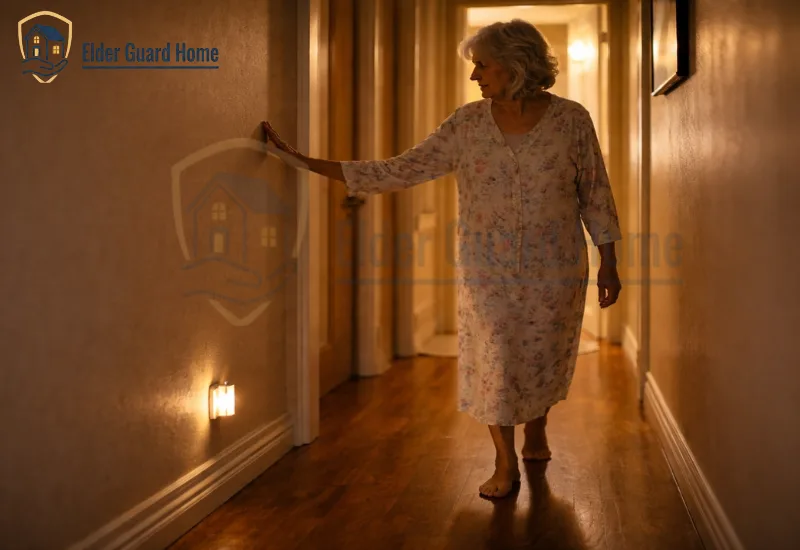
Picture this. It is 2am. Your mother wakes up needing the bathroom. She sits up, swings her legs over the edge of the bed, and steps onto the floor in complete darkness. She reaches for the wall switch — but it is four feet away. In those four steps, she cannot see the edge of the rug. She cannot judge the distance to the doorframe. And in a split second, she falls.
This is exactly why night lights for elderly adults are not optional — they are essential. According to the CDC, the fall death rate among adults aged 65 and older increased 21% between 2018 and 2024.
Research published in the National Institutes of Health confirms that most falls happen during nighttime hours on the short walk from bed to bathroom — a path that takes less than 30 seconds but carries enormous risk in darkness.
This guide reviews the six best night lights for elderly adults in 2026 and tells you exactly where to place each one. ElderGuard’s 9-point Senior Safety Checklist identifies lighting as one of the most overlooked home safety upgrades families make — so let us fix that right now.
What Are Night Lights for Elderly Adults?
Night lights for elderly adults are low-intensity, plug-in or battery-powered lights designed to illuminate the specific paths a senior uses at night — so they never take a single step in complete darkness.
The problem is not that seniors forget to turn on the lights. The problem is the gap between waking up and reaching the switch. Regular overhead lights require walking to a wall panel — which means navigating the room blind first. Night lights solve this by providing immediate, automatic illumination the moment your parent stirs.
As we age, our eyes change in ways that make nighttime navigation genuinely dangerous. Dark adaptation slows — meaning the eyes take much longer to adjust after waking. Depth perception declines. Glare becomes more painful. So even a short, familiar walk from bed to bathroom becomes significantly riskier without proper lighting support.
The four main types of night lights for elderly adults are motion-sensor plug-ins, dusk-to-dawn plug-ins, toilet bowl lights, and rechargeable stick-on models. Each serves a slightly different purpose — and the best setup uses at least two types together.
📎 Source: NIH PMC Nightlight Fall Prevention Study — pmc.ncbi.nlm.nih.gov
What to Look For in the Best Night Lights for Seniors
The best night lights for seniors share four key features — and missing any one of them can make a light useless or even counterproductive for an elderly adult.
Motion Sensor vs Dusk-to-Dawn — Which Works Better?
These are the two most common types and they serve different purposes. A motion sensor night light for elderly adults activates only when movement is detected — which makes it ideal for hallways and bathrooms where the light is only needed briefly. It conserves energy and does not disturb sleep by glowing all night.
Dusk-to-dawn lights use a photosensor to switch on automatically at dark and off at dawn. They provide constant low-level illumination all night — which is better for bedrooms and staircases where a senior needs to see the moment they open their eyes. The best home setups use both types: motion sensors in active areas and dusk-to-dawn in spaces that need constant visibility.
Light Color — Why Warm White Matters for Elderly Eyes
Not all white light is the same — and for seniors, the difference genuinely matters. Cool white or blue-toned light (above 4000K) suppresses melatonin and disrupts sleep quality. For elderly adults who already struggle with lighter sleep patterns, this makes things significantly worse.
Warm white light in the 2700K–3000K range is the safest and most comfortable option for nighttime use. It provides enough visibility to navigate safely while being gentle enough to avoid disrupting the sleep cycle. Amber or red-tinted light is even gentler for seniors with high light sensitivity — but warm white is the practical standard for most situations.
Brightness — Bright Enough to See, Dim Enough to Sleep
This is where many families get it wrong. Too bright and the light causes glare — a real hazard for seniors with cataracts or macular degeneration. Too dim and it does not actually illuminate the path properly.
The recommended lumen range for senior night lights is 10–50 lumens. Adjustable brightness is the best feature to look for because it lets you dial in the exact level your parent needs. Many models on this list offer brightness adjustment from as low as 1 lumen up to 50 — giving you full control without trial and error.
Placement Height and Coverage Area
An outlet-height plug-in works well for hallways and bathrooms but can cause eye-level glare in bedrooms if the outlet is positioned at the wrong height. For bedrooms, consider a lower placement or a rechargeable stick-on option at baseboard level.
Coverage area should overlap between adjacent lights. The goal is a continuous chain of illumination from the bedroom to the bathroom — with absolutely no dark gap in between. Even a short unlit section of hallway is enough to cause a fall.
The 6 Best Night Lights for Elderly Adults in 2026
All products reviewed below have a minimum 4.3-star rating on Amazon USA. Each has been selected based on safety features, ease of use, and specific suitability for elderly adults.
1. MAZ-TEK Motion Sensor Night Light — Best Overall for Seniors
One-sentence verdict: The MAZ-TEK is the most reliable plug-in motion sensor night light for elderly adults — it activates the moment your parent moves, never needs batteries, and costs less than $1 a year to run.
The MAZ-TEK plugs directly into any wall outlet and turns on automatically when motion is detected in low light. It switches off after 20 seconds of inactivity — long enough to light the path to the bathroom, but short enough to conserve energy through the night. Adjustable brightness lets you set it exactly right for your parent’s eyes without trial and error.
What makes the MAZ-TEK stand out for senior safety specifically is its instant activation — there is no perceptible delay between movement and illumination. For an elderly adult taking uncertain steps in the dark, that half-second delay found in cheaper models can be the difference between a safe step and a stumble. Plus, plug-in power means it is always on and always reliable — no dead batteries at 3am.
| Feature | Detail |
|---|---|
| Type | Motion sensor + plug-in |
| Brightness | Adjustable — up to 40 lumens |
| Light color | Warm white |
| Power | Plug-in — no batteries needed |
| Motion range | Up to 10 feet |
| Pack size | 2-pack |
✅ Pros:
- No batteries — always reliable, no maintenance
- Instant activation with zero perceptible delay
- Adjustable brightness suits sensitive elderly eyes
- 50,000-hour LED lifespan — lasts years without replacement
- Less than $1 per year in electricity costs
❌ Cons:
- Works at outlet height — may cause glare if outlet is positioned high in bedroom
- Motion range limited to 10 feet — two units needed for longer hallways
👤 Best For: Hallways and bathrooms on the bedroom-to-bathroom path
2. LOHAS LED Motion Sensor Night Light — Best Budget Pick
One-sentence verdict: The LOHAS 2-pack gives you genuine motion sensor night light for elderly protection at the lowest price point without cutting corners on warmth, reliability, or brightness control.
The LOHAS plugs into standard wall outlets and uses warm 3000K light — the same colour temperature recommended by lighting experts for senior nighttime use. Two adjustable brightness levels mean you can keep it dim for bedrooms and brighter for hallways. The dual-mode design lets caregivers set it to motion-only or always-on — which makes it versatile enough for any room.
For families on a tight budget who need to cover multiple rooms, the LOHAS hits a price point that makes whole-home coverage affordable. Two packs cover four rooms — enough for a bedroom, hallway, bathroom, and staircase landing for under $20.
| Feature | Detail |
|---|---|
| Type | Motion sensor + plug-in |
| Brightness | 30 or 60 lumens — two levels |
| Light color | 3000K warm white |
| Power | Plug-in |
| Modes | Motion-only or always-on |
| Pack size | 2-pack |
✅ Pros:
- Best value for money on this list
- Two brightness levels for different rooms
- Dual mode gives caregivers flexibility
- 3000K warm light safe for elderly eyes at night
❌ Cons:
- Plastic casing feels lightweight compared to competitors
- No dusk-to-dawn sensor — relies on motion only
👤 Best For: Budget-conscious caregivers covering multiple rooms at once
3. AUVON Plug-in LED Night Light — Best for Bedrooms
One-sentence verdict: The AUVON is the best bedroom night light for elderly adults — its dual motion and dusk-to-dawn sensor combination means it is always ready the moment your parent opens their eyes.
What sets the AUVON apart is its dual-sensor system. The dusk-to-dawn sensor turns it on at dark automatically.
The motion sensor then keeps it active throughout the night whenever movement is detected. So whether your parent stirs at 11pm or 3am, the light is already on and waiting.
The brightness range — fully adjustable from 1 to 50 lumens — is the finest control of any plug-in option on this list. That matters for seniors with cataracts or high glare sensitivity who need the dimmest possible light to navigate safely without discomfort.
The V-0 fire-resistant casing and over-current protection are worth noting too. These are not features you expect at this price point — but they make the AUVON a genuinely safe product to leave plugged in continuously for months at a time.
| Feature | Detail |
|---|---|
| Type | Motion sensor + dusk-to-dawn dual |
| Brightness | 1–50 lumens fully adjustable |
| Light color | Warm white |
| Power | Plug-in |
| Sensors | Dual — motion + ambient light |
| Pack size | 4-pack |
✅ Pros:
- Dual sensor for maximum reliability in bedrooms
- Finest brightness control — down to 1 lumen
- 4-pack covers the full bedroom-to-bathroom path
- V-0 fire-resistant casing — safe for continuous use
- 24-month warranty
❌ Cons:
- Slightly larger body than competitors — may block second outlet
- Higher price than single-sensor alternatives
👤 Best For: Bedrooms and seniors with cataracts, macular degeneration, or high light sensitivity
4. GE LED Motion Sensor Night Light — Best UL-Certified Option
One-sentence verdict: The GE is the safest, most trustworthy plug-in night lights for elderly adults who want brand-name reliability and zero setup.
GE is a name most seniors and their families already know and trust — and this night light earns that trust with full UL certification, consistent 40-lumen output, and a no-fuss plug-and-done design. There are no buttons to press, no settings to configure, and no sensors to calibrate. Your parent plugs it in and it simply works — activating on motion in darkness and turning off automatically when the room is still.
For families whose parent finds technology confusing or frustrating, the GE is the right choice. It requires absolutely nothing from the senior after installation. That simplicity is its greatest strength.
| Feature | Detail |
|---|---|
| Type | Motion sensor + plug-in |
| Brightness | 40 lumens fixed |
| Light color | Soft white |
| Power | Plug-in |
| Certification | UL-certified |
| Pack size | 2-pack |
✅ Pros:
- UL-certified — the highest consumer safety standard
- Trusted GE brand name seniors recognise and trust
- Zero setup — plug in and done
- Energy-efficient LED rated for years of continuous use
❌ Cons:
- Fixed brightness — cannot adjust for sensitive eyes
- No dusk-to-dawn option
👤 Best For: Seniors who dislike technology and families who want certified safety above all else
5. Emotionlite Night Light 6-Pack — Best for Whole-Home Coverage
One-sentence verdict: The Emotionlite 6-pack is the most practical night light to prevent falls elderly families need — it covers an entire home’s nighttime path in one affordable purchase.
When your parent’s bedroom, hallway, bathroom, kitchen, and staircase all need coverage, buying individual 2-packs adds up fast. The Emotionlite 6-pack solves that with six dusk-to-dawn plug-in lights at roughly half the per-unit cost of buying separately. Each light uses a photosensor to turn on automatically at dusk and off at dawn — no motion sensor, but constant reliable low-level illumination throughout every dark hour.
The 6-lumen output is gentle enough to leave on all night without disturbing sleep but bright enough to see foot placement clearly. For seniors who simply want light when they wake up — without any activation delay — the always-on dusk-to-dawn design is the most reassuring option.
| Feature | Detail |
|---|---|
| Type | Dusk-to-dawn sensor |
| Brightness | 6 lumens — gentle constant glow |
| Light color | Warm white |
| Power | Plug-in |
| Sensor | Ambient light only — always on at dark |
| Pack size | 6-pack |
✅ Pros:
- Best value for whole-home coverage — 6 lights in one purchase
- Always-on at dark — no activation delay, no dark gaps
- Requires zero effort from the senior after installation
- Compact and unobtrusive design
❌ Cons:
- No motion sensor — light stays on all night which uses slightly more energy
- Lower brightness than motion-sensor options — not ideal as the only light in a long hallway
👤 Best For: Multi-room setups and seniors who prefer constant gentle illumination with no technology to manage
6. Toilet Bowl Night Light — Best for Bathroom Fall Prevention
One-sentence verdict: A toilet bowl night light is the single most underrated night light to prevent falls elderly bathroom trips cause — and every senior’s bathroom should have one alongside their plug-in lights.
This product solves one specific problem brilliantly. When your parent reaches the bathroom at night, turning on the overhead light causes temporary visual blindness — the sudden bright glare can last 30 seconds or more. In those 30 seconds, they are navigating a room with a hard tile floor, a toilet, a sink, and a bath edge. The toilet bowl night light clips onto the inside rim and projects a soft LED glow activated by motion — enough to use the toilet safely without triggering that blinding overhead glare at all.
Most models offer multiple colour options and run on standard batteries for 6 to 12 months. There is no installation needed — it clips on in under 30 seconds.
| Feature | Detail |
|---|---|
| Type | Motion sensor — toilet mounted |
| Brightness | Ultra-low — gentle glow only |
| Light color | Multiple colour options |
| Power | Batteries — 6 to 12 months |
| Installation | Clip-on — no tools needed |
| Best placement | Inside toilet bowl rim |
✅ Pros:
- Eliminates blinding overhead light during nighttime bathroom visits
- No installation — clips on in 30 seconds
- Gentle glow does not disrupt the sleep cycle
- Works with any standard toilet
- Very affordable — under $15
❌ Cons:
- Battery-powered — needs periodic replacement every 6–12 months
- Not a path light — must be paired with plug-in options for complete coverage
👤 Best For: Every senior’s bathroom — use this alongside plug-in path lights for complete nighttime protection
All 6 Night Lights for Elderly Compared
| Product | Type | Brightness | Best Room | Pack | Rating |
|---|---|---|---|---|---|
| MAZ-TEK | Motion sensor | Up to 40 lm | Hallway / Bathroom | 2-pack | ⭐ 4.5 |
| LOHAS | Motion sensor | 30–60 lm | Any room | 2-pack | ⭐ 4.4 |
| AUVON | Motion + dusk-to-dawn | 1–50 lm | Bedroom | 4-pack | ⭐ 4.5 |
| GE LED | Motion sensor | 40 lm fixed | Any room | 2-pack | ⭐ 4.6 |
| Emotionlite | Dusk-to-dawn | 6 lm constant | Whole home | 6-pack | ⭐ 4.4 |
| Toilet Bowl Light | Motion — toilet | Glow only | Bathroom | 1-pack | ⭐ 4.4 |
Where to Place Night Lights for Elderly Adults
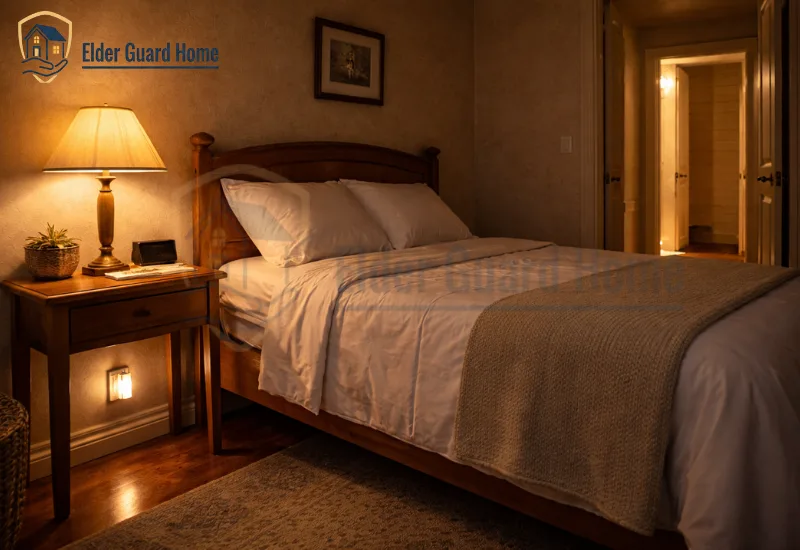
Placement is just as important as the product — a night light for elderly adults in the wrong spot does almost nothing to reduce fall risk.
Step 1 — Start With the Bed-to-Bathroom Path
This is the single highest-risk route in any senior’s home. Place one light at or near the bedside — either at baseboard level or in the nearest outlet. Add another at the bathroom entrance so your parent can see the doorframe before they step through it. Cover any hallway section in between so there is never a dark gap to navigate.
The goal is a continuous chain of light from the moment your parent’s feet touch the floor to the moment they reach the toilet safely.
Step 2 — Add Staircase Lighting at the Top and Bottom
Stairs are the second highest-risk location for elderly nighttime falls — and they are the most unforgiving. A misstep on a staircase at night can cause a serious injury. Place a dusk-to-dawn light at both the top landing and the bottom step. Use dusk-to-dawn rather than motion-activated here — a constant light is safer on stairs because your parent needs to see where the step is before they move toward it.
Step 3 — Cover the Bathroom Properly
Add a toilet bowl light inside the toilet. This alone eliminates the need to turn on the overhead light at night — which causes temporary visual blindness that lasts 20–30 seconds on a wet tile floor. Also place a plug-in at outlet height near the sink for general bathroom visibility. Avoid cool-white lights in the bathroom at night — warm white only.
Step 4 — Walk the Path Yourself at Night
Before your parent uses the new setup, walk the entire path yourself in the dark. You will immediately notice anything missing. Is there a dark patch between the bedroom door and the hallway outlet? Does the light at the bathroom entrance actually illuminate the floor before the step threshold? Small gaps you miss in daylight become significant hazards at 2am.
What These Lights Will Not Replace
Night lights for elderly adults dramatically reduce fall risk — but they do not eliminate every hazard in the home. Being honest about that is important.
Loose rugs are still dangerous regardless of how well-lit the path is. So are slippery bathroom floors, furniture positioned too close to walking routes, and beds that are too high to get off safely. A well-lit path to a slippery bathroom floor is still a risky path.
That is why night lights work best as part of a broader home safety approach. Our guide on non-slip bath mats for elderly adults covers bathroom floor safety in detail. Our review of bed rails for elderly adults addresses the getting-in-and-out-of-bed risk that happens right before that nighttime walk begins. For a complete room-by-room assessment of your parent’s home, ElderGuard’s 9-point Senior Safety Checklist is the most practical place to start.
What Caregivers Say
The following experiences were shared by caregivers in our community. Names have been changed to protect privacy. These are real situations — not paid testimonials.
“My mum had a near-fall at 3am trying to reach the bathroom light switch. I installed two MAZ-TEK motion lights — one near her bed and one at the bathroom door. She has not needed to touch a light switch at night since. What surprised me most is that she actually gets up in the night more often now — because she is not afraid of the dark walk anymore. That independence matters so much to her.” — Claire B., daughter and caregiver, Texas
“Dad used to turn on the overhead bathroom light every single time he got up at night. He said afterward he could not see properly for several minutes and had to hold the wall. After we added a toilet bowl night light, he stopped using the overhead light completely. He said it was the first time in years he felt steady in the bathroom at night. It cost less than $12 and took 30 seconds to install.” — Marcus A., son and primary caregiver, Georgia
“I use the Emotionlite 6-pack as my standard setup in every senior client’s home. It covers the whole house in one purchase and requires absolutely nothing from the senior to operate — no buttons, no reminders, just light whenever it is dark. I have recommended it to at least a dozen families and every single one has reported fewer nighttime disturbances and more confidence from their parent.” — Janet W., professional caregiver, Ohio
Frequently Asked Questions
What is the best night light for elderly adults to prevent nighttime falls?
The best overall option is the MAZ-TEK Motion Sensor Night Light — it activates instantly when your parent moves, never needs batteries, and costs under $1 a year to run. For bedrooms specifically, the AUVON with its dual motion and dusk-to-dawn sensor is the most reliable choice. Both work best when used together along the bedroom-to-bathroom path.
Where should I place a night light for an elderly parent living alone?
Start with the three most critical spots: near the bedside, in the hallway between the bedroom and bathroom, and at the bathroom entrance. Add a toilet bowl light inside the bathroom to avoid the overhead light glare. Also place lights at the top and bottom of any staircase your parent uses. The goal is a continuous chain of light with no dark gaps.
Are motion sensor night lights safe to leave plugged in all night?
Yes — modern LED motion sensor night lights are specifically designed for continuous plug-in use. They consume almost no energy, produce almost no heat, and have LED lifespans measured in tens of thousands of hours. Look for UL-certified models like the GE for the highest safety assurance if that is a concern.
What color night light is best for seniors — warm white or cool white?
Warm white every time. Cool white or blue-toned light suppresses melatonin and disrupts sleep quality — which is already more fragile in elderly adults. Stick to lights rated 2700K–3000K. Amber or red-tinted light is even gentler for seniors with very high light sensitivity.
How many night lights does an elderly person need in their home?
At minimum, four: one near the bed, one in the hallway, one at the bathroom entrance, and a toilet bowl light inside the bathroom. A staircase needs two more — top and bottom. So realistically, a 6-pack covers a standard single-floor home, while a two-story home needs 8 to 10 lights for complete coverage.
Conclusion
Night lights for elderly adults are the most affordable, most effective home safety upgrade most families are not making — and that needs to change. The right light in the right spot costs under $20 and takes five minutes to install. Yet it directly addresses the most common cause of nighttime falls in seniors living at home.
The best night lights for seniors on this list all share the same qualities: warm light, reliable activation, and plug-in power that never runs out of batteries at 3am. Start with the MAZ-TEK for hallways and bathrooms, the AUVON for the bedroom, and a toilet bowl light for the bathroom. Add the Emotionlite 6-pack if you want to cover the whole home in one purchase.
Pair your new lighting with non-slip bath mats for the bathroom floor and bed rails for elderly adults for safer getting in and out of bed. Together, these three upgrades address the three most dangerous moments of your parent’s night — and all of them can be done this weekend without a contractor or a renovation.
Small changes. Real safety. Start tonight.