
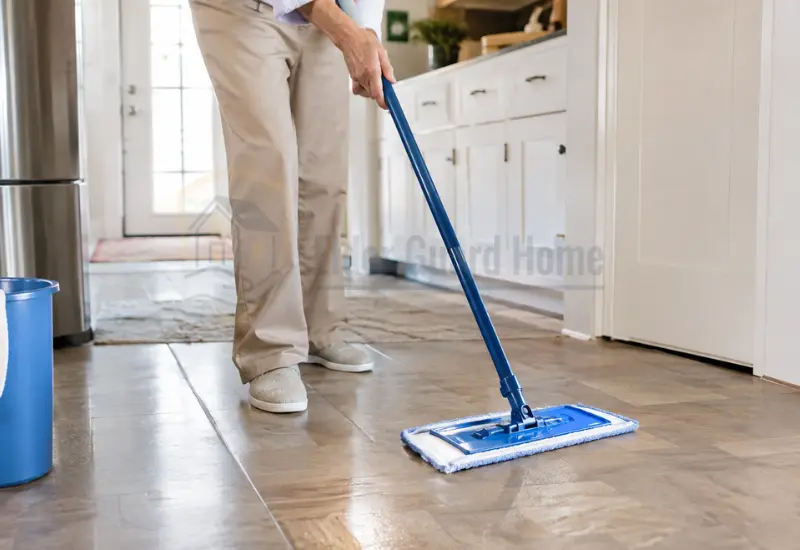
Vinyl floors are not automatically slippery. Their traction depends on the product, surface condition, moisture, and maintenance.
A floor can also become more slippery after years of cleaning or surface wear. The same vinyl product may feel different under changing conditions.
Cleaning Residue Can Leave Vinyl Floors Slick
Some cleaning products can leave a film behind after repeated use. That film may change how the floor feels underfoot.
This problem can be easy to miss during routine cleaning. The floor may look shiny while feeling unusually slick.
Manufacturers commonly recommend specific cleaners for vinyl flooring. Some also warn against wax, polish, or unsuitable cleaning products.
For example, COREtec recommends pH-neutral cleaners without polish or wax.
If your vinyl floor suddenly feels different, inspect the cleaning routine first.
Water and Moisture Reduce Traction
Water can make many smooth flooring surfaces more difficult to walk across.
This matters most in bathrooms, kitchens, laundry areas, and entryways. Spilled drinks can create the same problem in living areas.
Older adults may also encounter moisture near sinks and showers. Small wet areas can therefore deserve more attention than large dry rooms.
Wipe spills promptly and allow damp flooring to dry completely.
The NIA specifically recommends nonslip solutions on surfaces that may become wet.
Some Vinyl Surfaces Are Smoother Than Others
Vinyl is a broad flooring category.
LVP, luxury vinyl tile, and sheet vinyl can have different surface textures. Some products have embossed textures that provide a different walking feel.
Other products may have smoother decorative surfaces.
Do not assume all vinyl floors have the same traction. Check the actual flooring product whenever possible.
Surface Wear Can Change Floor Traction
Older vinyl can develop scratches, worn areas, discoloration, or damaged surface layers.
Heavy traffic can make certain sections look and feel different.
Surface wear can also make cleaning problems more noticeable.
Inspect areas where people walk most frequently. Pay special attention to kitchens, hallways, and bathroom approaches.
How to Make Vinyl Floors Less Slippery
Start by identifying why the floor feels slippery. Do not immediately apply a new coating or traction product.
A simple cleaning change may solve the problem.
Other situations may require repairs, mats, treatment, or replacement.
1. Remove Cleaning Residue
First, review everything currently used on the floor.
Check your cleaner, dilution, mop, and cleaning frequency.
Avoid adding more product when the floor already feels coated. Excess cleaner can remain on the surface instead of improving cleanliness.
Use the flooring manufacturer’s recommended cleaner and method.
Shaw recommends removing dirt regularly and wiping spills quickly. It also recommends a neutral-pH cleaner for routine wet cleaning.
If residue remains, follow the manufacturer’s deep-cleaning instructions.
Do not experiment with strong chemicals without checking compatibility.
2. Use the Right Vinyl Floor Cleaner
The correct cleaner depends on the flooring product.
Some vinyl floors require specific pH-balanced products. Others have different requirements for finishes or surface treatments.
Avoid assuming that a general household cleaner is suitable.
Shaw advises against abrasive cleaners, ammonia-based products, vinegar-based products, and harsh chemicals.
Armstrong also warns against detergents, abrasive cleaners, and unsuitable polish products.
Always check the flooring manufacturer’s current care instructions.
3. Keep Vinyl Floors Dry
Moisture control is one of the simplest safety improvements.
Clean spills as soon as they happen. Do not allow water to remain around sinks or entryways.
Use suitable mats where moisture regularly enters the home.
Dry the surrounding floor after cleaning.
Pay particular attention to bathroom and kitchen walking routes.
A dry floor also makes it easier to identify other traction problems.
4. Choose Mats Carefully
Mats can help control moisture near entrances and other wet areas.
However, a loose mat can create a separate fall hazard.
The CDC recommends removing throw rugs or securing them against movement.
Choose low-profile mats that remain stable during normal walking.
Check the mat backing for compatibility with your vinyl floor.
Some rubber or latex-backed products can stain certain vinyl floors.
Armstrong specifically warns that some rubber and latex-backed mats can cause staining.
5. Use a Suitable Anti-Slip Treatment
Anti-slip treatments can be useful in some situations.
However, compatibility matters more than simply choosing a product labeled anti-slip.
The treatment must be suitable for your specific vinyl flooring.
Check whether the manufacturer permits coatings or traction treatments.
Test any approved treatment according to its instructions.
Never assume that a product designed for tile or concrete works on vinyl.
An unsuitable coating could damage the surface or change its appearance.
It could also create a new cleaning problem.
6. Check LVP and Sheet Vinyl Surface Wear
Inspect the floor closely instead of judging it from across the room.
Look for worn areas, scratches, peeling surfaces, damaged edges, and unusual discoloration.
LVP can develop problems around individual planks.
Sheet vinyl can develop damage across larger continuous areas.
A damaged surface may need repair rather than another cleaning product.
Document the affected area before contacting the flooring manufacturer.
7. Pay Attention to Bathroom and Kitchen Areas
Bathrooms deserve special attention because water is frequently present.
Kitchen floors also face spills, grease, and repeated cleaning.
Keep walking areas around sinks as dry as practical.
Use suitable mats without creating raised edges.
Check the floor after bathing, cooking, or cleaning.
If a floor repeatedly becomes dangerously slippery, investigate the underlying cause.
Do not simply place another loose mat over the problem.
8. Check Vinyl Seams and Edges
Sheet vinyl has fewer seams than many plank floors.
However, seams can still become damaged or separated.
LVP has joints between individual planks.
Look for lifted edges, gaps, movement, or damaged sections.
These problems can affect both walking stability and mobility equipment.
Do not cover damaged seams with tape or improvised materials.
Ask a qualified flooring professional about appropriate repairs.
9. Consider Walker and Rollator Movement
A floor can feel acceptable while still behaving differently under walker wheels.
Test the actual mobility aid on the vinyl surface.
Watch how the wheels move during straight walking and turning.
Check whether the walker rolls smoothly without unexpected sliding.
Also test transitions between vinyl and nearby rugs.
The NIA recommends using canes and walkers correctly when additional stability is needed.
If the walker behaves unpredictably, consider professional assessment.
10. Address Areas With Repeated Slipping
One isolated slippery spot may have an obvious cause.
Repeated slipping in the same location deserves closer inspection.
Look for moisture, residue, surface wear, lighting problems, or nearby mats.
Also check whether the person’s footwear contributes to the problem.
If the surface remains unusually slippery, consider professional flooring advice.
LVP vs. Sheet Vinyl: Which Can Be More Slippery?
Neither material is automatically safer in every home.
The actual product, texture, finish, installation, and maintenance all matter.
LVP Flooring
LVP consists of individual planks or tiles.
This creates many joints across the floor.
A properly installed LVP floor can provide a firm walking surface.
However, surface texture varies between products.
Inspect the actual product rather than relying on the LVP label.
Sheet Vinyl
Sheet vinyl can create a more continuous walking surface.
It generally has fewer floor joints than plank flooring.
That can simplify cleaning in some rooms.
However, sheet vinyl can still become slippery when wet or coated with residue.
Surface texture and product specifications remain important.
Which One Should Seniors Choose?
There is no universal winner between LVP and sheet vinyl.
Existing flooring should first be evaluated for actual safety.
If the current floor remains stable and manageable, replacement may not be necessary.
Focus on traction, moisture, maintenance, transitions, and mobility needs.
What Should You Not Put on Vinyl Floors to Prevent Slipping?
Trying to increase traction can sometimes create additional problems.
Avoid applying products simply because they claim to make floors safer.
Always check compatibility first.
Avoid Excess Wax and Polish
Many modern vinyl floors do not need traditional waxing.
Some manufacturers specifically warn against wax or polish products.
COREtec recommends avoiding shine, wax, and polish cleaning products.
Armstrong also warns against paste wax and solvent-based polishes for its luxury vinyl floors.
Do not assume extra shine means better floor maintenance.
Avoid Oily or Improvised Treatments
Do not use household oils to increase traction.
Avoid homemade mixtures that have not been approved for vinyl flooring.
An oily surface can create another slip concern.
It can also attract dirt and complicate future cleaning.
Avoid Incompatible Anti-Slip Products
A traction product designed for another flooring material may not suit vinyl.
Check the product label and flooring manufacturer’s instructions.
Look for specific compatibility with your flooring type.
When uncertain, contact the flooring manufacturer before applying anything.
Do Not Ignore Manufacturer Cleaning Instructions
Your floor’s care instructions are more useful than generic internet cleaning advice.
Keep the product name and installation information if available.
This information can help identify suitable cleaners and treatments.
It can also help determine whether the floor needs professional repair.
Are Vinyl Floors Safe for Seniors in Bathrooms and Kitchens?
Vinyl can work well in bathrooms and kitchens.
However, moisture changes the safety equation.
A floor that feels stable when dry may feel different when wet.
Keep spills under control and choose suitable mats carefully.
Check areas around showers, sinks, refrigerators, and cooking surfaces.
If the same location repeatedly becomes slippery, investigate the flooring condition.
Do not rely on footwear alone to compensate for a problematic surface.
Are Mats Safe on Vinyl Floors for Older Adults?
Mats can help manage water and dirt.
They can also introduce sliding, curling, and raised-edge hazards.
The NIA recommends securing carpets and avoiding loose throw rugs.
Read our guide on how to make a rug safe for an elderly parent.
When a Mat Can Improve Safety
A mat may help when it remains completely stable.
It should also have a suitable low-profile design.
Use mats where they solve a specific moisture or dirt problem.
Entryways and areas beside sinks may benefit from appropriate mats.
When a Mat Creates a Fall Hazard
Remove or replace a mat that moves during normal use.
Also reconsider mats with curled edges or damaged backing.
Watch for mats that interfere with doors.
Walker users need special attention around raised mat edges.
How to Make Mats Safer on Vinyl
Check the mat backing before installation.
Confirm that the backing will not stain or damage your flooring.
Keep the mat flat and fully supported.
Test it with the person’s actual footwear and mobility equipment.
Inspect it again after several days of normal use.
How to Make Vinyl Floors Safer for Someone Using a Walker or Rollator
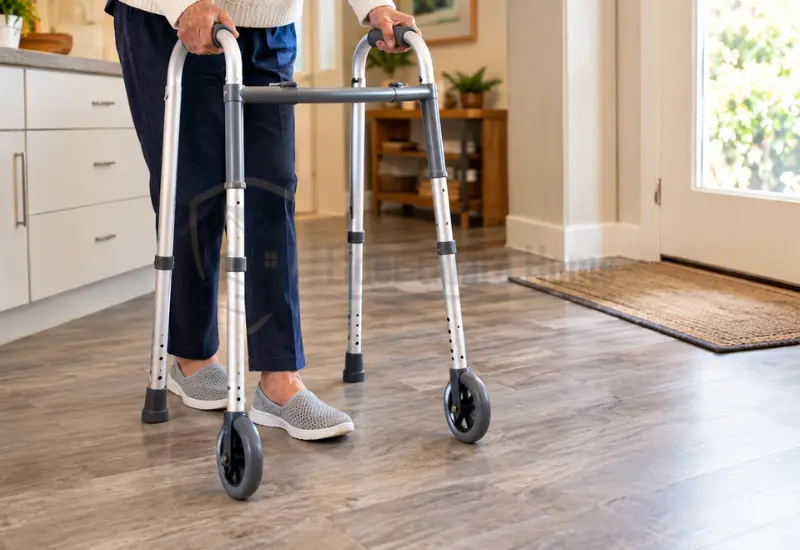
Mobility equipment changes how flooring should be evaluated.
A walker or rollator does not interact with flooring like ordinary footwear.
Check Walker Wheels and Tips
Check wheels, tips, and other contact points regularly.
They should remain intact and properly fitted.
The NIA recommends checking that walker wheels roll smoothly.
Do not use damaged equipment on a questionable floor.
Watch for Changes Between Flooring and Mats
A walker can react differently when moving from vinyl onto a mat.
The edge may catch a wheel or change rolling resistance.
Test these transitions from both directions.
If the walker catches, reconsider the mat or transition.
Keep Mobility Paths Clear
Keep the main walking route free from clutter.
Avoid placing unnecessary mats across narrow pathways.
Furniture should not force sharp turns around slippery areas.
The CDC recommends keeping floors clear of trip hazards.
Check Seams, Edges, and Loose Sections
Inspect every visible flooring joint along major walking routes.
Look for lifted plank edges or damaged sheet-vinyl seams.
These defects can interfere with walker wheels.
Repair flooring problems before adding traction products.
A Simple Vinyl Floor Safety Check for Seniors
Use this inspection whenever the floor feels unusually slippery.
Check for Slick Cleaning Residue
Run a clean hand lightly across the dry surface.
Look for an unusual film or sticky feeling.
Review the products used during recent cleaning.
Check for Moisture
Inspect bathrooms, kitchens, entrances, and areas around sinks.
Look for repeated wet spots.
Identify where the moisture comes from.
Check Surface Wear
Look closely at high-traffic areas.
Compare worn sections with less-used parts of the floor.
Look for scratches, peeling, discoloration, or damaged surfaces.
Check Mats and Edges
Push each mat gently in several directions.
Check every corner and edge.
Make sure doors do not catch the mat.
Check Seams
Inspect LVP joints and sheet-vinyl seams.
Look for lifting, separation, movement, or visible damage.
Check Mobility Aids
Test the person’s walker or rollator.
Watch for catching, sliding, hesitation, or unexpected movement.
Check Bathroom and Kitchen Transitions
Look at transitions near wet areas.
Make sure mats and flooring changes do not create raised edges.
If a transition remains difficult, see our guide on how to tell if a floor transition is too high for a walker.
When Should Vinyl Flooring Be Replaced?
Not every slippery vinyl floor needs replacement.
Start by identifying the actual problem.
Cleaning residue can often be addressed without replacing flooring.
A loose mat can also be removed or replaced.
Some damaged flooring requires professional repair.
Replacement becomes more reasonable when the surface remains problematic after appropriate corrections.
Consider replacement when you find:
- Persistent surface damage.
- Severe wear.
- Repeatedly damaged seams.
- Curling or loose sections.
- Significant water damage.
- Flooring that cannot provide suitable traction.
- A surface incompatible with changing mobility needs.
- Problems that remain after professional assessment.
Do not replace flooring simply because another product looks newer.
Replace it when the existing surface no longer supports safe everyday movement.