
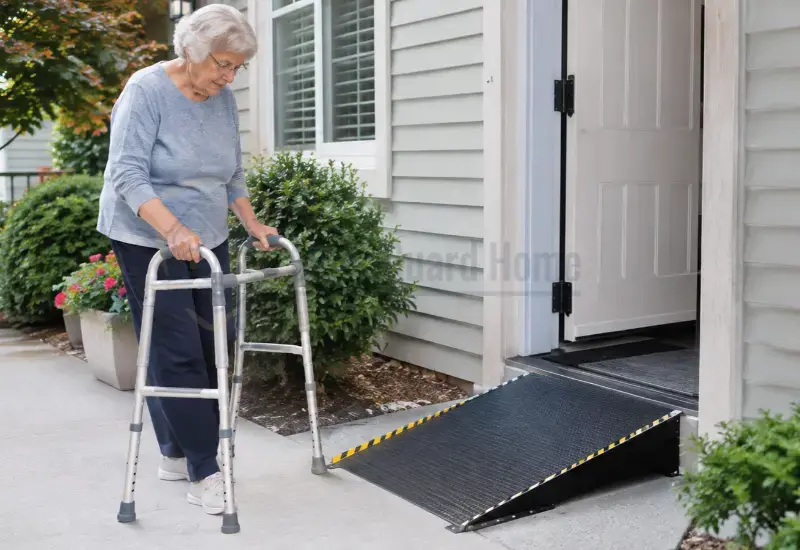
How Do You Choose a Threshold Ramp for a Walker?
Choose a threshold ramp by matching its dimensions to the doorway and mobility device.
Before shopping, learn how to tell if a floor transition is too high for a walker, then use that measurement to choose a suitable ramp.”
Follow these steps before ordering:
- Measure the vertical height difference between the two floor surfaces.
- Check how much horizontal space is available for the ramp.
- Measure the clear doorway width and the ramp’s usable surface.
- Choose rubber, aluminum, or a modular design for the location.
- Check the weight rating, traction, stability, and door clearance.
- Confirm that the ramp works with the person’s actual walker or rollator.
A low threshold may suit a compact rubber wedge or aluminum ramp. A higher rise may require a longer or modular solution.
Do not choose by maximum height alone. The ramp must fit the actual doorway and allow controlled movement.
What Is a Threshold Ramp, and When Does a Walker Need One?
A threshold ramp is a sloped surface that bridges a height difference between adjacent walking areas. It replaces an abrupt lip with a more gradual transition.
These ramps are commonly used at interior doorways, exterior entrances, patio doors, and other raised thresholds.
Common doorway problems a ramp can address
A threshold ramp may help when a person struggles with:
- Raised wooden or metal door sills.
- Small steps between rooms.
- Uneven transitions between different flooring surfaces.
- Sliding-glass-door tracks that create a raised edge.
- Exterior thresholds that interrupt an otherwise level walkway.
The correct solution depends on the size and shape of the obstacle. Some doorways have several different heights across the same transition.
When a threshold ramp may not be enough
A compact doorway ramp is not designed to solve every access problem.
A very high step may require a longer ramp with adequate approach and landing space. A loose threshold may need repair instead of a ramp.
An uneven floor or damaged doorway may also need professional assessment. Avoid covering structural damage with a portable wedge.
A threshold ramp for elderly users should improve access without creating a new obstruction. It should not rock, slide, or interfere with normal door operation.
How to Measure Your Threshold Before Buying a Ramp
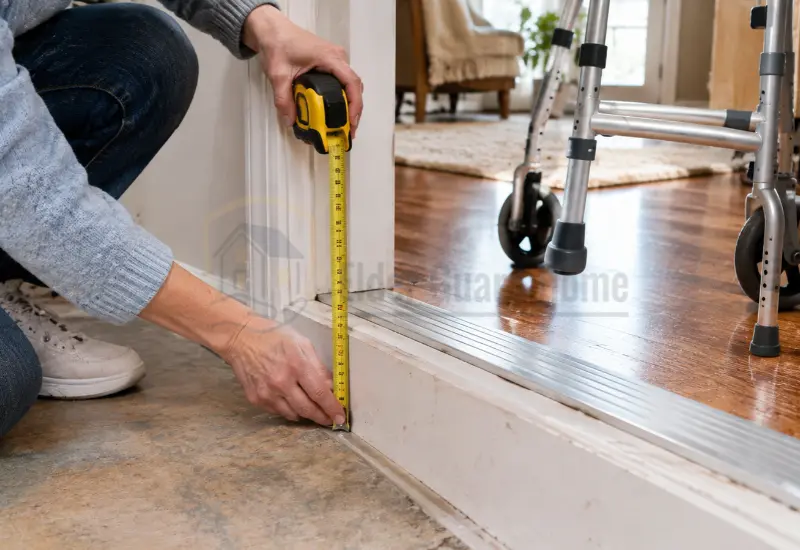
Accurate measurements prevent many common buying mistakes. Measure the doorway before comparing product listings.
Measure the threshold height
Use a tape measure or ruler to measure vertically from the lower walking surface to the top of the threshold.
Record the actual rise in inches. If the threshold slopes or varies across its width, measure the highest relevant point.
Do not estimate the height by looking at the doorway. A difference of even half an inch can affect which ramp fits.
Measure both sides of the doorway
The inside and outside surfaces may not sit at the same height. Sliding doors can also have tracks with several raised sections.
Measure the transition from each approach where necessary. Check whether a single ramp can accommodate the shape or whether a different design is needed.
Measure the available ramp length
Ramp length determines how much space the ramp occupies as it rises.
A longer ramp generally provides a gentler incline for the same height difference. However, the doorway may not have enough room for a longer model.
Measure the clear floor space before choosing a ramp. Include the space needed to approach and leave the doorway comfortably.
Measure the usable doorway width
Measure the clear opening rather than relying only on the door’s advertised width.
Check the ramp’s actual usable surface. Some models have raised edges or sidewalls that reduce the available crossing width.
The ramp should accommodate the user’s walker or rollator and normal movement. It should also leave enough room for the person to position the device.
Check the door swing and nearby obstacles
Open and close the door slowly while checking the proposed ramp location.
Look for conflicts with the door bottom, weatherstripping, sliding tracks, or floor trim. Check whether the ramp would obstruct the doorway when the door is fully open.
For more help understanding the original transition, read our guide on safe flooring options for aging in place.
How to Choose the Right Ramp Length for the Threshold Height
The threshold ramp height is only one part of the decision. Ramp length and slope also affect how the transition feels underfoot.
Understand rise, run, and slope
Rise is the vertical height the ramp must bridge. Run is the horizontal distance the ramp covers. Slope describes how quickly the ramp gains height.
A longer ramp generally creates a gentler incline for the same rise. A short ramp can become steep even when its listed height matches the threshold.
The ADA’s general ramp standard uses a 1:12 slope in many accessible-route situations. That is a useful reference for understanding slope, but it is not a universal rule for every residential threshold product. Requirements and suitability depend on the application.
For a person using a walker, the ramp must also suit their balance, strength, mobility device, and available space.
Threshold ramp length examples
The table below shows the horizontal run corresponding to a 1:12 reference slope. These are mathematical examples, not recommendations for every home.
| Measured rise | Run at a 1:12 reference slope |
|---|---|
| ½ inch | 6 inches |
| 1 inch | 12 inches |
| 2 inches | 24 inches |
| 3 inches | 36 inches |
| 4 inches | 48 inches |
A molded threshold ramp may have a shorter run and a steeper incline. Check the manufacturer’s specifications and suitability for the intended user.
What if the ramp is too short or too tall?
A short ramp may create an abrupt incline that feels difficult to cross. A ramp that is too tall may leave a raised edge at the top.
Both situations can create new hazards. Never assume that matching the listed maximum rise guarantees a suitable fit.
What should you do with a four-inch threshold?
A four-inch rise needs particular attention. A compact wedge may be too steep for comfortable, controlled movement.
Measure the available run and landing areas carefully. Consider a longer or modular access solution if the doorway and surrounding space allow it.
For complex or unusually high transitions, seek advice from a qualified accessibility professional.
Rubber vs. Aluminum Threshold Ramps — Which Is Better for Walkers?
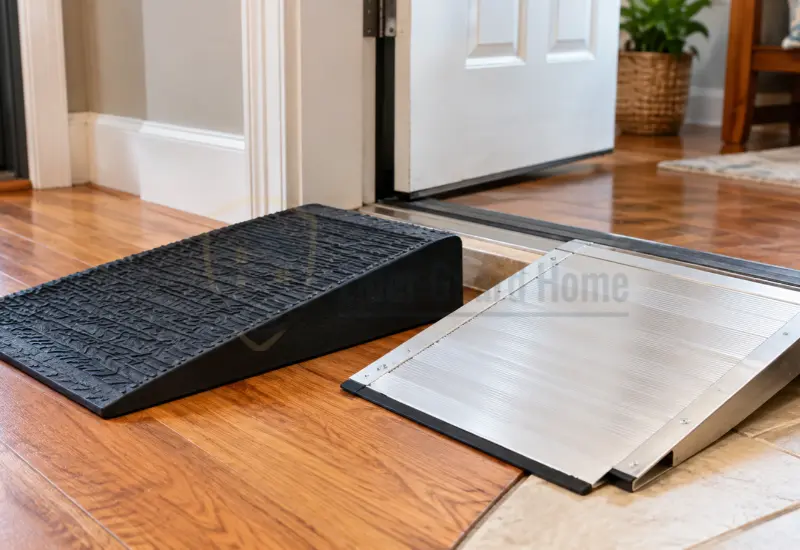
Rubber and aluminum are common choices, but neither material is best for every doorway.
The right option depends on the rise, location, handling needs, surface finish, and installation method.
Rubber threshold ramps for seniors
Rubber ramps are often used for small doorway transitions. Many have textured surfaces and sloped edges.
Potential advantages:
- Some models provide a substantial, stable base.
- Textured surfaces may improve traction.
- Many designs are suitable for indoor or outdoor use.
- Certain models can be trimmed, following manufacturer instructions.
Potential limitations:
- Heavier models may be difficult to reposition.
- Some rubber products have a noticeable odor when new.
- The size and thickness may interfere with door clearance.
- Outdoor suitability varies by product and installation.
A rubber threshold ramp for seniors may work well when the height is modest and the ramp can remain securely in place.
For wooden floors, also review how to make hardwood floors less slippery for seniors, especially if the surrounding surface feels slick.
Aluminum threshold ramps for walkers
Aluminum ramps are available in portable, modular, and adjustable designs. Some have transition lips or mounting hardware.
Potential advantages:
- Many models are relatively lightweight.
- Some designs are easier to carry or reposition.
- Modular products can accommodate certain nonstandard transitions.
- Rigid construction can provide a firm crossing surface.
Potential limitations:
- Surface traction varies by model.
- Exposed metal may become slippery under some conditions.
- Some designs require screws or other fixing methods.
- Edges and support points must fit the doorway correctly.
An aluminum threshold ramp for walkers may suit a doorway where portability or a rigid platform matters. For outdoor use, verify the manufacturer’s wet-weather guidance and surface specifications.
Rubber vs. aluminum threshold ramp comparison
| Feature | Rubber | Aluminum |
|---|---|---|
| Handling | Some models are heavy | Many models are lighter |
| Traction | Depends on tread and rubber compound | Depends on texture and finish |
| Portability | Varies by size and weight | Often available in portable designs |
| Adjustability | Usually model-specific | Available in some modular designs |
| Outdoor use | Check weather and placement ratings | Check traction, corrosion resistance, and installation |
| Door clearance | Check thickness and ramp profile | Check platform height and transition lips |
Do not select a material based on appearance alone. Confirm the actual dimensions, traction, weight rating, and installation requirements.
Modular vs. Portable Threshold Ramps — Which Type Do You Need?
These designs serve different purposes. The best choice depends on the threshold and whether the ramp will stay in one place.
Modular threshold ramps for higher transitions
Modular ramps use configurable components or sections to accommodate certain heights and widths.
They may be useful for larger rises or transitions that do not match standard one-piece wedges. Some systems allow additional sections or height adjustments.
Before buying, confirm the maximum supported rise and the dimensions of the complete configuration. Check how the parts connect and whether the manufacturer requires anchoring.
Portable threshold ramps for temporary access
Portable ramps can help with temporary access needs, travel, or situations where a permanent modification is not practical.
Consider the ramp’s weight, storage requirements, carrying method, and setup process. A ramp that a caregiver can move easily may still be difficult for the person using the walker.
Check whether the ramp is designed for the actual threshold shape. Portability does not guarantee stability.
When a longer access ramp may be necessary
A high exterior sill or substantial step may need more than a compact threshold wedge.
A longer ramp can require considerable floor space. The landing areas, approach, door operation, and available turning space must all be considered.
If the transition is unusually high or complicated, obtain professional guidance before purchasing.
How to Choose a Threshold Ramp for a Walker or Rollator
A ramp must work with the mobility device, not just the doorway. Walker designs differ, so check the equipment the person uses every day.
Check the walker’s front wheels and rear legs
Some walkers have two front wheels and rubber tips at the rear. Others have four wheels or different support arrangements.
Small wheels and rubber tips may behave differently when crossing a sloped surface. Check that the device can move across the ramp without catching, tipping, or shifting unexpectedly.
Consider four-wheel rollator casters
Rollators often have swivel casters and brakes. These features can affect how the device tracks across a ramp.
Check the usable width and the available room to align the rollator. Avoid turning sharply on a narrow or unstable ramp.
The user should follow the device manufacturer’s instructions and receive assistance when needed during initial testing.
Check the ramp’s usable width
A ramp may look wide enough in a product photo but offer less usable space than expected.
Measure the clear crossing surface. Consider the width of the walker, the user’s stance, and the room needed to move naturally.
Do not choose a narrow ramp solely because it fits the doorway. The ramp must allow controlled movement.
Test the transition in both directions
The ramp may feel different when entering and leaving a room. Check both directions under supervision.
Confirm that the ramp stays in place and the walker clears the edges. If the user struggles, stop using it until the fit or setup has been reviewed.
Weight Capacity, Stability, and Non-Slip Surface — What Matters Most?
Product listings often emphasize very high weight capacities. For walker users, the rating is important, but it does not prove the ramp is suitable.
Check the manufacturer’s weight capacity
Read the load rating and installation requirements for the exact model. Do not assume that different sizes of the same product share the same specifications.
Follow all stated restrictions and mounting instructions. A high weight rating cannot compensate for a poor fit or unstable placement.
How to stop a threshold ramp from sliding
Check the underside and the surface where the ramp will sit. Some models use a high-friction base, while others require fixing hardware.
Use only manufacturer-approved installation methods. Avoid improvised adhesives or loose mats that may introduce new movement or trip hazards.
Inspect the ramp after repositioning or cleaning. If it rocks or slides during normal use, stop using it until the problem is corrected.
Check traction in wet conditions
A textured surface does not automatically mean the ramp is safe in every wet condition.
For an exterior doorway, verify that the manufacturer approves the ramp for outdoor exposure. Consider drainage, rain, debris, and routine cleaning.
Keep the surface clear of mud, leaves, and other material that can reduce traction.
Inspect the edges, lips, and seams
Look for gaps between the ramp and the floor. Check for loose sections, raised edges, and sharp transitions.
Walker wheels, rubber tips, and rollator casters should not catch at the entry or exit. Recheck these areas after installation and whenever the ramp moves.
Keep nearby rugs secure, too, and follow this guide on how to make a rug safe for an elderly parent to reduce additional trip hazards.
Indoor vs. Outdoor Threshold Ramps — What Should You Check?
A ramp used inside a home may face different conditions from one at an exterior entrance.
Choosing a ramp for indoor doorways
Check the flooring, door swing, and clearance beneath the door. A low-profile design may fit some interior transitions, but its actual dimensions matter.
Ensure the ramp sits securely on the floor. If the doorway connects different flooring materials, inspect the edges for gaps or movement.
If the ramp sits on vinyl flooring, see how to make vinyl floors less slippery for seniors for additional traction and cleaning advice.
Choosing a ramp for exterior entrances
Outdoor ramps may face rain, temperature changes, sunlight, and dirt. Check the product’s intended use and maintenance requirements.
A ramp should not block drainage or interfere with the door seal. Confirm that it remains secure on the actual landing surface.
Choosing a ramp for sliding-glass doors
Sliding doors often have tracks that differ from ordinary door sills. Some tracks include channels or multiple raised sections.
Measure the entire transition and check the door’s movement. Do not cover a track or drainage opening unless the ramp is specifically designed for that configuration.
Best Threshold Ramps for Walkers — Products Worth Comparing
The right product depends on your measurements. Rather than choosing a ramp based on popularity alone, start with the rise, available run, and mobility device.
The following models are candidates for comparison, not a claim that they have been independently tested. Verify current Amazon.com ratings, review counts, dimensions, prices, and availability before purchasing or publishing.
1. FACHNUO Rubber Threshold Ramp — For Low-Rise Transitions
A FACHNUO rubber threshold ramp is a candidate to investigate for a low doorway rise. Rubber wedge designs can offer a broad crossing surface without a complicated assembly.
Check before buying:
- The exact rise and width of the selected model.
- Whether the product can be trimmed and how trimming is performed.
- The manufacturer’s indoor and outdoor suitability guidance.
- Surface traction and stability on your floor type.
- Whether the ramp interferes with the door.
Best suited to consider: A low threshold where the chosen size matches the doorway and the ramp can sit securely.
Potential limitation: A low-rise version will not fit a taller threshold simply because it is the same brand.
Find FACHNUO threshold ramps on Amazon.com
2. EZ-ACCESS TRANSITIONS Angled Entry Mat — For Fixed Entryways
EZ-ACCESS offers threshold-access products in different configurations. The TRANSITIONS range is worth comparing when you need a ramp designed for a particular rise and doorway.
Check before buying:
- The exact model and height option.
- Its listed dimensions and load rating.
- Whether it can be trimmed or needs fixing.
- The warranty terms for that specific product.
- Whether the door clears the installed ramp.
Best suited to consider: A frequently used entry where a properly fitted ramp can remain in place.
Potential limitation: Different products in the range may have different designs and installation requirements. Verify the exact listing.
Find EZ-ACCESS TRANSITIONS ramps on Amazon.com
3. Ruedamann Rubber Threshold Ramp — For Different Rise Heights
Ruedamann offers rubber threshold ramps in different sizes. Compare the exact version against your measurements instead of assuming every model shares the same dimensions.
Check before buying:
- The listed rise and ramp length.
- Width across the usable surface.
- Weight and handling requirements.
- Whether trimming is permitted.
- The surface’s traction and the manufacturer’s placement guidance.
Best suited to consider: A doorway where a rubber design matches the measured rise and available floor space.
Potential limitation: A heavier ramp may be difficult to reposition, and a taller model may need more room than expected.
Check Ruedamann threshold ramps on Amazon.com
4. Silver Spring Threshold Ramp — For Certain Track or Higher-Threshold Setups
Silver Spring offers mobility access ramps in several configurations. Some threshold models are designed with channels or other features for specific doorway situations.
Check before buying:
- The exact model’s maximum supported rise.
- Whether any channels match the doorway’s track or obstruction.
- The usable width and load rating.
- The ramp’s weight and placement requirements.
- Whether the surface and design suit walker use.
Best suited to consider: A doorway with a more complicated transition, provided the exact model fits the measured shape.
Potential limitation: A large or heavy ramp may be unnecessary for a small interior threshold. Check the complete dimensions before ordering.
Find Silver Spring threshold ramps on Amazon.com
Which of these threshold ramps should you choose?
Use this quick comparison to narrow down your options. Confirm the product specifications before making a final choice.
| Product to investigate | Potential use | Most important check |
|---|---|---|
| FACHNUO rubber ramp | Low-rise transition | Exact rise and usable width |
| EZ-ACCESS TRANSITIONS | Frequently used entry | Model, installation, and door clearance |
| Ruedamann rubber ramp | Different threshold heights | Rise, length, and handling weight |
| Silver Spring ramp | Some complex doorway setups | Channel design and actual transition shape |
Important buying note: Amazon star ratings, review counts, prices, and availability change. Check the live listing for the exact model and size. Do not treat a brand’s overall rating as the rating for every product it sells.
We have not independently tested these products. This list is a starting point for product research, not a declaration that any model is safe for every walker user.
Common Threshold Ramp Buying Mistakes to Avoid
A ramp can create another hazard if the dimensions or installation are wrong.
Buying by maximum height alone
A product’s maximum supported rise does not tell you whether its slope is suitable. Check the ramp length and available floor space too.
Choosing the shortest ramp available
Short ramps take up less room, but may create a steeper incline. Compare the actual rise and run before deciding.
Ignoring the door swing
A ramp that blocks the door may be impractical or unsafe. Check the complete door movement before installation.
Assuming every textured ramp works when wet
Surface designs differ. Verify the manufacturer’s guidance for outdoor use and wet conditions.
Forgetting the walker or rollator
A ramp must accommodate the actual mobility device. Check its width, wheels, glides, and the user’s movement.
Using a threshold ramp for a much larger step
A small wedge is not a substitute for a suitable longer ramp. Seek professional guidance when the rise or available space makes the solution uncertain.
Avoid creating another raised edge nearby; our guide to the best low-profile floor mats for seniors explains how to reduce mat-related trip risks.
How to Check a Threshold Ramp After Installation
Before regular use, inspect the complete transition carefully.
- Confirm that the ramp sits flat and does not rock.
- Check that it does not slide during normal movement.
- Open and close the door fully.
- Look for gaps, raised edges, and loose sections.
- Confirm that the approach and landing areas remain clear.
- Check that the walker or rollator fits the usable surface.
- Supervise the first crossing and stop if the user feels unstable.
- Recheck the ramp after cleaning, repositioning, or exposure to weather.
If the ramp moves or the user struggles to cross it, stop using it until the issue has been resolved. Ask an occupational therapist or accessibility professional for help when the correct setup is unclear.
FAQ
What is the best threshold ramp for walkers?
The best ramp is the one that matches the measured rise, available floor space, and user’s mobility device. Compare the usable width, length, traction, stability, and door clearance before choosing a model.
How do I choose the right threshold ramp height?
Measure the vertical difference between the two walking surfaces. Check the product’s stated rise range and confirm that its shape suits the entire transition.
How do I measure for a threshold ramp?
Measure the height difference, clear doorway width, available horizontal run, and space on both sides. Also check door swing and any raised tracks or irregular surfaces.
How long should a threshold ramp be for a two-inch rise?
At a 1:12 reference slope, a two-inch rise corresponds to 24 inches of horizontal run. This is a mathematical reference, not a universal residential requirement. Check the product’s design and suitability for the user.
Can a walker go over a four-inch doorway threshold?
Possibly, but the right solution depends on the available space, ramp design, and user’s abilities. A compact threshold wedge may be too steep, so consider a longer access solution or professional assessment.
Are rubber or aluminum threshold ramps better for seniors?
Neither material is always better. Rubber models may provide a substantial base, while aluminum models may be lighter or more adjustable. Compare the exact surface, dimensions, installation, and intended use.
Can I use a portable threshold ramp outdoors?
Only if the manufacturer approves that model for outdoor use. Check wet traction, weather suitability, stability, drainage, and installation requirements.
How do I stop a threshold ramp from sliding?
Follow the manufacturer’s placement and fixing instructions. Check the underside and floor compatibility. Do not improvise with loose mats or unapproved adhesives.
What width should a threshold ramp be for a rollator?
Choose a ramp with enough usable width for the rollator and the person’s movement. Measure the device and the doorway, and check whether sidewalls reduce the crossing surface.
Can a threshold ramp fit under a door?
Some can, but others are too tall. Check the clearance beneath the door and the ramp’s actual profile before buying.
Can I use a threshold ramp on a sliding-glass-door track?
Only if the ramp is compatible with that track and does not block required drainage or door movement. Measure the complete track and verify the manufacturer’s instructions.
When should I choose a modular ramp instead?
Consider a modular design when the rise is larger, the transition is irregular, or a standard wedge does not fit. Confirm the assembled dimensions, installation requirements, and available landing space.
Conclusion — Choose a Ramp That Fits the Person and the Doorway
Choosing the best threshold ramps for walkers starts with careful measurement. The right product must fit the rise, available floor space, and doorway width.
Compare rubber, aluminum, modular, and portable designs based on the actual location. Check traction, stability, load rating, and door clearance before buying.
Most importantly, consider the person who will use the ramp. A product that fits the doorway may still be unsuitable for their walker or rollator.
Measure first, verify the specifications, and test the installed transition carefully. If the ramp creates instability or the rise is unusually high, seek professional guidance.