
Who This Guide Is For
This guide on “how to prevent Forgetful seniors from leaving stove on”is written for:
- Adult children whose parent has left the stove on and is scared it will happen again
- Family caregivers managing a senior with early to mid-stage memory loss or dementia
- Seniors living alone who want kitchen safety tools that do not require remembering anything
- Families who are not ready to move a parent into assisted living and want to extend safe independent living at home
- Anyone who has noticed burnt pots, scorched dishcloths, or the smell of gas in a parent’s kitchen
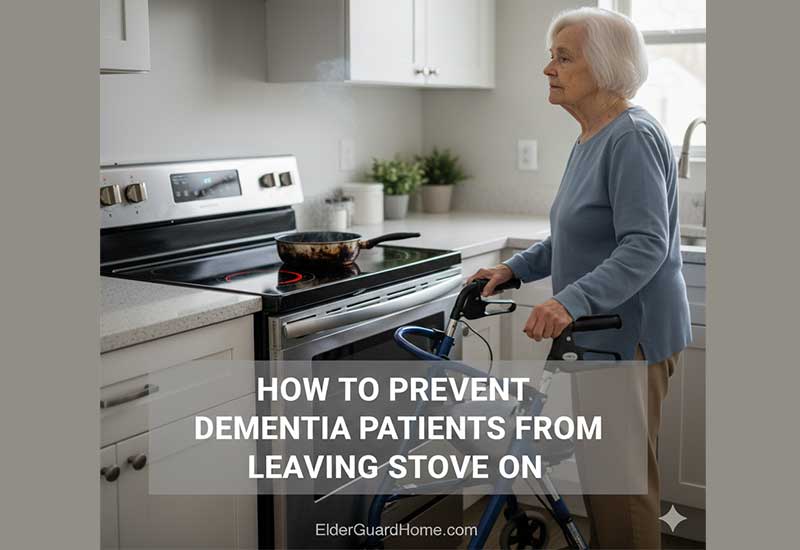
Picture this. Your father calls you at 9pm to say everything is fine. You hang up feeling okay. Then at 11pm his neighbour calls — the smoke alarm in his kitchen has been going off for twenty minutes. He left the soup on. He forgot completely.
The fear of a loved one forgetting a burner is a constant weight, leading many to ask: how to prevent forgetful seniors from leaving stove on without stripping away their independence?
Kitchen fires are a leading cause of home accidents among seniors, particularly those experiencing the early to middle stages of cognitive decline.
In this comprehensive 2026 guide, we will explore the psychology of “memory-loss cooking,” environmental modifications, and the latest technology in automatic stove shut off devices for elderly residents.
By the end of this article, you will have a clear, actionable plan to secure your kitchen and provide your loved one with a safer living environment.
What Does "Leaving the Stove On" Actually Mean for Seniors?
Leaving the stove on in seniors with memory loss is not carelessness — it is a direct result of how cognitive decline affects the brain’s executive function.
A senior may start boiling water with full intention of returning in two minutes. But a phone call, a noise outside, or simply walking into another room breaks that chain of thought. Their brain can no longer hold the original intent in working memory while managing a new task — so the stove stays on, the water boils dry, and a fire risk begins.
This is different from normal forgetfulness. A person without cognitive decline who forgets a pot will usually smell it, hear it, or remember it within minutes. A senior with memory loss may genuinely have no awareness that it is happening at all. That is why reminders and signs are not enough — and why automatic stove shut off devices for elderly adults are the only reliable long-term solution.
📎 Source: NIH National Institute on Aging — Cognitive Decline and Daily Safety — nia.nih.gov
What to Look For in Stove Safety Solutions for Seniors
The best stove safety for seniors with memory loss comes from solutions that require nothing from the senior to activate.
Does It Work Without the Senior Remembering?
This is the single most important question. Visual reminders, knob covers, and timers the senior has to set all rely on your parent doing something. For seniors with memory loss, that reliance is exactly the problem. The right solution acts automatically — with no input needed from anyone.
Electric or Gas — Does It Matter?
Yes — and electric vs gas stove safety for elderly adults is not a close comparison. Electric induction cooktops are significantly safer. They use magnetic energy to heat the pan, not the surface — so the cooktop itself never gets hot.
If the pan is removed, the heat stops immediately. Gas stoves carry an additional risk: a flame-out where the burner continues to release gas into the kitchen without any heat or visible flame. For any senior with memory loss, replacing a gas stove with an induction cooktop is the single safest upgrade available.
Automatic Shut-Off vs Alarm-Based
There are two categories of technology here. Shut-off devices physically cut the power or gas to the stove — no human action needed. Alarm-based devices alert someone when a risk is detected but rely on that person then taking action. For seniors living alone, shut-off devices are the right category.
3 Low-Cost Methods to prevent Forgetful seniors from leaving stove on
These options work best for seniors in the very early stages of memory loss — or as a layer on top of a shut-off device.
1. Remove the Knobs When Not Cooking
Pulling the stove knobs off when your parent finishes cooking is a simple and free fix. No knob means no ability to turn the burner on. The main downside is that some seniors find this frustrating — it can trigger agitation if they feel locked out of their own kitchen. Frame it as a temporary measure while you set up a longer-term solution.
2. High-Contrast Marker on the Off Position
Some seniors do not forget to turn the stove off — they simply cannot see clearly enough to confirm the dial is at the off position. A small red sticker or a dot of bright nail polish on the “Off” marking of each knob makes the correct position unmistakable. This works well alongside other measures for seniors with both memory loss and visual impairment.
3. Stove Knob Covers
Childproof stove knob covers clip over each knob and require a deliberate two-step action to use. They are not a long-term solution for moderate or advanced memory loss — a determined or confused senior will often manage to bypass them. But they add a small friction layer that can prevent absent-minded activation in early-stage situations.
Sometimes the issue is not forgetting the stove is on, but failing to see that the dial is turned to “High.” Using high contrast floor tape or bright red stickers on the “Off” position of the stove knobs can help those with both memory loss and visual impairment.
A cluttered kitchen floor is a trip hazard. If you use a small rug in front of the sink, it must be secured with the high-grip rug pads for elderly safety to prevent the edges from curling under a senior’s feet.
Is Leaving the Stove On a Sign of Dementia?
Leaving a burner on occasionally is not automatically a sign of dementia — but a pattern of it is worth taking seriously.
The key difference is whether your parent remembers the incident afterward. A person without cognitive decline will usually recall leaving the stove on and feel embarrassed. A senior in early memory loss may have no recollection of it at all — and may deny it happened even when shown evidence.
Watch for these signs alongside the stove incidents:
- Getting confused in familiar places or on familiar routes
- Repeating the same question within a short conversation
- Difficulty managing bills, medications, or appointments
- Poor judgment in situations that were previously easy to navigate
- Noticeable personality or mood changes
If the stove incidents are part of a wider pattern like this, it is time to treat the kitchen as an active safety risk. Download ElderGuard’s printable 9-point Senior Safety Checklist to assess your parent’s full home — not just the kitchen.
📎 Source: CDC Alzheimer’s Disease and Healthy Aging — cdc.gov
Peace of mind comes from knowing the house is protected from fire.
How to Prevent Forgetful Seniors From Leaving Stove On: Step-by-Step
Follow these steps in order. Each step builds on the last — so by Step 5 your parent has multiple layers of protection working together.
- Assess how serious the problem is. Has this happened once, or repeatedly? Does your parent remember the incident afterward? If it has happened more than twice and they have no memory of it, skip straight to Step 3.
- Start with a low-cost layer. Install BurnerAlert knob discs on all burners. This costs under $40 and takes two minutes. It will not solve the problem alone for moderate memory loss — but it is a useful first layer while you set up the bigger solution.
- Install FireAvert between the stove and the wall outlet. This is the most important step. Pull the stove out, unplug it, plug FireAvert into the outlet, then plug the stove into FireAvert. Check that your smoke detector is working and positioned in or near the kitchen. FireAvert is now active.
- Test the system. With your parent present, press the test button on the smoke detector. Confirm that FireAvert cuts the stove power when the alarm sounds. Reset and confirm it returns to normal operation. This also shows your parent the system is working for them, not against them.
- Consider replacing the stove with an induction cooktop. If your parent does most of their cooking on one burner — which is very common for seniors living alone — a portable induction cooktop on the counter is safer than any modification to the original stove. Store or disable the original stove. This removes the fire risk entirely rather than managing it.
- Do a full kitchen safety audit. Clear flammable items from within three feet of the cooking area — towels, paper, loose curtains. Check that smoke alarms are working and interconnected so a kitchen alarm also sounds in the bedroom.
- Check the kitchen floor. A safe stove means nothing if your parent slips on the way to it. If there is a rug in front of the sink or stove, secure it with high-grip non-slip rug pads for hardwood floors so the edges never curl under their feet while cooking.
📎 Source: CPSC Home Fire Safety — cpsc.gov
Top 3 Automatic Stove Shut-Off Devices for Elderly Adults (2026)
Cooking safety is a primary concern for many households today. Specifically, the USFA provides a detailed home safety checklist for older adults.
These official guidelines help our team select the best stove safety hardware. Furthermore, using automatic timers and shut-off tools can prevent common kitchen hazards.
These are the three most reliable automatic stove shut off devices for elderly adults available right now. All have strong Amazon ratings and require zero ongoing action from the senior.
1. FireAvert Automatic Stove Shut-Off — Best Reactive Shut-Off Device
One-sentence verdict: FireAvert is the most reliable emergency shut-off for elderly adults — it listens for your existing smoke alarm and kills the stove power the moment the alarm sounds.
FireAvert plugs directly between the stove and the wall outlet. It does nothing until it hears your smoke detector go off — then it cuts the stove power immediately and automatically. There are no apps, no settings, and no buttons. Once it is plugged in, it simply waits and reacts.
What makes FireAvert specifically right for seniors is that it requires absolutely nothing from your parent — ever. It does not depend on them remembering a setting or responding to an alert. It acts on its own when the situation becomes dangerous. A gas version is also available for gas stove users, using an electronic shut-off valve instead.
| Feature | Detail |
|---|---|
| Type | Smoke-alarm reactive shut-off |
| Compatible stoves | Electric (standard) and Gas (separate model) |
| Installation | Plug-and-play — no electrician needed for electric model |
| Requires senior action? | No — fully automatic |
| App or Wi-Fi needed? | No |
| Price range | Around $250 |
✅ Pros:
- Fully automatic — needs no input from the senior at any point
- Works with any existing smoke detector — no replacement needed
- Gas version available for gas stove homes
- Plug-and-play installation in under five minutes for electric stoves
- No subscription, no app, no Wi-Fi required
❌ Cons:
- Reactive only — it waits for smoke before acting, not before smoke starts
- Gas version requires a licensed plumber for proper installation
- Around $250 — higher upfront cost than alarm-only alternatives
👤 Best For: Seniors living alone with a standard electric stove — especially those whose caregiver is not nearby to respond to alerts.

2. BurnerAlert Stove Alarm — Best Low-Cost Reminder Device
One-sentence verdict: BurnerAlert is the best low-cost stove safety gadget for elderly adults who are in early-stage memory loss and still respond well to audible reminders.
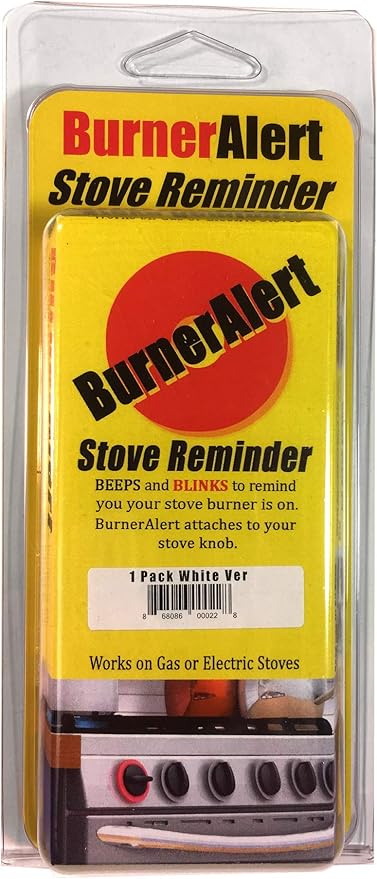
BurnerAlert fits behind your existing stove knobs — no tools needed. When a knob is turned to the on position, the disc activates and beeps at regular intervals while the burner is running. It does not cut power, but it creates a persistent audible reminder that the stove is on. For a senior who simply forgets and walks away, that regular beep can be enough to trigger the memory.
This is the right starting point for families who are not yet sure how significant the memory issue is, or who want an affordable first layer before investing in a full shut-off system.
| Feature | Detail |
|---|---|
| Type | Audible reminder — knob-mounted sensor |
| Compatible stoves | Gas and electric — any knob-based stove |
| Installation | No tools — slides behind existing knobs |
| Requires senior action? | No — activates automatically when knob is turned |
| App or Wi-Fi needed? | No |
| Price range | Under $40 |
✅ Pros:
- Under $40 — most affordable option on this list
- Works on gas and electric stoves with standard knobs
- No tools and no electrician — installs in under two minutes
- Battery-powered — works during power cuts
- Non-intrusive — does not change how the stove looks or functions
❌ Cons:
- Does not cut power — relies on the senior hearing and responding to the beep
- Not effective for moderate to advanced memory loss where audible cues are ignored
- Battery needs periodic replacement
👤 Best For: Seniors in early-stage memory loss who still respond to sound, and families looking for an affordable first layer of protection
3. Portable Induction Cooktop — Best Full Stove Replacement
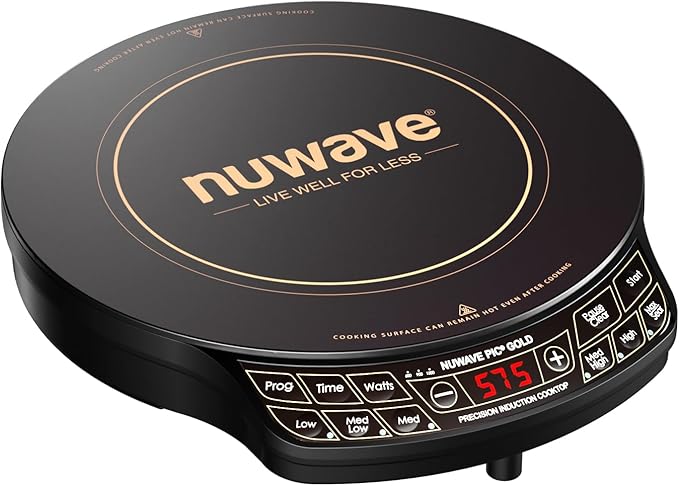
One-sentence verdict: A portable induction cooktop is the safest possible cooking solution for a forgetful senior — the surface never gets hot, and a built-in auto shut-off timer means the heat stops even if your parent walks away and forgets entirely.
This is not a gadget that attaches to the existing stove — it replaces it entirely. A portable induction cooktop plugs into a standard 110V wall outlet and sits on the counter. Because induction uses magnetic energy to heat the pan rather than the surface, the cooktop itself never gets dangerously hot. If your parent removes the pan or walks away, the heating stops automatically.
Almost all induction plates include a built-in timer with an auto shut-off — typically settable up to 180 minutes. Your parent sets it when they start cooking. When the time runs out, the heat stops. That single feature eliminates the most common scenario: a senior who starts cooking, walks out, and simply does not come back.
| Feature | Detail |
|---|---|
| Type | Countertop induction cooktop with auto timer |
| Compatible stoves | Replaces stovetop entirely — needs induction-ready pans |
| Installation | Zero — plugs into standard 110V outlet |
| Requires senior action? | Timer set at start — shuts off automatically |
| Surface heat risk? | No — surface stays cool to touch |
| Price range | $40–$90 for most models |
✅ Pros:
- Safest cooking surface available — no open flame, no hot surface
- Built-in auto shut-off timer stops heat even if senior forgets completely
- No installation — plug in and use
- Affordable — most models under $90
- Can disable or store the original stove entirely once this is in use
❌ Cons:
- Requires induction-compatible pans — older cookware may not work
- Timer still needs to be set at the start of cooking
- Single burner — not suitable for multi-dish cooking
👤 Best For: Seniors who do most of their cooking on one burner — soups, tea, reheating — and families ready to replace the original stove with a safer alternative
All 3 Solutions Compared
| Device | Type | Senior Action Needed? | Best For |
|---|---|---|---|
| FireAvert | Reactive shut-off — cuts power on smoke alarm | None | Seniors living alone |
| BurnerAlert | Audible reminder — beeps while burner is on | Must hear and respond | Early-stage memory loss |
| Induction Cooktop | Stove replacement — auto timer cuts heat | Set timer at start | Single-burner cooking |
Comparing Automatic Shut-Off Solutions
| Device Type | Best For | Safety Pros | Considerations |
|---|---|---|---|
| Motion Sensor | Distracted Seniors | Cuts power automatically if no motion is detected. | Requires professional electrical installation. |
| Smart Knobs | Early Stage Dementia | Affordable DIY fix that limits stove access. | Determined users can sometimes bypass them. |
| Induction Plate | Single-Meal Cooking | No open flames; surface stays cool to the touch. | Only works with magnetic induction-ready pans. |
| Gas Cut-off Valve | Gas Stove Users | Stops invisible gas leaks and fire risks. | Requires a certified plumber for safety setup. |
The Forgetful senior Kitchen Safety Checklist
To truly master how to prevent forgetful seniors from leaving stove on, you need a holistic approach. Use this checklist to audit your kitchen safety:
[ ] Smoke Alarms: Are they working? Are they interconnected so an alarm in the kitchen sounds in the bedroom?
[ ] Fire Extinguishers: Is there a fire blanket or a “toss-in” fire extinguisher nearby?
[ ] Clear the Zone: Are there flammable items (towels, paper towels, curtains) within 3 feet of the stove?
[ ] Lighting: Is the stove area brightly lit so the senior can see the controls clearly?
While fire is the primary concern, remember that kitchen floors are often slick. Along with stove safety, ensure your tiles are treated with the reliable anti-slip solution for ceramic floors to prevent a fall while cooking.
What These Devices Will Not Fix
Automatic stove shut off devices for elderly adults are highly effective — but honest about what they cover and what they do not.
FireAvert only activates when the smoke alarm sounds. That means it stops a fire once smoke appears — not before a pot boils dry or before a burner has been running for an hour. It does not prevent the stove from being left on. It prevents the consequence of it.
The induction cooktop is the closest thing to a complete solution — but it still requires the senior to set the timer at the start of cooking. A senior who forgets to do that gets no automatic protection.
No single device replaces a full home safety review. Kitchen fire risk is real — but so are slip risks, fall risks, and isolation risks that affect seniors living alone. For a room-by-room assessment, start with ElderGuard’s complete aging in place safety guide. For kitchen appliance safety beyond the stove, our guide on safe electric kettles for elderly with tremors covers the next most common kitchen burn risk.
One of the most effective ways to reduce kitchen fire risks is installing automatic stove shut-off devices for elderly that automatically turn off the stove when no movement or cooking activity is detected.
Professional Installation and ADA Compliance
When installing any automatic stove shut off devices for elderly safety, ensure they are installed according to local building codes. For electric stoves, these devices usually sit between the stove plug and the wall outlet (240V). For gas stoves, a professional plumber must install a solenoid valve on the gas line. While the cost may be higher up-front, it is significantly cheaper than the cost of a house fire or a move to an assisted living facility.
Frequently Asked Questions
Can you put child-proof knobs on a senior's stove?
Yes, child-proof stove locks can work as a temporary solution for seniors in the early stages of memory loss. However, many seniors find these frustrating, which can lead to “dementia agitation.” For long-term safety, an automatic stove shut off device for elderly users is a more dignified and reliable solution.
Are induction cooktops safer than traditional electric coils for forgetful seniors?
Absolutely. Induction is the safest choice for how to prevent forgetful seniors from leaving stove on. Because induction requires a magnetic pan to create heat, the “burner” itself never gets hot. If the senior walks away and takes the pan with them, the heating stops instantly, and the surface is safe to touch within seconds.
Can I still use my oven with these devices?
Most of these products monitor the entire appliance (stove and oven). If the oven is left on for a long duration, some devices might trigger, so it is important to choose a model with a “Manual Override” for long baking sessions.
Will FireAvert work with a gas stove?
Yes, there is a specific Gas version of FireAvert available on Amazon. It uses an electronic gas shut-off valve that triggers when your smoke alarm sounds.
Is leaving the stove on a sign of dementia?
Leaving the stove on once is not a sign of dementia on its own — but a repeated pattern, especially when your parent has no memory of the incident, is a red flag worth taking seriously. Look for other signs alongside it: repeating questions, getting confused in familiar places, or difficulty managing daily tasks. If you are seeing a pattern, arrange a cognitive assessment with your parent’s doctor.
Final Thoughts on Kitchen Security
How to prevent forgetful seniors from leaving stove on comes down to one principle: remove the need for your parent to remember anything. Visual signs and knob covers are useful starting points — but for any senior with a real memory pattern, automatic protection is the only reliable answer.
Start with FireAvert for emergency shut-off. Add a portable induction cooktop if your parent cooks simple single-burner meals. Pair both with the BurnerAlert discs as a low-cost first layer. That combination covers every scenario: the stove left on before smoke, the stove left on until smoke, and the daily habit risk of a senior cooking alone.
The kitchen is one part of a complete home safety picture. Pair your stove safety upgrades with non-slip bath mats for elderly adults for the bathroom and check the top 12 senior-friendly kitchen safety gadgets to cover every other appliance risk in the kitchen at the same time. For a full room-by-room plan, ElderGuard’s 9-point Senior Safety Checklist gives you a clear starting point today.