
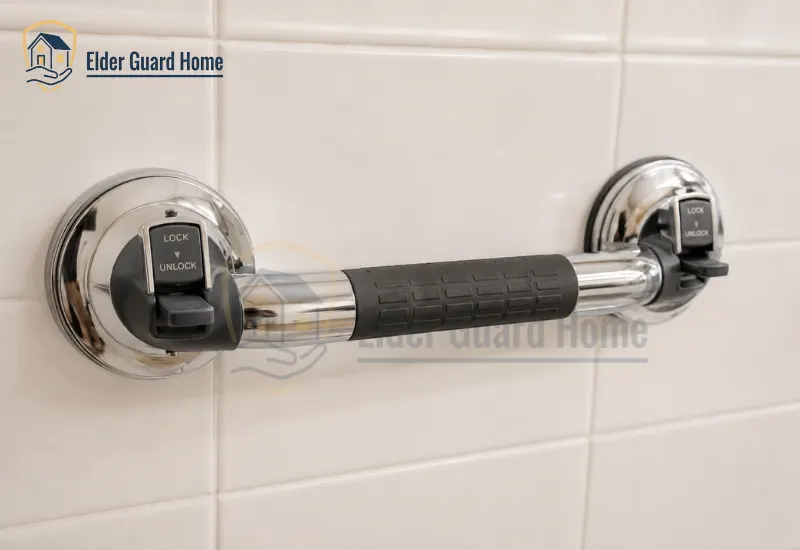
Bathroom safety can become more difficult when an older adult needs extra support while moving. A suction grab rail can provide a convenient handhold without drilling into the bathroom wall.
However, not every suction grab bar works on every bathroom surface. The wall material, suction design, installation, and user’s mobility all affect whether the product is appropriate.
This guide explains how bathroom suction grab bars for elderly users work and what to check before buying one. We also compare three popular suction models for different needs.
You will learn which surfaces support suction, how to check the attachment, and when a permanent grab bar makes more sense. We also explain why a manufacturer’s weight rating should not be treated as permission to use a suction bar for full body weight.
If your parent needs substantial support during transfers or has a significant fall risk, consider a properly installed permanent grab bar instead.
This guide gives you the full picture so you can make the right choice for your parent. For ADA-standard placement heights that apply to all grab bars including suction rails, see our ada heights for grab bars guide.
Who Should Consider Suction Grab Rails?
Suction grab rails may suit people who need light balance support and cannot install permanent bathroom hardware.
They can be useful for:
- Renters who cannot drill into walls.
- Travelers needing temporary bathroom support.
- Caregivers setting up a short-term solution.
- Older adults who need an additional handhold.
- Families waiting for permanent grab-bar installation.
Suction rails are not appropriate for every user. People who need substantial weight-bearing support should consider a properly installed permanent grab bar.
How Suction Grab Rails for Elderly Work
Suction grab rails use suction cups to create a sealed connection against a smooth, non-porous surface. Locking mechanisms help press the cups against the wall and maintain the seal.
The quality of that seal depends on the surface, suction cups, installation, and product design. Dust, soap residue, moisture, texture, and uneven surfaces can interfere with attachment.
Suction also differs from mechanical mounting. A permanently installed grab bar transfers force through its anchors and supporting structure. A suction rail depends on maintaining its seal against the wall.
For that reason, suction rails should be treated as balance-support products rather than substitutes for properly installed permanent grab bars.
Heavy Duty suction grab bars for seniors — What Heavy Duty Actually Means
Many suction grab bars advertise weight capacities of 200 pounds or more. That number should not be interpreted as a guarantee that the product can safely catch a falling person.
A manufacturer’s stated capacity applies under specified test or use conditions. Those conditions can differ between products.
Suction grab bars should therefore be used according to the manufacturer’s instructions. If an older adult needs to pull strongly, transfer substantial body weight, or rely on a bar during a fall, a properly installed permanent grab bar is a better option.
| Rail Type | Stated Weight Limit | Real-World Safe Load | Best For |
|---|---|---|---|
| Standard suction grab rail | 150–180 lbs | Light balance support only | Very low-risk daily assistance |
| Heavy duty suction grab rail | 240–330 lbs | Moderate balance support — not fall arrest | Seniors with mild balance issues on smooth surfaces |
| Drilled grab bar (ADA compliant) | 250–500 lbs static | Full weight bearing including fall load | Any senior with fall history or significant balance issues |
Permanent grab bars can provide stronger support when properly selected and installed. ADA requirements apply to covered facilities and include specific requirements for grab-bar dimensions, placement, spacing, and structural strength.
For anyone who has fallen before, a drilled bar is the only safe option. For fall statistics see cdc.gov.
Bathroom Suction Grab Bars for Elderly: Which Surfaces Work?

Surface compatibility is one of the most important factors when choosing bathroom suction grab bars for elderly users. Suction requires a smooth surface that can maintain an airtight seal.
Always follow the specific manufacturer’s surface requirements. Do not assume that every suction grab rail works on every type of tile or shower wall.
| Surface Type | Suction Works | Notes |
|---|---|---|
| Ceramic tile — smooth glazed | ✅ Yes | Must be 4×4 inch tile or larger — smaller tiles have too many grout lines |
| Glass shower walls | ✅ Yes | Ideal surface — smooth, non-porous, consistent seal |
| Acrylic shower walls | ✅ Yes | Works well on smooth acrylic — avoid textured acrylic |
| Fiberglass — smooth only | ✅ Yes | Smooth fiberglass only — textured or pebbled fiberglass does not hold |
| Polished marble | ✅ Yes | Polished finish only — unfinished or honed marble is porous and will not hold |
| Textured tile or stone | ❌ No | Surface texture breaks the vacuum seal — suction will fail |
| Grout lines | ❌ No | Never install over a grout line — immediate seal failure |
| Painted walls or drywall | ❌ No | Paint is porous and air-permeable — suction will not hold |
| Wallpaper | ❌ No | Completely unsuitable — never attempt |
How to Check a Bathroom Surface Before Installation
Start by reading the manufacturer’s surface requirements. Then inspect the wall for texture, grout lines, cracks, dust, soap residue, and uneven areas.
Clean and dry the surface exactly as the manufacturer recommends. Install the rail according to its instructions and check that every suction cup sits correctly.
Before relying on the rail, perform the manufacturer’s recommended stability check. If the rail moves, releases, or fails its indicator, do not use it.
For fiberglass shower walls with a drilled installation, see our how to install grab bars in fiberglass shower guide.
How to Use Shower Suction Safety Bars More Safely
Buying the right removable grab rails is only the first step. How you maintain and check them every day determines whether they are safe. These 5 rules are non-negotiable.
- Always do a firm tug test before each use. Grip the bar and pull outward with full arm strength before your parent touches it. If it moves even slightly, remove and reapply immediately. Never let your parent rely on a bar that has not been tug-tested that day.
- Check the safety indicator if the bar has one. Bars like the Reyiu have a color-coded indicator — green means secure, red means reapply. Check it before every use. It takes 2 seconds and removes all guesswork about suction status.
- Remove and reapply suction weekly. Release the latch, remove the bar, clean both the cup and wall surface, and reapply. This resets the vacuum seal. Skipping this weekly reset allows the seal to degrade without visible warning.
- Never reinstall after applying bathroom cleaner. Cleaning product residue breaks the vacuum seal. Rinse and dry the wall completely before reinstalling. This is the most overlooked cause of suction rail failure in home bathrooms.
- Replace immediately if the bar moves during the tug test. Remove it, clean both surfaces, allow full drying, and reapply. If it fails a second time, the surface may no longer be suitable for suction installation. See our bathroom fall prevention guide for the full picture of bathroom safety.
Best Suction Grab Bars for Seniors: 3 Options Compared

We compared three suction grab bars based on published specifications, attachment design, surface requirements, grip design, safety indicators, and intended use. We did not treat manufacturer weight ratings as proof of fall protection.
| Product | Best For | Length | Key Feature | Surface | Weight Rating |
|---|---|---|---|---|---|
| LEVERLOC 2-Pack | Simple no-drill support | 12 inches | Locking suction cups | Smooth, non-porous | Up to 240 lb* |
| TAILI 16.8-Inch | Longer grip | 16.8 inches | Locking suction cups | Smooth, non-porous | Up to 240 lb* |
| Reyiu 2-Pack | Visual suction check | 16.5 inches | Safety indicator | Smooth, non-porous | Check current listing |
* Weight ratings are manufacturer-stated capacities. Always verify the exact
model and follow the manufacturer’s installation and safety instructions.
Suction grab bars are generally intended for balance support, not as
substitutes for properly installed permanent grab bars.
1. LEVERLOC 2-Pack Suction Grab Bars — Best for Simple No-Drill Support
| Spec | Detail |
|---|---|
| Length | 12 inches per bar |
| Weight Capacity | 240 lbs per bar |
| Suction Type | Patented octopus bionic suction cup with locking latch |
| Surface Required | Smooth non-porous tile, glass, acrylic, stainless steel (4×4 inch minimum tile) |
| Pack | 2 bars |
| Colors | Grey, Silver |
| Safety Indicator | No |
The LEVERLOC uses locking suction cups and is designed for smooth, non-porous surfaces. Its published product information lists a 240-pound maximum capacity and describes the bar as a balance-assistance product rather than a full-body support device.
✅ Pros
- Strongest suction in class — patented bionic cup design
- Anti-slip strip along full handle length
- Tool-free 5-second installation
- Fully waterproof
- Removable and reusable
❌ Cons
- No safety indicator — requires manual tug test every use
- 12 inch length is shorter than some seniors prefer
- Works only on smooth non-porous surfaces
👤 Best For: Renters and caregivers seeking removable balance support on suitable bathroom surfaces.
Why we picked it: Its simple design and removable installation make it practical for temporary bathroom support.
2. TAILI 2 Pack Suction Grab Bars - Best for a Longer Grip
TAILI offers several suction grab-bar models with different specifications. The 16.8-inch model is designed for smooth, non-porous surfaces and uses locking suction cups. Current manufacturer information lists a 240-pound capacity for that model.
| Spec | Detail |
|---|---|
| Length | 16.8 inches per bar |
| Weight Capacity | 240 lbs per bar |
| Suction Type | Upgraded rubber suction cup with locking latch |
| Surface Required | Smooth non-porous tile, glass, acrylic, marble (4×4 inch minimum tile) |
| Pack | 2 bars |
| Colors | Grey, Silver, Blue |
| Safety Indicator | No |
Verdict: The TAILI offers the highest stated weight capacity of any suction grab rail in its price range — and the longer 16.8-inch length gives seniors a more confident two-handed grip.
✅ Pros
- Highest weight capacity in this roundup at 330 lbs
- Longer bar length — better grip reach for taller seniors
- Curved wave design on underside improves finger grip
- Upgraded rubber suction cups for stronger initial seal
- Fully waterproof
❌ Cons
- No safety indicator — manual tug test required every use
- Larger size can be harder to position precisely on smaller tile sections
- Rubber cups require more thorough cleaning than silicone types
👤 Best For: Seniors who need a longer bar for a two-handed grip and want the highest stated weight capacity in the suction rail category.
Important: Check the exact model number before purchasing because TAILI sells multiple suction-bar versions with different published specifications.
3. Reyiu 2 Pack Grab Bars - Best for a Visual Safety Indicator
The Reyiu model stands out because it includes a color-coded suction indicator. The indicator can provide an additional visual check before use.
| Spec | Detail |
|---|---|
| Length | 16.5 inches per bar |
| Weight Capacity | Not stated — balance support use recommended |
| Suction Type | Dual suction cup with locking latch |
| Surface Required | Smooth non-porous tile, glass, acrylic (4×4 inch minimum tile) |
| Pack | 2 bars |
| Safety Indicator | Yes — green (secure) / red (insufficient suction) |
| Colors | Grey |
Verdict: The Reyiu is the only bar in this roundup with a built-in color-coded safety indicator — the single most important feature for seniors who cannot reliably perform the manual tug test themselves.
✅ Pros
- Color-coded safety indicator — green means safe, red means reapply
- 16.5-inch length for confident grip reach
- Anti-slip textured handle surface
- Tool-free installation in 5 seconds
- Removable and reusable
❌ Cons
- No stated weight capacity — use for balance support only
- Indicator must be visible from user’s position to be effective
- Dual cup design requires both cups to seat correctly on large enough tile
👤 Best For: Seniors living alone who need visual confirmation that the bar is safely attached before relying on it — especially those who may not have a caregiver present to do the daily tug test.
What to Look for in the Suction Grab Bars?
When choosing the best suction grab bars for seniors, check these points before buying:
- Surface Compatibility: Choose a bar designed for smooth, non-porous surfaces. Avoid textured tile, grout lines, and uneven surfaces unless the manufacturer specifically approves them.
- Locking Mechanism: Look for locking levers that help secure the suction cups. A locking system can make the attachment easier to check before use.
- Safety Indicator: Some models include green and red indicators. These provide a quick visual check of the suction status.
- Grip Design: Choose a handle with a comfortable, textured grip. This matters when hands are wet or slippery.
- Bar Length: Shorter bars suit single-hand support. Longer bars provide more room for changing hand positions.
- Weight Rating: Check the manufacturer’s stated weight rating for the exact model. Do not treat that number as proof that the bar can catch a falling person.
- Ease of Inspection: Choose a model that makes regular inspection simple. The bar should be easy to remove, reposition, and check when needed.
- Intended Use: Suction bars are best considered for temporary or light balance support. If someone needs substantial weight-bearing support, consider a properly installed permanent grab bar.
Shower Suction Safety Bars vs. Permanent Grab Bars
Shower suction safety bars can provide temporary balance support without drilling. Permanent grab bars use mechanical mounting and can provide stronger support when correctly installed.
The right choice depends on the user’s needs, the bathroom surface, and whether permanent installation is possible.
Before choosing grab handles for baths and showers, every family should understand exactly where the two options differ. This table gives you the honest comparison.
| Feature | Suction Grab Rails | Drilled Grab Bars |
|---|---|---|
| Weight capacity | 240–330 lbs static — not fall load | 250–500 lbs including fall load |
| Installation | Tool-free, 5 seconds | Requires drilling — 1–2 hours |
| Permanence | Removable and repositionable | Permanent — cannot move without repair |
| Surface limits | Smooth non-porous only | Works on all wall types with correct anchor |
| Daily maintenance | Tug test required every use | Load test at installation only |
| Fall safety | Balance support only | Full fall arrest capable |
| ADA compliant | No | Yes — when correctly installed |
| Best for | Renters, travelers, temporary use | Permanent home safety installation |
My honest recommendation after 9 years of home safety assessments: suction rails are the right choice for seniors who need light daily balance assistance, live in a rental, travel frequently, or need a temporary solution while a permanent bar is being installed.
For any senior who has fallen before, has significant balance or mobility issues, or uses a walker or wheelchair, a drilled bar is the only safe permanent solution. See our guide on how to install shower grab bars on tile without studs and our ada compliant grab bars guide for drilled installation options.
When Suction Grab Rails Are NOT Enough
Suction grab rails are not suitable for every bathroom or every user. Consider a permanent grab bar when the user needs stronger or more consistent support.
A permanent option may be more appropriate when:
- The user has a high fall risk.
- The user regularly places substantial body weight on supports.
- The user needs help transferring from a wheelchair.
- The user needs strong support while standing.
- The bathroom surface cannot maintain a suitable suction seal.
- The user cannot reliably follow the product’s inspection instructions.
- The suction rail repeatedly loses its seal.
If someone needs a grab bar to catch a fall or support substantial body weight, do not assume a suction product can perform that role. Consider a properly installed permanent grab bar instead.
Your parent cannot reliably do the daily tug test. If your parent lives alone and cannot consistently perform or remember the daily tug test, a suction rail is not a safe long-term solution. Pair your bathroom safety plan with non-slip bath mats for elderly and a permanent drilled bar where possible.
How to Choose Bathroom Suction Grab Bars for Elderly
Choosing bathroom suction grab bars for elderly users starts with the bathroom surface and the person’s support needs.
First, check whether the wall provides the smooth, non-porous surface required by the manufacturer. Next, check the product’s attachment system, grip design, dimensions, and published capacity.
Do not choose a suction bar only because it has a high weight rating. The rating does not automatically mean the bar is suitable for catching a fall.
Also consider where the user needs support. A shower entry, bathtub edge, or toilet area may require different positioning.
If the user needs strong weight-bearing support, discuss a permanent grab-bar installation with a qualified professional.
Frequently Asked Questions
Are suction grab bars safe for seniors?
Suction grab bars can provide temporary balance support when installed correctly on suitable surfaces. They should not replace permanent grab bars when a person needs substantial weight-bearing support.
How much weight can suction grab bars hold?
Heavy duty suction grab bars state weight limits of 240–330 pounds in static test conditions. A fall generates 3–5 times body weight in dynamic force — far beyond what suction rails can hold. They are balance aids only, not fall arrest devices.
What surfaces do suction grab rails work on?
Suction grab rails work on smooth, non-porous, airtight surfaces only — including glazed ceramic tile (4×4 inch minimum), glass, smooth acrylic, smooth fiberglass, and polished marble. They do not work on textured tile, painted walls, drywall, grout lines, or wallpaper.
How often should I check suction grab rails?
Follow the manufacturer’s inspection instructions and check the bar before relying on it. If it moves, loosens, or shows a warning indicator, stop using it until it is correctly reinstalled.
Do a firm tug test before every single use. Remove, clean, and reapply the suction seal at least once per week to reset the vacuum. Never use bathroom cleaning products on the wall before reinstalling — residue breaks the suction seal.
Can I use suction grab rails in a rental property?
Yes. Suction grab rails require no drilling and leave no wall damage, making them ideal for rental properties where drilling is not permitted. Always confirm the wall surface is suitable before installation and maintain the daily tug test routine.
What are the best suction grab bars for seniors?
The best suction grab bars for seniors depend on the user’s needs, bathroom surface, grip preference, and product specifications. We compare LEVERLOC, TAILI, and Reyiu in this guide.
Do suction grab bars work on tile?
Suction grab bars can work on smooth, non-porous tile when the suction cups can form a proper seal. Always follow the manufacturer’s surface requirements.
Conclusion: Are Suction Grab Rails Right for Your Bathroom?
The best suction grab rails for elderly users are not necessarily the strongest-looking models. The right choice depends on the bathroom surface, attachment system, user’s mobility, and intended use.
Suction grab rails can be useful for temporary or light balance support. They can also help renters and families who cannot drill into bathroom walls.
However, they should not replace a properly installed permanent grab bar when someone needs substantial support. Always follow the manufacturer’s installation, weight, and inspection instructions.
If you are unsure whether your parent needs a suction rail or permanent grab bar, start with their actual mobility needs rather than the product’s advertised capacity.
Download your free 9-point Senior Safety Checklist to make sure every safety measure in the home is correctly matched to your parent’s real needs. For ADA-standard drilled bar placement, see our ada heights for grab bars guide.