
Who This Guide Is For
This guide is written for:
- Adult children whose parent has been diagnosed with early or mid-stage memory loss and still cooks at home
- Family caregivers who have noticed kitchen incidents — burnt pots, forgotten burners, or the smell of gas — and need to act now
- Seniors living alone who want to set up their kitchen so it stays safe without needing constant supervision
- Families who want to keep a parent at home independently for as long as possible without moving to assisted living
- Professional caregivers conducting home safety assessments for clients with cognitive decline
The kitchen is the room most family caregivers worry about first — and for good reason.
Dementia kitchen safety is not about locking a senior out of their own home. It is about removing the specific risks that memory loss creates while keeping as much independence intact as possible.
A senior with early memory loss can still boil water, make toast, and heat soup. But they can no longer reliably remember that they started. That gap — between starting a task and remembering to finish it — is where kitchen accidents happen.
This guide covers every practical modification available in 2026, matched to the stage of memory loss your parent is in right now.
According to the CDC, cooking fires are the leading cause of home fires and home fire injuries in the United States — and adults aged 65 and older have a fire death rate more than twice the national average.
The kitchen modifications in this guide directly address that risk at the source. Use ElderGuard’s 9-point Senior Safety Checklist alongside this guide to assess every other room in the home at the same time.
📎 Source: CDC Home Fire Safety — cdc.gov
What Is Dementia Kitchen Safety?
Dementia kitchen safety is the practice of modifying the kitchen environment to prevent accidents caused by memory loss — without relying on the person with dementia to follow rules or remember instructions.
This is the key distinction from standard kitchen safety. Most safety advice assumes the person using the kitchen can remember what they were told, notice when something goes wrong, and respond appropriately. Memory loss removes all three of those assumptions.
That is why standard approaches — reminders on the fridge, verbal instructions, asking a senior to be more careful — do not work and should not be relied on.
Effective kitchen safety for seniors with memory loss works at the environment level.
It changes what is physically possible in the kitchen, so that even if the senior forgets entirely what they were doing, the kitchen itself prevents the most dangerous outcomes. Automatic shut-off devices cut power without the senior doing anything.
Induction cooktops eliminate hot surfaces entirely. Knob covers make the stove harder to turn on accidentally. Each layer works independently — so if one is bypassed, the next one still provides protection.
📎 Source: NIA Alzheimer’s Caregiving — nia.nih.gov
How Memory Loss Changes Kitchen Risk
Understanding exactly how memory loss affects kitchen behaviour helps caregivers choose the right modifications for where their parent is right now.
The Distraction Problem
The most common kitchen incident with memory loss is not confusion about how to cook — it is distraction. A senior starts the stove, then the phone rings, or they hear something outside, or they simply walk into another room and the original task is gone from their working memory completely. The stove stays on. This happens at every stage of memory loss and is the primary risk stove safety for dementia patients addresses.
The Recognition Problem
As memory loss progresses, seniors may not recognise that something is wrong even when they are in the kitchen. A pot boiling dry, smoke starting to appear, or the smell of gas may not trigger the alarm response it once did. This is not stubbornness — it is a change in how the brain processes environmental signals. Modifications at this stage need to be fully automatic because the senior can no longer be relied on to notice and respond.
The Judgment Problem
In later stages, a senior may attempt to use the kitchen in ways that are unsafe — placing items directly on a burner, trying to heat things that should not be heated, or using appliances incorrectly. At this point the kitchen needs to be restructured significantly — not just modified — to remain safe for independent use.
What to Look For Before Making Changes
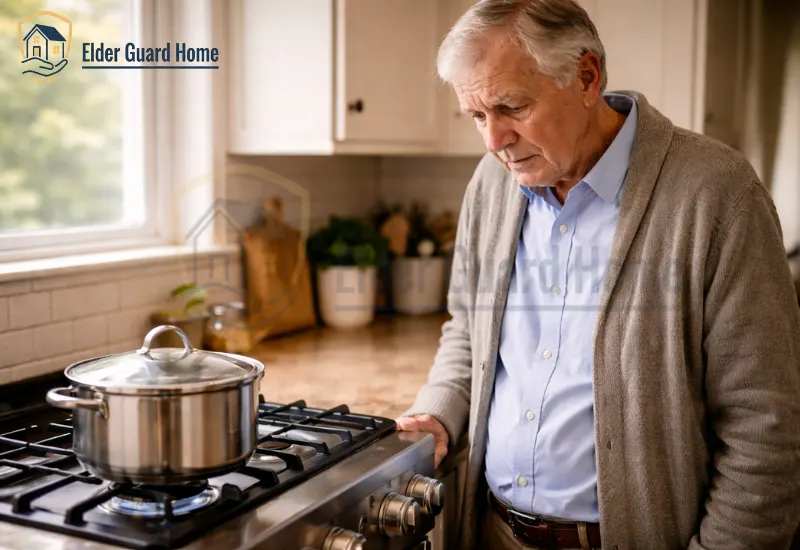
The right modifications depend on which stage of memory loss your parent is in. These are the kitchen-specific warning signs that tell you which level of intervention is needed.
Early stage — low-tech modifications sufficient
- Occasionally forgets a pot is on but remembers when reminded
- Still responds to audible alerts and reminders
- Recognises when something smells wrong or looks wrong
- Finishes cooking tasks independently most of the time
Mid stage — automatic devices essential
- Leaves the stove on regularly and has no memory of doing so
- Does not respond reliably to reminders or audible alerts
- Has had one or more incidents involving burnt pots, scorched surfaces, or near-fires
- Needs prompting to complete cooking tasks safely
Late stage — kitchen restructuring required
- Cannot safely use the stove independently regardless of modifications
- Attempts to use appliances in unsafe ways
- Requires supervision for all kitchen activity
Most families reading this guide are dealing with early to mid-stage situations. The modifications below are matched to those two stages specifically.
Dementia Kitchen Safety Modifications — By Stage
Stage 1 — Low-Cost Changes You Can Make Today
These modifications cost under $50 and need no professional installation. They work best for early-stage memory loss and as extra layers on top of automatic devices.
- Remove knobs when cooking is finished. No knob means no ability to turn the burner on accidentally. Pull them off when your parent finishes cooking each day. This works well in early stage when the senior can still cook but should not have unsupervised stove access.
- Install stove knob covers. Childproof knob covers clip over each burner knob and require a deliberate two-step action to use. They add friction to absent-minded activation without fully preventing a senior who wants to cook from doing so.
- Clear the stovetop completely. Remove everything from the stovetop that is not a pot or pan in active use — paper towels, dish cloths, wooden utensils stored nearby. A cluttered stovetop is a fire waiting for a distraction. This costs nothing and reduces risk immediately.
- Use high-contrast markers on the Off position. A small red sticker or dot of bright nail polish on the Off marking of each knob makes the correct position unmistakable at a glance. This helps seniors with both memory loss and visual impairment.
- Add a BurnerAlert disc to each knob. BurnerAlert discs sit behind your existing stove knobs and beep at set intervals while a burner is on. They do not cut power but provide a persistent audible reminder. For early-stage memory loss where the senior still responds to sound, this layer alone prevents most incidents.
Stage 2 — Automatic Devices for Mid-Stage Memory Loss
At mid-stage, relying on your parent to hear and respond to an alert is no longer safe enough. These devices act on their own — no input needed from the senior at any point.
- FireAvert Automatic Stove Shut-Off plugs between the stove and the wall outlet and listens for your existing smoke detector. When the alarm sounds, it cuts stove power immediately. No app, no Wi-Fi, no buttons needed. A gas version is available but requires professional plumber installation.
- This is the single most important device for stove safety for dementia patients who live alone. It does not stop the stove being left on — but it stops that from becoming a fire. For a full review of FireAvert alongside other automatic options, see our guide on how to prevent forgetful seniors from leaving the stove on.
- Motion-Sensor Automatic Shut-Off Systems monitor kitchen movement. If the stove is on and no motion is detected for 5 to 10 minutes, the device cuts power automatically. This addresses the most common dementia kitchen incident — a senior who starts cooking, walks out, and does not come back. These systems need professional electrical installation but provide proactive shut-off before smoke appears. Full product details are in our guide on automatic stove shut-off devices for elderly adults.
Stage 3 — Replace the Stove Entirely
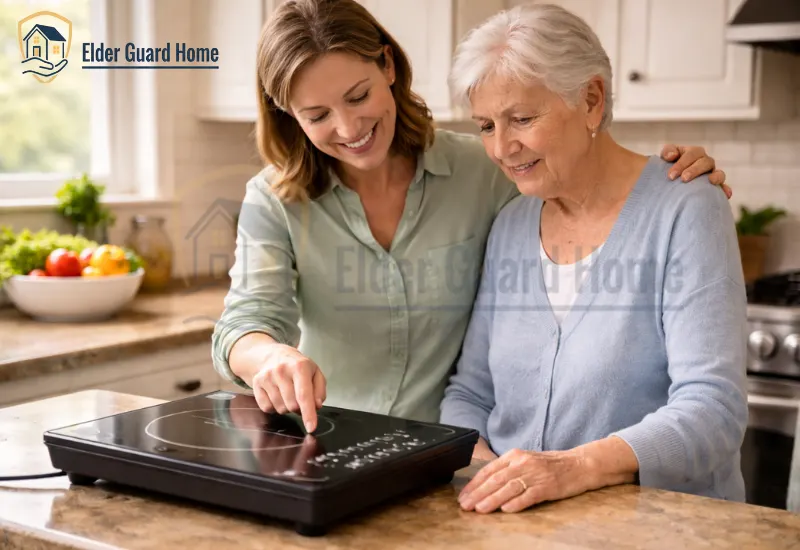
For many mid-stage families, replacing the stove with a portable induction cooktop is the safest move available. Induction heats the pan using magnetic energy — not the surface. The cooktop itself never gets dangerously hot. If your parent walks away or removes the pan, the heat stops immediately.
Almost all models include a built-in auto shut-off timer. Your parent sets it at the start of cooking. When it runs out, the heat stops — regardless of whether they remember. This is how to make the kitchen safe for elderly with dementia at the appliance level rather than the modification level.
A portable induction cooktop plugs into any standard wall outlet and sits on the counter. The original stove can be stored, disconnected, or have its knobs removed permanently. Most senior-suitable models cost between $40 and $90. This single change removes the most dangerous element from the kitchen — an open flame or continuously hot surface — entirely.
The Dementia Kitchen Safety Checklist
Use this checklist to audit your parent’s kitchen against ElderGuard’s 9-point Senior Safety Checklist framework. Work through it room by room — print it and take it with you.
Stove and cooking area:
- Automatic shut-off device installed between stove and wall outlet
- Knobs removed or covered when not in active use
- Stovetop surface completely clear of flammable items
- Smoke alarm working and positioned within range of the kitchen
- Gas supply accessible only to a trusted adult if gas stove
General kitchen environment:
- Sharp knives stored out of reach or in a locked drawer
- Toxic cleaning products stored in a locked cabinet
- Kettle replaced with a safer model — see our guide on safe electric kettles for elderly with tremors for options with auto shut-off and no-tip designs
- Microwave settings simplified — remove functions the senior does not use
- Toaster oven replaced with a microwave where possible
Kitchen floor:
- No loose rugs or mats on the kitchen floor
- Any rug in front of the sink secured with non-slip rug pads so edges cannot curl
- Floor clear of clutter, bags, and items that create a trip hazard
- Good lighting over the stove and work surfaces — see our guide on night lights for elderly adults for kitchen lighting options
Labels and organisation:
- Frequently used items stored at counter height — nothing above shoulder level
- Microwave and kettle labelled with simple one-step instructions if needed
- Emergency numbers posted clearly on the fridge in large print
📎 Source: CPSC Home Fire Prevention — cpsc.gov
How to Talk to Your Parent About Kitchen Safety Changes
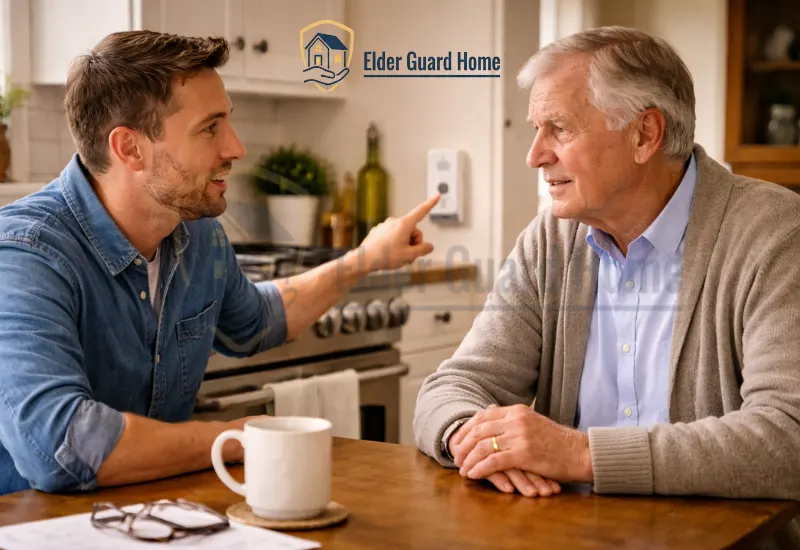
The hardest part of dementia kitchen safety is often not the modifications — it is the conversation.
Most seniors feel a deep sense of pride and identity around cooking. It represents independence, capability, and normalcy. When a caregiver starts removing knobs or installing devices, it can feel like an attack on that identity — even when the intent is entirely protective.
Frame Every Change as Home Insurance
Never introduce a device as something their memory loss requires. Instead, frame it as a home upgrade that protects the whole house. “I read that this device prevents kitchen fires — I want to install it in my home too” removes the implication that your parent is the problem. The device is just good home safety practice.
Involve Them in the Process
Where possible, let your parent be part of the installation. Show them how FireAvert works. Let them test the induction cooktop. When a senior feels included in a change rather than managed by it, they are significantly more likely to accept it without agitation or resistance.
Start Small and Build Layers
Do not make every change at once. One new device per visit allows your parent to adjust gradually. Start with the least intrusive change — BurnerAlert discs or knob covers — and add automatic devices in subsequent visits as needed.
What Caregivers Say
The following experiences were shared by caregivers in our community. Names have been changed to protect privacy. These are real situations — not paid testimonials.
“Mum was diagnosed with early-stage memory loss eighteen months ago and was still cooking every day. We started with the FireAvert because it required absolutely nothing from her — we just plugged it in, tested it, and it was done. She did not even notice it was there. Eight months later she has had zero kitchen incidents. The peace of mind it has given our whole family is hard to put into words.” — Rachel T., daughter and caregiver, Pennsylvania
“Dad kept leaving the back burner on after making his morning tea. We tried reminders, we tried notes on the fridge — none of it worked because he simply had no memory of turning the stove on in the first place. We switched him to a portable induction cooktop with a 30-minute auto timer and he has been using it independently for four months. He still makes his own breakfast every single morning. That independence means everything to him.” — James O., son and primary caregiver, Arizona
“As a professional caregiver I assess a lot of kitchens for clients with early dementia. The combination I recommend every single time is FireAvert plus an induction cooktop plus knob removal when the caregiver leaves. Those three layers together mean the kitchen is safe at every stage of the day — when the caregiver is there, when they are not, and even in the middle of the night. I have used this setup in over twenty client homes with no kitchen fire incidents.” — Linda W., certified home caregiver, Ohio
Frequently Asked Questions
What is the most important dementia kitchen safety change to make first?
Install an automatic stove shut-off device first — specifically FireAvert for electric stoves or its gas equivalent for gas stoves. This is the single change that addresses the highest-risk scenario: a stove left on when no one is in the kitchen. It costs around $250, installs in five minutes for electric stoves, and requires nothing from your parent to activate. Every other modification builds on top of this foundation.
Is an induction cooktop safe for a senior with dementia?
Yes — induction is the safest cooking surface available for seniors with memory loss. The surface never gets hot because induction heats the pan directly using magnetic energy. If your parent walks away and the pan is removed or the timer runs out, the heat stops automatically. It does not eliminate all kitchen risk but it removes the most dangerous element — an open flame or continuously hot surface — entirely.
How do I stop my parent with dementia from using the stove unsafely without taking it away completely?
Start with knob covers and BurnerAlert discs as a first layer. Add FireAvert for automatic emergency shut-off. If incidents continue, replace the stove with a portable induction cooktop and remove or disable the original stove. Each step preserves as much independence as possible while adding a layer of protection. The goal is to match the level of modification to the current level of risk — not to remove all cooking ability at once.
Should I lock the kitchen for a parent with dementia?
Locking the kitchen is generally a last resort and can cause significant distress and agitation in seniors with memory loss. The modifications in this guide are specifically designed to make the kitchen safe for continued independent use — so locking is not necessary in early or mid-stage situations. If your parent is in a late stage where kitchen use is genuinely unsafe regardless of modifications, consult with their care team about the right approach for your specific situation.
What other rooms need safety modifications alongside the kitchen?
The bathroom is the next highest-risk room after the kitchen for seniors with memory loss — wet floors, hard surfaces, and the physical demands of bathing create significant fall risk. Start with non-slip bath mats for elderly adults and work through ElderGuard’s 9-point Senior Safety Checklist for a complete room-by-room assessment.
Conclusion
Dementia kitchen safety is not about removing your parent’s independence — it is about protecting it for as long as possible by removing the specific risks that memory loss creates. The right modifications mean your parent can keep making their morning tea, heating their soup, and using their own kitchen — safely — without someone needing to stand over them every minute.
Start with FireAvert for automatic emergency protection. Add a portable induction cooktop if your parent cooks simple single-burner meals. Layer in knob covers and BurnerAlert discs for additional daytime protection. Work through the kitchen safety checklist above to close every remaining gap.
The kitchen is one part of a complete home safety picture. Pair these modifications with safe electric kettles for elderly with tremors for the next most common kitchen burn risk, and check the complete aging in place safety guide for a room-by-room plan covering the whole home. Download ElderGuard’s 9-point Senior Safety Checklist to make sure nothing is missed.