
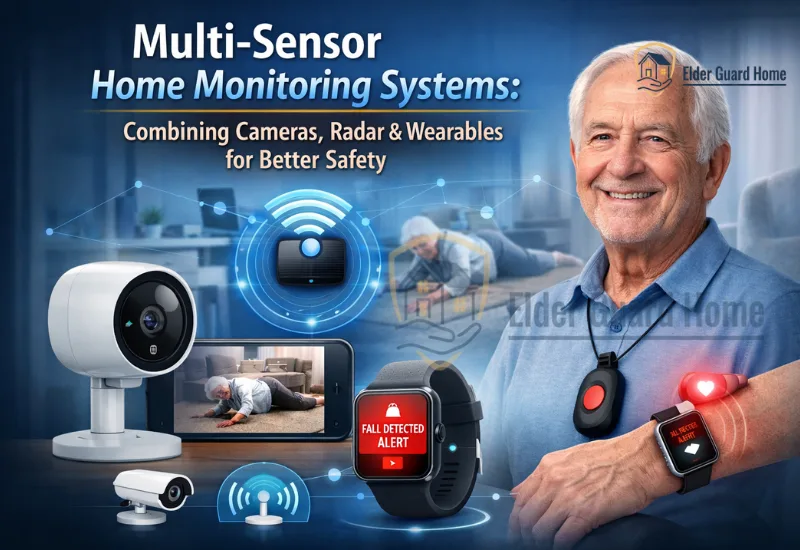
Falls remain one of the biggest safety risks for older adults living independently. Multi-Sensor Home Monitoring Systems address this challenge by combining cameras, radar, and wearable technology into one layered protection model. Instead of depending on a single device, these systems build redundancy into the home itself.
However, single-sensor systems often leave gaps. A camera may miss a fall behind furniture. A wearable may not be worn. Radar alone may misinterpret unusual motion. Therefore, the conversation is shifting from detection type to detection architecture.
This article focuses specifically on system design — not on redefining fall detection basics. If you’re exploring non-wearable systems specifically, see our guide on Wearable-free senior fall monitoring for foundational context.
Here, we’ll explain what hybrid home safety systems are, why multi-device senior monitoring reduces blind spots, and how a multi-sensor fall detection system compares to standalone setups. In addition, we’ll cover the pros, cons, and realistic limitations so you can decide what truly fits your home.
What Are Hybrid Home Safety Systems?
Hybrid home safety systems integrate multiple sensing technologies to reduce detection failure points. Rather than choosing between camera, radar, or wearable monitoring, they combine them strategically.
The goal is not more devices. Instead, the goal is better reliability through architecture.
Single-Sensor vs Multi-Sensor Architecture
Single-sensor systems operate independently. For example, a camera analyzes posture visually. However, it cannot detect movement in a blocked area. Similarly, a wearable device triggers only when pressed or when sudden acceleration is detected.
In contrast, multi-sensor architecture overlaps monitoring zones. When radar detects unusual motion, a camera may verify posture. When a wearable alert is triggered, environmental sensors confirm immobility.
Therefore, blind spots shrink significantly.
Additionally, single sensors rely on one type of data. However, data from one modality can be misleading. A pet jumping off furniture may resemble a fall pattern. In contrast, layered data filtering improves accuracy.
As a result, hybrid systems reduce dependency on a single data stream.
Why Multi-Device Senior Monitoring Improves Reliability
Multi-device senior monitoring improves safety through redundancy. If one device fails, another continues working. Therefore, system uptime increases.
Moreover, cross-validation reduces false alarms. When two or more sensors confirm a fall pattern, alerts become more credible. Conversely, if only one signal appears inconsistent, the system can delay escalation.
However, detection alone is not enough. Families also need immediate notification pathways, which is why many households combine fall monitoring with a security system that alerts family members in real time.
This significantly lowers nuisance alerts. For deeper analysis, see our detailed breakdown of AI fall detection false alarms and why single-sensor systems struggle with environmental noise.
Furthermore, layered systems adapt better to complex homes. Large layouts, bathrooms, and furniture-heavy rooms often create detection challenges. However, multi-sensor coverage minimizes these weak zones.
In short, reliability improves because confirmation replaces assumption.
The Problem with Single-Sensor Monitoring
Before understanding hybrid systems, we must identify the limitations of standalone devices.
1. Camera-Only Systems
Provide visual confirmation
However, create privacy concerns
Also struggle in low light or blocked angles
For a deeper comparison, see our guide on radar vs camera monitoring differences.
2. Radar-Only Systems
Protect privacy
Work in darkness
However, may misclassify unusual movements
We explore radar false alarm behavior in detail in our false alarm rate analysis cluster.
3. Wearable-Only Devices
Depend entirely on user compliance
Fail if removed
Often forgotten in bathrooms
As discussed in our AI vs medical alert button comparison, wearable dependency remains a major risk factor.
Therefore, relying on one sensor creates gaps.
And gaps create risk.
Why Hybrid Home Safety Systems Are Growing Fast
Firstly, the senior population is rising. According to the World Health Organization, falls are a leading cause of injury among older adults worldwide.
However, no single device detects every fall scenario.
For example:
Cameras struggle in bathrooms.
Radar can misinterpret pets.
Wearables fail if not worn.
Therefore, families are moving toward multi-device senior monitoring setups.
Because when one sensor misses something, another often catches it.
How a Multi-Sensor Fall Detection System Works?
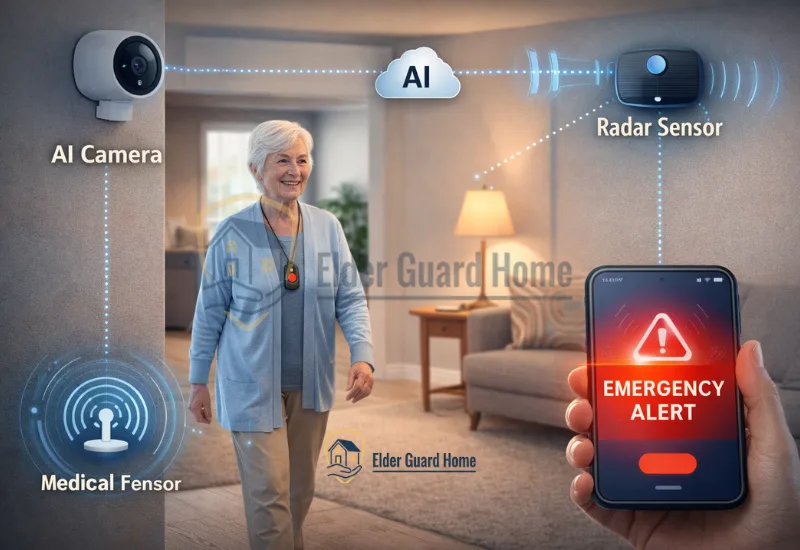
A multi-sensor fall detection system operates through coordinated layers rather than isolated devices. Each layer performs a specific role. However, the real strength lies in how they communicate.
Layer 1: Camera-Based Monitoring Layer
Camera-based monitoring analyzes posture, body angle, and sudden collapse patterns. AI models evaluate visual context rather than just motion speed.
However, privacy tradeoffs must be considered. Cameras in private areas may create discomfort. Therefore, placement strategy is critical.
If you want a deeper breakdown of visual monitoring strengths and limitations, read our comparison of radar-based vs camera-based fall detection technology for a focused analysis.
Importantly, cameras provide confirmation power. Yet, they work best when paired with additional sensors.
Layer 2: Radar Motion Tracking Layer
Radar technology tracks micro-movements through radio waves. Unlike cameras, it works in darkness. Moreover, it does not capture visual imagery, which improves privacy.
Radar can detect subtle shifts such as sudden impact followed by immobility. Therefore, it performs well in bedrooms and bathrooms.
However, radar alone cannot interpret full context. It identifies motion patterns, not posture details. That is why hybrid architecture strengthens its output without redefining its core role.
In short, radar adds invisible coverage.
Layer 3: Wearable Sensor Layer
Wearables track acceleration, tilt, and sometimes gait instability. In addition, most include an emergency button for manual alerts.
This layer acts as a personal safety backup. If environmental sensors miss an event, the wearer can manually trigger help.
However, compliance remains a challenge. Seniors may remove devices while sleeping or bathing. Therefore, wearable data becomes more powerful when supported by room-based monitoring.
In addition, wearable alerts can trigger environmental cross-checking. If a button is pressed, the system can immediately confirm posture and motion patterns before escalating.
Thus, wearables strengthen verification rather than acting alone.
To cover mobility outside the home, a wearable like SecuLife GPS Tracker with Fall Detection ensures fall alerts and location data are instantly shared with caregivers or emergency contacts.
Layer 4: Sensor Fusion and AI Decision Engine
Sensor fusion is the intelligence layer. It merges camera, radar, and wearable data into one decision stream.
Instead of reacting instantly to one trigger, the AI filters context. For example:
- Impact detected + no movement for 30 seconds
- Wearable alert + floor-level posture
- Sudden collapse + radar immobility confirmation
Therefore, false positives decrease.
Moreover, the AI can distinguish between predictive and reactive events. Predictive monitoring may flag instability trends over time. Reactive detection confirms an actual fall.
In fact, some advanced platforms go even further by analyzing gait instability and behavioral trends — a concept explained in our detailed guide to AI fall prediction systems for seniors.
As a result, response becomes both faster and smarter.
This coordinated filtering is what separates hybrid architecture from simple device stacking.
Summary:
Continuous Environmental Monitoring:
- Radar tracks micro-movements
- Cameras analyze posture (if enabled)
- AI models process behavioral patterns
Importantly, environmental sensors work 24/7.
Wearable Event Trigger:
If the user presses a button, the system verifies:
- Was there impact movement?
- Was there posture change?
- Is the person still on the floor?
Therefore, alerts are validated before escalation.
Cross-Verification Logic:
This is where hybrid fall detection systems outperform standalone devices.
Because instead of reacting to one signal, the system waits for:
- Impact + immobility
- Or posture collapse + inactivity
- Or wearable trigger + motion anomaly
As a result, false positives decrease significantly.
Hybrid Fall Detection Systems vs Single-Sensor Systems
To clarify the difference, here is a direct comparison:
| Feature | Single-Sensor System | Hybrid Fall Detection System |
|---|---|---|
| Coverage | Limited to device range | Overlapping multi-room coverage |
| Accuracy | Moderate | Higher due to cross-validation |
| Privacy | Depends on device type | Configurable (radar + selective camera use) |
| Installation Complexity | Simple | Moderate to advanced |
| Cost | Lower upfront | Higher due to multiple devices |
Single-sensor systems are simpler and more affordable. However, they rely heavily on one detection method.
In contrast, hybrid fall detection systems prioritize redundancy. Therefore, accuracy improves and blind spots decrease.
However, installation complexity and cost increase. As a result, suitability depends on household risk level and budget.
Where Multi-Sensor Home Monitoring Systems Work Best
Multi-sensor architectures are not necessary in every environment. However, in higher-risk settings, they provide measurable safety advantages. Because layered monitoring reduces blind spots, these systems perform best where risk exposure is elevated.
Private Homes with Moderate to High Fall Risk
Private residences remain the most common deployment setting. However, not all homes carry equal risk. Seniors with balance issues, mobility limitations, or prior fall history benefit most from layered monitoring.
Bathrooms, for example, are high-risk zones due to slippery surfaces and tight layouts. Therefore, hybrid setups that combine radar and selective camera placement improve coverage without overexposing private spaces.
For a deeper breakdown of high-risk zones, see our guide on AI fall detection systems for bathroom safety.
Moreover, larger homes introduce layout complexity. As a result, multi-sensor placement reduces hallway and corner blind spots.
Seniors with Cognitive Decline
Cognitive impairment changes monitoring needs significantly. Individuals with memory issues may forget to wear devices or may disable equipment unintentionally.
Therefore, multi-device senior monitoring provides background protection even when wearable compliance drops. Environmental sensors continue working passively. In addition, cross-validation improves accuracy when movement patterns become unpredictable.
Because dementia increases wandering and instability risks, layered systems provide added reassurance for caregivers.
Assisted Living Facilities
Assisted living environments benefit from aggregated monitoring. Instead of monitoring one resident at a time, hybrid systems allow centralized oversight across multiple rooms.
As a result, staff response times improve. Moreover, data aggregation enables risk scoring. Facilities can identify residents with rising instability patterns and intervene earlier.
However, privacy policies must be carefully structured. Therefore, selective deployment — such as radar in private rooms and cameras in common areas — often works best.
In larger facilities, scalability planning becomes essential. Nevertheless, layered architecture supports structured monitoring at scale.
Post-Surgery Recovery Cases
Recovery periods represent temporary high-risk windows. Seniors returning home after surgery often face balance instability and medication-related dizziness.
Therefore, short-term hybrid deployment makes practical sense. Environmental sensors provide passive oversight, while wearables offer manual backup.
Once mobility stabilizes, systems can be scaled back. This transitional approach reduces long-term cost burden while still protecting during peak vulnerability.
In these scenarios, hybrid monitoring acts as a bridge — not necessarily a permanent installation.
For broader in-home monitoring without visual recording, systems like NOMO Smart Care Medical Alert System provide camera-free fall alerts and emergency communication, making them ideal in layered hybrid safety setups.
Pros and Cons of Hybrid Home Safety Systems
Hybrid home safety systems provide strong advantages. However, tradeoffs exist. A balanced view is essential before committing.
Pros
Reduced blind spots: Because multiple sensors overlap, coverage improves across rooms.
Lower false alarm rates: Cross-validation filters inconsistent signals. As a result, nuisance alerts decline.
Higher reliability: If one sensor fails, others remain active. Therefore, uptime increases.
Layered protection: Cameras, radar, and wearables complement one another instead of competing.
Better caregiver confidence: Families gain reassurance through redundant verification systems.
Flexible Privacy Control: Users can disable cameras in sensitive spaces. Meanwhile, radar continues monitoring. Therefore, privacy and protection can coexist.
Cons
Higher setup cost: Multiple devices increase upfront investment.
Installation complexity: Placement requires planning. Therefore, professional assistance may be recommended.
Data privacy concerns: Cameras raise understandable sensitivity issues. However, radar-only zones can reduce exposure.
System integration challenges: Not all brands integrate smoothly. As a result, ecosystem compatibility must be evaluated carefully.
On the other hand, cost concerns can sometimes be offset by exploring AI fall detection systems with no monthly fee, depending on provider structure.
Therefore, decision-making should balance risk level against complexity and budget.
Recommended Devices to Build a Hybrid Home Safety System
Building a hybrid setup does not always require a single all-in-one package. Instead, many families combine reliable devices from different categories to create layered protection.
Below, we’ve selected one high-quality option from each core layer — camera, radar or environmental monitoring, and wearable emergency alert. Together, these devices illustrate how a multi-sensor home monitoring system can be assembled for stronger coverage and fewer blind spots.
However, remember that no single product guarantees complete safety. Therefore, the goal is strategic layering rather than device stacking.
1. Blink Mini 2 Plug-In Smart Security Camera (Indoor)
Why this matters:
The Blink Mini 2 is a genuine Amazon-available indoor camera with motion detection, 1080p video quality, and integration with Alexa. It’s one of the most popular and widely reviewed indoor cameras on Amazon.com for home monitoring and peace of mind.
📌 Key Points
- 1080p Full-HD video for clear live view and playback.
- Motion detection alerts sent to your phone.
- Night vision ensures monitoring works day & night.
- Compatible with Alexa so you can view on Echo devices.
💡 Best Use: Great for room-level monitoring in hybrid safety systems.
👉 Check it on Amazon – ideal as the camera layer in a hybrid home monitoring setup.
2. NOMO Smart Care Medical Alert System
A camera-free in-home monitoring system with fall detection and emergency alert support over secure Wi-Fi. This makes it useful as part of a hybrid home safety system where cameras are optional but alerts are still fast.
📌 Main Benefits
- Provides fall detection and emergency alerts without cameras, which helps maintain privacy while still detecting incidents.
- Includes a hub + motion & sound satellites for broad in-home monitoring coverage.
- Two-way voice communication enables instant contact during emergencies.
- 24/7 monitoring with optional emergency response trial makes it easier to test.
💡 Best For: Families wanting camera-free monitoring plus fall and activity alerts throughout the home.
👉 Get it on Amazon to integrate passive monitoring into your hybrid safety setup.
3. SecuLife GPS Tracker with Fall Detection
A wearable medical alert device that combines GPS tracking, SOS panic button, and fall detection for seniors on the go.
📌 Main Benefits
- GPS tracking with real-time fall detection and SOS emergency button helps caregivers know location instantly.
- Two-way communication speakerphone lets the wearer talk directly to caregivers or responders.
- Cellular connectivity ensures it works beyond the home, unlike Wi-Fi-only devices.
- Lightweight and easy to wear, which supports uptake among seniors.
💡 Best For: Seniors who are mobile, travel, or need both fall detection and location tracking.
👉 Shop on Amazon to add a wearable safety layer to your hybrid system.
Best For: Who Should Choose Multi-Device Senior Monitoring?
Multi-sensor fall detection systems are best for:
Seniors living alone
High fall-risk individuals
Post-surgery recovery patients
Families wanting redundancy
Homes with complex layouts
Large homes with multiple blind spots
Professional care settings requiring aggregated oversight
Because layered monitoring reduces uncertainty, these groups benefit most from multi-sensor deployment.
Not Ideal For:
Low-risk, fully mobile individuals
Budget-limited households
Privacy-sensitive environments uncomfortable with any camera usage
Therefore, suitability depends on both risk profile and comfort level. Additionally, some seniors prefer simplified setups without mobile apps, so exploring a home security system for seniors without smartphone access may be a better fit in lower-tech households.
Limitations of Multi-Sensor Fall Detection Systems
Although performance improves through redundancy, hybrid systems are not flawless. Understanding structural limitations prevents unrealistic expectations.
First, cost scalability can become challenging. Expanding coverage across multiple rooms increases hardware investment. Therefore, phased deployment is often recommended.
Second, data synchronization failures may occur. If sensors lose connectivity or update inconsistently, cross-validation weakens. As a result, maintenance and firmware updates become critical.
Third, maintenance requirements increase. More devices mean more batteries, more firmware patches, and more system checks.
Additionally, over-monitoring fatigue can emerge. Families may feel overwhelmed by excessive data dashboards. Therefore, notification customization is essential.
Finally, technology dependency remains a concern. Power outages or internet disruptions can temporarily reduce functionality. However, backup protocols and local processing can mitigate risk. If cloud-based, systems require stable internet.
In short, hybrid architecture improves reliability — but it does not eliminate technological vulnerability entirely.
Are Multi-Sensor Home Monitoring Systems Worth It?
The answer depends on context.
Multi-sensor home monitoring systems are not necessary for every household. Low-risk individuals may find standalone systems sufficient.
However, in moderate to high-risk scenarios, layered protection provides meaningful safety improvement. Because redundancy reduces blind spots and false alarms, reliability increases.
Therefore, these systems are best viewed as complementary tools. They should work alongside home modifications such as grab bars, improved lighting, and non-slip flooring.
In high-risk cases, hybrid monitoring delivers measurable peace of mind. In low-risk cases, simpler solutions may suffice.
Balanced evaluation leads to better decisions.
The answer depends on risk tolerance.
If you want:
Maximum redundancy
Fewer false alarms
Broader coverage
Long-term scalability
Then yes.
FAQ
Are hybrid fall detection systems more accurate?
Yes, generally. Because they cross-verify signals from multiple sensors, accuracy improves compared to single-device setups. However, performance depends on installation quality.
Do multi-sensor fall detection systems reduce false alarms?
Yes. Sensor fusion filters inconsistent movement patterns. As a result, nuisance alerts decline significantly.
Do hybrid home safety systems require professional installation?
Not always. However, due to multi-device placement and calibration, professional installation is often recommended for optimal coverage.
Are multi-device senior monitoring systems expensive?
They typically cost more upfront than single-sensor systems. However, long-term value increases in higher-risk households.
Can multi-sensor systems predict falls?
Some advanced systems analyze gait instability and behavioral changes. Therefore, they may flag elevated risk trends. However, predictive capability varies by provider.
What is the main advantage of multi-sensor home monitoring systems?
The main advantage is redundancy. Because multiple sensors verify events, detection becomes more reliable and false alarms decrease.
Do hybrid fall detection systems invade privacy?
Not necessarily. Many hybrid home safety systems allow camera disabling while radar continues monitoring.
Are these systems better than medical alert buttons?
They are different. Wearable buttons require manual activation, while hybrid systems detect events automatically.
Final Thoughts
Safety technology is evolving rapidly.
However, no single sensor solves every scenario.
Therefore, multi-sensor home monitoring systems represent a practical next step in residential fall detection.
They do not replace non-wearable AI systems. Instead, they strengthen them.
And ultimately, layered protection provides peace of mind that single-device setups simply cannot match.