Falls are one of the biggest risks for aging adults.
However, most systems only respond after impact.
That is changing.
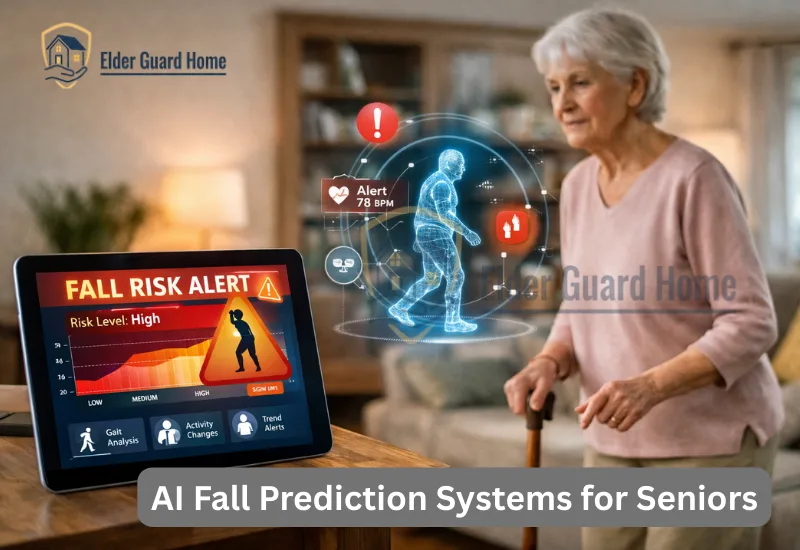
AI fall prediction systems for seniors aim to detect risk before a fall occurs. Instead of waiting for an accident, they analyze movement pattern analysis for elderly individuals in real time.
Over time, small changes in gait, balance, or daily activity can signal rising instability. Predictive algorithms detect these trends. Then, alerts are triggered before a crisis happens.
As a result, AI-based senior safety monitoring becomes proactive rather than reactive.
However, if you’re new to this category, start with our complete guide to non-wearable AI fall monitoring system, which explains how non-wearable systems monitor seniors in real time before exploring predictive upgrades.
In this guide, we’ll explain:
How predictive fall detection technology works
How it differs from standard fall detection
The technologies powering fall risk monitoring systems
The real-world accuracy and limitations
Whether proactive fall prevention technology is ready for home use
Let’s start with the fundamentals.
How do AI fall prediction systems for seniors work?
Predictive fall detection technology continuously monitor movement patterns and behavioral changes.
They use sensors and machine learning models to detect subtle instability trends.
When risk increases, the system alerts caregivers.
Unlike traditional fall detection, the goal is prevention. Therefore, families receive early warnings instead of post-fall alerts.
How Does AI Predict Fall Risk Before It Happens?
AI fall prediction systems for seniors do not wait for impact. Instead, they look for patterns. Over time, those patterns reveal risk trends.
Traditional systems react. However, predictive fall detection technology focuses on early signals. As a result, caregivers receive warnings before instability becomes dangerous.
Let’s break down how that works.
Movement Pattern Analysis
First, AI systems observe how a person moves daily.
They measure walking speed, stride consistency, posture shifts, and room transitions. Over weeks, movement pattern analysis for elderly individuals creates a behavioral baseline.
Then, the system compares new data against that baseline.
If small irregularities increase, risk levels adjust.
According to the National Institute on Aging, gradual mobility decline is a major fall risk factor. Therefore, tracking micro-deviations over time matters.
Unlike detection systems, these models look for change progression. Consequently, prevention becomes possible.
Gait Instability Detection
Gait is one of the strongest fall indicators.
Even minor stride asymmetry can signal neurological or muscular decline. Therefore, predictive systems analyze:
Step timing
Weight transfer
Balance shifts
Sudden hesitation
Research from the Centers for Disease Control and Prevention shows that 1 in 4 adults over 65 fall each year. Because of this high incidence, early gait monitoring is critical.
AI-based senior safety monitoring tools flag instability trends early. As a result, caregivers can recommend mobility aids or therapy sooner.
Micro-Changes in Daily Behavior
Not all risk comes from walking.
Sometimes behavior changes first.
For example:
Longer bathroom visits
Slower room transitions
Reduced kitchen activity
More frequent wall support
Individually, these shifts seem minor. However, collectively they signal rising vulnerability.
Therefore, fall risk monitoring systems analyze activity frequency and routine deviation.
If patterns shift consistently, alerts are triggered. Consequently, families intervene before a fall occurs.
Long-Term Risk Scoring
Prediction is not based on one event. Instead, it relies on cumulative scoring.
AI models assign weighted risk values to multiple variables. Then, they generate a dynamic fall risk score.
Unlike emergency alerts, this score evolves gradually. Therefore, proactive fall prevention technology becomes measurable and trend-driven.
Over time, care planning improves. Moreover, risk becomes visible rather than assumed.
Fall Detection vs Fall Prediction: What’s the Difference?
Both systems improve safety. However, their purpose differs.
Fall detection reacts.
Fall prediction anticipates.
Here is a clear comparison:
| Feature | Fall Detection | AI Fall Prediction Systems for Seniors |
|---|---|---|
| Timing | After impact | Before potential fall |
| Primary Goal | Emergency response | Risk prevention |
| Data Focus | Sudden motion events | Long-term movement trends |
| Alert Type | Immediate SOS alert | Rising risk warnings |
| Care Planning Value | Limited to incident response | Trend-based preventive planning |
While detection systems are essential for emergency response, false triggers remain a known concern. If you want to understand how detection systems handle misfires and alert accuracy, read our in-depth breakdown of AI fall detection false alarms and how to reduce them.
However, prediction operates differently. Therefore, the two should not be confused.
What Technology Is Used in Predictive Fall Risk Monitoring Systems?
Several technologies support predictive fall detection technology. However, their role remains analytical, not reactive.
Radar
Radar tracks micro-movements without cameras.
It measures motion velocity and body position. However, this article does not explore radar deeply. For a deeper technical breakdown of sensor differences, see our full comparison of radar vs camera AI fall detection systems for home use, where we analyze privacy, accuracy, and performance trade-offs.
Computer Vision
Vision systems analyze posture and motion patterns.
However, privacy concerns limit adoption in some homes.
Wearables with Gait Sensors
Some systems rely on wearable accelerometers.
These devices track stride irregularities precisely. However, compliance can be inconsistent among seniors.
AI Behavioral Models
This is the predictive core.
Machine learning models analyze longitudinal behavior trends. Then, they identify deviation clusters linked to fall risk.
Therefore, AI behavioral modeling drives proactive fall prevention technology.
Edge AI Processing
Edge AI processes data locally.
As a result, latency drops. Moreover, privacy improves because raw data stays in-home.
Are AI Fall Prediction Systems Clinically Validated?
This is where caution matters.
Research Landscape
Universities continue studying gait-based prediction.
For example, mobility risk research is ongoing at institutions like Johns Hopkins University and other academic centers.
However, most systems are still evolving.
Limitations
Prediction models depend on data quality.
If sensor coverage is poor, accuracy drops. Therefore, setup matters significantly.
False Positives
Because prediction relies on trends, temporary illness can raise risk scores artificially.
Consequently, caregivers must interpret alerts carefully.
Medical-Grade vs Consumer-Grade
Medical-grade systems undergo clinical testing.
However, consumer systems may not require FDA-level evaluation.
According to the U.S. Food and Drug Administration, classification depends on intended medical claims.
Therefore, families should verify regulatory status before purchase.
Real-World Applications of proactive fall prevention technology
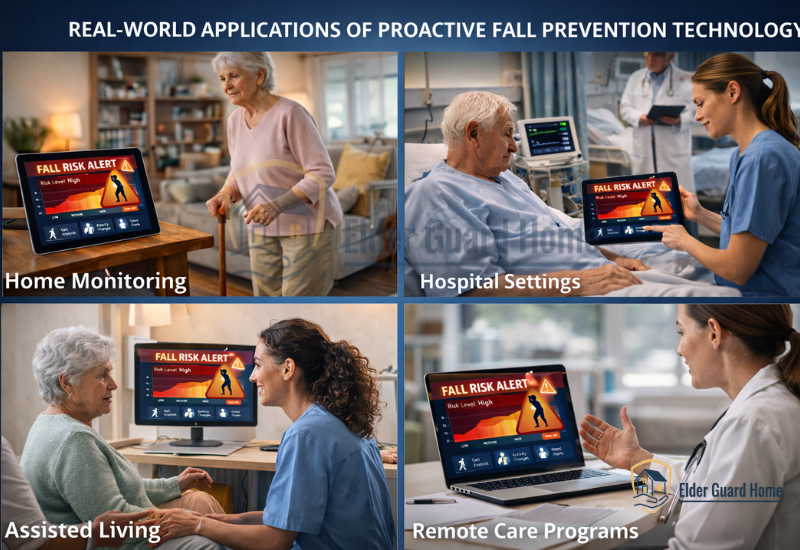
Home Monitoring
At home, AI fall prediction systems for seniors support independent living.
Early warnings allow preventive measures. Consequently, emergency events decrease.
Assisted Living
Facilities use aggregated risk scores to identify high-risk residents.
Therefore, staffing decisions improve.
Hospital Settings
Hospitals monitor mobility decline during recovery.
As a result, discharge planning becomes safer.
Remote Care Programs
Telehealth providers use predictive analytics to prioritize visits.
Moreover, care efficiency improves across distributed populations.
Because bathrooms are high-risk zones, predictive monitoring is especially valuable there. For placement strategies and privacy considerations, read our guide to AI fall detection systems for bathroom safety.
Pros and Cons of AI Fall Prediction Systems
Pros
Early intervention
Risk trend awareness
Care planning insights
Reduced emergency likelihood
Because alerts occur early, prevention becomes possible.
Cons
Not 100% predictive
Requires continuous data collection
Privacy concerns
Still emerging technology
Therefore, expectations must remain realistic.
Who Should Consider AI Fall Prediction Systems?
These systems are not for everyone. However, certain groups benefit most.
High-risk seniors with prior falls
Post-surgery patients
Parkinson’s or mobility decline cases
Professional care agencies
If someone already experiences balance instability, predictive monitoring adds value.
However, low-risk individuals may not need advanced systems.
Limitations of predictive fall detection technology and Ethical Considerations
AI fall prediction systems for seniors offer powerful insights. However, they are not flawless. Therefore, families must understand the real-world trade-offs before relying fully on predictive fall detection technology.
Below are the most important limitations and ethical concerns to consider:
Over-reliance on Technology
Predictive systems estimate risk. However, they cannot eliminate it. If families assume proactive fall prevention technology replaces supervision or home modifications, risk may actually increase. Therefore, these systems should support — not replace — human judgment and environmental safety measures.
Data Privacy and Continuous Monitoring
Fall risk monitoring systems collect ongoing movement data. In some cases, this includes behavioral trends and activity frequency. As a result, privacy concerns naturally arise.
Even when AI-based senior safety monitoring uses edge processing, families should review:
- Where data is stored
- Who can access it
- How long it is retained
Transparency matters. Otherwise, trust erodes.
False Reassurance
Risk scoring provides probability, not certainty. Therefore, a “low risk” status does not guarantee safety.
Because movement pattern analysis for elderly individuals depends on trend data, sudden events — such as dizziness, dehydration, or medication side effects — may still cause unexpected falls. Consequently, predictive systems reduce risk but cannot prevent every incident.
False Positives and Alert Fatigue
Temporary illness or fatigue can elevate risk scores. However, that does not always mean a fall is imminent. If caregivers receive too many non-critical alerts, attention declines. As a result, true warnings may be overlooked. Therefore, calibration and context matter in predictive fall detection technology.
Medical and Legal Ambiguity
Some AI fall prediction systems for seniors are marketed as wellness tools. Others imply medical-grade monitoring. However, regulatory standards vary.
If a system claims clinical accuracy without sufficient validation, liability questions arise. Therefore, families and care agencies should verify whether the system is positioned as:
- A wellness monitoring device
- Or a regulated medical tool
The distinction matters legally and ethically.
Algorithm Bias and Data Quality
AI models learn from training data. However, if datasets lack diversity in mobility patterns, predictions may become less accurate for certain populations.
For example, mobility differences due to arthritis, neurological disorders, or cultural movement habits may influence scoring. Therefore, predictive accuracy depends heavily on model design and dataset quality.
In summary, AI fall prediction systems for seniors provide valuable foresight. However, they are part of a broader safety strategy.
When combined with environmental safety improvements, physical therapy, and caregiver oversight, proactive fall prevention technology becomes far more effective.
Used alone, it remains helpful — but incomplete.
When Not to Use predictive fall detection Systems
AI fall prediction systems for seniors are powerful. However, they are not suitable for every situation. In some cases, simpler safety solutions may be more practical.
Below are scenarios where predictive fall detection technology may not be necessary or appropriate.
When Fall Risk Is Extremely Low
If a senior is fully mobile, physically active, and has no history of instability, predictive monitoring may be excessive.In such cases, basic home safety improvements and regular health checkups may be sufficient. Therefore, advanced fall risk monitoring systems could add cost without meaningful benefit.
When Immediate Emergency Response Is the Only Need
Some families only want post-fall alerts.
If prevention analytics are not a priority, traditional detection systems may be more aligned with expectations. Predictive systems focus on trends. However, they do not replace emergency response infrastructure.
When There Is Strong Resistance to Monitoring
AI-based senior safety monitoring requires ongoing data collection.
If the individual strongly opposes behavioral tracking, trust may suffer. Therefore, consent and comfort must come first. Technology should never feel invasive.
When Setup Conditions Are Poor
Predictive fall detection technology depends on consistent data input.
If the home layout blocks sensors or wearable compliance is unreliable, risk scoring becomes unstable. As a result, alerts may become inaccurate or inconsistent.
When Medical Oversight Is Required but Not Available
Predictive systems estimate risk. However, they do not diagnose conditions.
If a senior has complex neurological or cardiovascular issues, clinical supervision is essential. In these cases, proactive fall prevention technology should support medical care — not substitute for it.
When Budget Constraints Outweigh Benefit
Advanced AI fall prediction systems for seniors may involve higher upfront costs.
Therefore, families should evaluate whether simpler interventions — such as physical therapy, grab bars, improved lighting, or mobility aids — would deliver greater impact first.
In short, predictive systems work best in moderate-to-high risk scenarios where early insight can change outcomes.
However, they are not mandatory for every household.
When used thoughtfully, fall risk monitoring systems enhance safety. When used indiscriminately, they may add complexity without proportional benefit.
Balanced implementation is always the smarter path.
FAQ
Can AI really predict falls?
AI cannot predict exact fall timing. However, it can estimate rising fall risk using movement pattern analysis for elderly individuals and long-term behavior trends.
Is fall prediction better than fall detection?
Not better. Just different. Detection responds to emergencies. Prediction focuses on prevention. Ideally, both work together.
Do predictive systems require wearables?
Not always. Some use radar or vision sensors. Others rely on wearable gait trackers. The choice depends on system design.
Are these systems approved by medical authorities?
Some medical-grade systems follow regulatory pathways. However, many consumer fall risk monitoring systems are classified as wellness tools rather than medical devices.
How accurate are AI fall prediction systems?
Accuracy varies by technology and data duration. Generally, long-term monitoring improves reliability. However, no system offers 100% certainty.
Final Verdict: Is Predictive AI the Future of Senior Safety?
AI fall prediction systems for seniors represent a major step forward.
However, they are not magic.
They improve visibility.
AI fall prediction system support prevention.
They enhance planning.
Yet, they do not guarantee zero falls.
Therefore, predictive technology should complement — not replace — safe home design, mobility care, and caregiver awareness.
Balanced adoption is key.