
Who This Guide Is For
This guide is written for:
- Adult children who visit once a week or less and want to know exactly what to look for
- Caregivers who feel something is “off” with their parent but cannot name what it is
- Families whose elderly parent says “I am fine” but something does not feel right
- Anyone whose parent lives alone and has recently lost a spouse, stopped driving, or retired
- Professionals supporting seniors with senior home safety tips for elderly living alone and aging in place
Your parent says they are fine. They eat, they watch TV, they answer the phone. But something feels different. The signs your elderly parent is lonely are rarely obvious — and that is exactly why most caregivers miss them until a health crisis forces the conversation.
The research is no longer ambiguous. The WHO now classifies chronic loneliness as a global public health priority on par with smoking and obesity. According to NIA-funded research, feeling lonely increases dementia risk by 31%. About 1 in 4 adults aged 65 and older in the United States are socially isolated — and the majority of them are aging in place at home, not in facilities.
This is not a mood problem. It is a medical emergency — and it happens quietly, inside the very home you think is keeping your parent safe. This guide covers all 13 signs of loneliness in elderly parents, what they mean when they appear together, and 7 specific approaches that work even for seniors who insist they are perfectly fine.
Why Elderly Loneliness at Home Is Different From Just Being Alone
Elderly loneliness at home is not the same as enjoying quiet time. A senior who chooses solitude and feels content is not lonely. A senior who wants connection but cannot access it — that is dangerous isolation, and it is a completely different thing.
Seniors aging in place face a specific set of circumstances that create isolation faster than most families expect. Retirement removes daily social structure overnight. Driving loss makes every social activity dependent on someone else’s schedule. Spouse loss — for the first time in decades — means the house is silent in a way it has never been before. Adult children move away. Neighborhoods change. Friends die or move into facilities.
According to the CDC, social isolation in elderly parents who live alone is strongly associated with higher rates of heart disease, stroke, depression, and cognitive decline. The physical consequences are measurable and serious. But they only show up after the social world has already collapsed — which is why catching the early signs matters so much.
The 13 Signs Your Elderly Parent Is Dangerously Lonely

These are not the obvious signs. Every caregiver knows to watch for sadness or withdrawal. What most families miss are the physical signals, the behavioral patterns in conversation, and the home environment clues that appear weeks or months earlier.
Group 1 — The Physical Signs Most Caregivers Mistake for Aging
These signs do not look like loneliness. They look like getting older. That is exactly why they get missed.
Sign 1 — They Have Stopped Caring About How They Look
Unwashed hair. The same clothes worn multiple days in a row. Skipped shaving or abandoned makeup routines your parent kept for decades. Most families chalk this up to “slowing down.” It is not.
When there is no one to look good for and nowhere to go, grooming drops fast. This is one of the earliest visible signs of loneliness in elderly parents — and one of the most actionable. Ask gently about their week. Who did they see? Where did they go?
Sign 2 — They Are Sleeping at Odd Hours or Far Too Much
No social schedule means no reason to be up at 7am. Loneliness disrupts the body clock in a specific way — seniors start sleeping 11–12 hours, napping 3 times a day, or staying up until 2am watching television.
This is not just tiredness or aging. It is the absence of social rhythm. Human beings wake up for other people. When there are no other people, the structure collapses.
Sign 3 — They Have Lost Weight Without Trying
Eating alone kills appetite. Research published in the Journal of the Academy of Nutrition and Dietetics shows that lonely seniors eat less, skip meals, and lose interest in cooking over time.
A parent who used to make proper meals now snacks on crackers, skips dinner entirely, or eats the same simple thing every day. Unexplained weight loss without a new diagnosis is a red flag that deserves a direct conversation.
Sign 4 — They Complain About More Physical Pain Than Usual
This one surprises most families. Loneliness amplifies pain perception neurologically — it is not imagined and it is not exaggerated. Seniors who suddenly report more aches, joint pain, or headaches with no new medical explanation may be expressing emotional distress through physical language.
The body speaks when the words will not come. If your parent’s pain complaints have increased but their doctor finds nothing new, consider what else may have changed in their daily life.
Group 2 — The Behavioral Signs That Show Up in Conversation
Listen for these patterns in how your parent talks — not just what they say.
Sign 5 — They Ask You to Stay Longer Every Single Time
Every visit ends with “do you have to go already?” Every phone call stretches past an hour talking about nothing in particular. This is not just affection — it is a specific pattern of escalating contact need. When the frequency and intensity of this increases visit by visit, your parent is telling you something. They are not being clingy. They are running low.
Sign 6 — They Have Become Overly Interested in Your Problems
Lonely seniors sometimes become intensely focused on family drama, news stories, or your personal difficulties. It gives them mental engagement and a sense of being needed.
It can feel like nosiness or worry — but it is actually emotional hunger. When your parent asks the same question about your work stress or your child’s school situation multiple times across multiple calls, they are not being intrusive. They are looking for a thread of connection to hold onto.
Sign 7 — They Repeat the Same Stories More Than Usual
This is not always memory loss. Repetition spikes when a person has no new social input. If your parent’s social world has shrunk to almost nothing, they have no new experiences to share — so they return to the stories they have.
The same story told three or four times in one visit is worth paying attention to. It means the incoming stream of new experience has nearly stopped.
Sign 8 — They Have Stopped Mentioning Other People
This is the most overlooked sign on this entire list. When your parent stops referencing friends, neighbors, the woman from church, or their regular hair appointment — those people are no longer in their life. They may not tell you directly.
They may not even fully realize it themselves. But a conversation where your parent never mentions another person by name — where the whole world of the conversation is just you and them — signals a collapsed social network.
Group 3 — The Home Environment Signs You Can See With Your Eyes
Walk through the house. The home tells you what your parent will not.
Sign 9 — The TV Is On All Day Even When They Are Not Watching
Background noise as company. This is a specific elderly loneliness at home coping mechanism — and one of the most reliable signs. The TV is not entertainment at this point. It is a substitute for human presence. If your parent cannot tell you what they watched yesterday, or if the TV is on in an empty room, that background noise is filling a silence that used to be filled with people.
Sign 10 — Mail and Dishes Are Piling Up
This is not laziness. It is a loss of motivation that comes directly from social disconnection. When there is no one coming over and no external schedule to maintain, basic household routines slide.
A parent who kept an immaculate home now has stacked mail on the counter and dishes left from two days ago. The home reflects the internal state. This change in home environment deserves a gentle, non-judgmental conversation — not a lecture about tidiness.
Sign 11 — Their Phone Shows Almost No Outgoing Calls
Ask gently to see the recent calls list — frame it as checking the phone is working properly. A parent who says “I talk to people all the time” but has made almost no outgoing calls in the past week is not connecting.
They are waiting for others to reach out — and it is not happening. Lonely seniors often stop initiating contact because repeated unanswered attempts are too painful. They wait instead. And waiting alone is where the isolation deepens.
Sign 12 — They Have Rearranged Their Sitting Space Toward the Window or Door
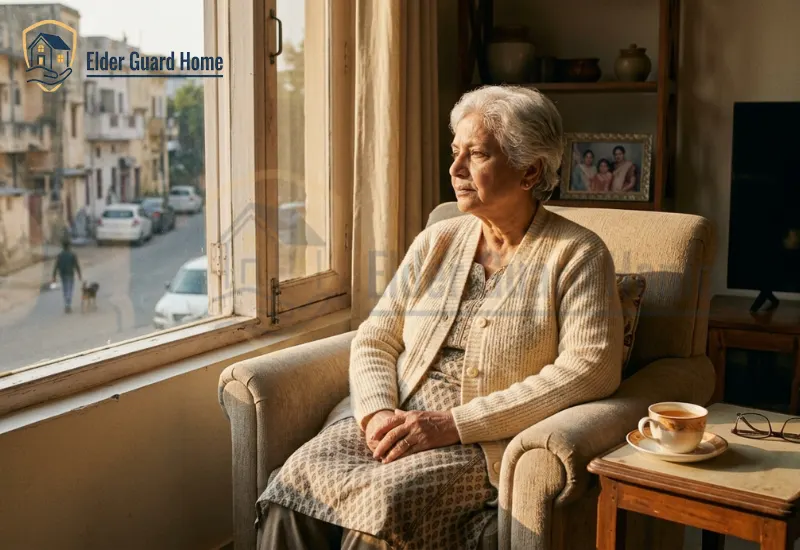
Behavioral geography. Lonely seniors unconsciously move their favorite chair, their reading spot, or their television toward front windows and doors — where they can watch the street, see neighbors, observe the world going past.
It is the physical expression of wanting contact they cannot initiate. If your parent’s chair has migrated across the room since your last visit, notice it. It is not a decorating choice.
Sign 13 — The House Feels Emptier Than It Used To
No flowers. Nothing new on the surfaces. No evidence of a recent activity, a hobby in progress, or anything that arrived since your last visit. When a senior stops engaging with life, the home stops evolving.
Things stay exactly where they were months ago. The same magazines. The same arrangement. Nothing new comes in because nothing is happening. A home that once felt lived-in now feels like a waiting room.
What These Signs Mean Together — And When to Act
One sign on its own may mean nothing. Two or three appearing together — especially from different groups — is the threshold that deserves a real response, not a mental note.
A parent showing physical signs from Group 1 alongside home environment changes from Group 3 is telling you something consistent across their whole life. That is not coincidence. That is a pattern. And patterns in social isolation in elderly parents tend to deepen faster than families expect once they take hold.
According to NIA research, the health consequences of prolonged social isolation accumulate over months — not years. Acting on 3 early signs prevents the crisis that 6 advanced signs predict. You do not need to wait for certainty. You need to respond to the pattern.
How to Help a Lonely Elderly Parent — 7 Things That Actually Work
Here are 7 approaches that work even for resistant, independent seniors.
1. Schedule a standing weekly call — same day, same time. Routine removes the burden of initiating. Your parent knows Thursday at 6pm is the call. Consistency matters more than frequency.
2. Find one group activity — not a general suggestion to socialize. Specific beats vague every time. A senior center Tuesday morning, a library book club, a faith community meal. One anchor activity creates a social structure that ripples outward.
3. Introduce a voice assistant as company — not technology. Alexa or Google Home gives your parent something to interact with all day. Frame it as a useful gadget, not a care tool. It is a bridge between real human interactions — not a replacement.
4. Look into check-in call services built for seniors. Your parent may accept a scheduled call from a trained volunteer more readily than they accept family worry. It feels less loaded than family worry and provides structured contact at scale.
5. Make visits purposeful, not just dutiful. Bring something to do together — a photo album, a recipe, the first episode of a show. A task-based visit lasts longer and gives your parent something to look forward to next time.
6. Address the driving loss directly. Rideshare services built for seniors — like GoGoGrandparent — restore independent access to places your parent used to go alone. Driving loss is the single most common trigger for the isolation spiral.
7. Talk to their doctor and name it directly. Loneliness is now a clinical screening item in geriatric care. Use the word lonely. A doctor can connect your parent to programs they will accept from a physician before accepting them from you.
When to Be More Worried — Signs That Loneliness Has Become a Crisis
Most signs of loneliness in elderly parents are early-stage and reversible with the right response. But four specific escalation signals mean the situation has moved beyond a conversation and requires professional involvement.
- They express that life feels pointless or that they would not mind not waking up. This is not dramatic language. Take it literally and contact their doctor the same day.
- They have stopped eating for more than 2 consecutive days. Beyond appetite loss — this is a physical shutdown signal.
- They show signs of rapid cognitive change — confusion, disorientation, or memory gaps that were not present 2–3 months ago. Loneliness accelerates cognitive decline. Our dementia kitchen safety guide covers what to watch for when memory changes affect daily safety at home.
- They have completely stopped answering the phone or door — not occasionally, but as a consistent pattern over 5 or more days.
According to the National Institute of Mental Health, untreated depression in seniors looks different from depression in younger adults — and is frequently triggered or deepened by social isolation. If you see these escalation signs, contact their primary care provider directly. Do not wait for your parent to agree to the call.
What Caregivers Told Us
The following experiences were shared by caregivers in our community. Names have been changed to protect privacy. These are real situations — not paid testimonials.
Susan, 51 — daughter of a 79-year-old mother in Minnesota: “My mom always said she was fine. She sounded fine on the phone. But when I visited in February I noticed her chair had moved to face the front window and the TV was on when she was in the kitchen. I asked her how often she left the house that week. She thought about it for a long time and said once — to check the mail. That was the moment I understood what had been happening for months while I thought she was fine.”
Thomas, 57 — son caring for his father in North Carolina: “My dad stopped mentioning his friend Ed. They had been friends for 40 years. I just did not notice for months that Ed never came up in conversation anymore. When I finally asked, my dad said Ed had moved to be near his daughter the previous summer. My dad had lost his last regular social contact and never said a word about it. He just got quieter.”
Maria, 48 — caregiver for her mother-in-law in California: “The weight loss was what finally got through to me. She had lost 11 pounds in 3 months and the doctor could not find anything wrong medically. I started paying attention differently after that. The TV on all day. The same meals. Nothing new anywhere in the house. It had been going on far longer than I realized. I just had not known what I was looking at.”
Frequently Asked Questions
What are the first signs of loneliness in elderly parents?
The earliest signs of loneliness in elderly parents are usually physical — unexplained weight loss, disrupted sleep, and increased pain complaints — before emotional withdrawal becomes obvious. Changes in grooming and home environment often appear around the same time. Most families notice but attribute them to normal aging rather than isolation.
How do I talk to my elderly parent about loneliness without offending them?
Avoid the word “lonely” initially — many seniors hear it as an accusation of neediness. Start with observations instead: “I noticed you seem tired lately” or “I do not hear you mention Margaret anymore.” Ask questions rather than making statements.
Is loneliness in elderly adults a sign of depression?
Loneliness and depression are related but different. Loneliness is a social condition — the gap between wanted and actual human connection. Prolonged elderly loneliness at home can trigger or worsen depression, but not every lonely senior is depressed. The escalation signs listed above are where loneliness crosses into territory needing clinical attention.
How does social isolation affect elderly health long-term?
According to CDC research, social isolation in elderly parents is associated with a 50% increased dementia risk, a 29% increased heart disease risk, and a 32% increased stroke risk. These outcomes are measured in population studies — not projections.
What is the difference between loneliness and social isolation in seniors?
Loneliness is a feeling — the subjective experience of wanting more connection. Social isolation in elderly parents is an objective condition — measurably few contacts regardless of how the person feels. Both are serious health risk factors, but isolation is easier to measure and often easier to address with practical changes.
Conclusion
The signs your elderly parent is lonely are there if you know what to look for. They show up in the body before the emotions. They show up in the home before the conversation. And they show up months before the health crisis that finally forces the family to act. You now know all 13.
Three or more signs from different groups is your signal to respond — not to wait for more evidence, not to bring it up gently in a few weeks. The earlier you act on how to help a lonely elderly parent, the more reversible the situation is. Start with one standing call, one group activity, one visit with a purpose. Small consistent actions beat grand occasional gestures every time.
The physical home environment matters just as much as the social one. Good lighting at night reduces the anxiety of moving around a quiet house alone — our best night lights for elderly adults guide covers the practical side of that. For a complete picture of your parent’s home safety — physical and emotional — ElderGuard’s 9-point Senior Safety Checklist gives you a room-by-room starting point that is free and printable.